Sports Equipment
Compression socks for running: benefits and when to use them
What do they contribute to running, how to choose the size, and how socks, stockings, and arm sleeves differ.

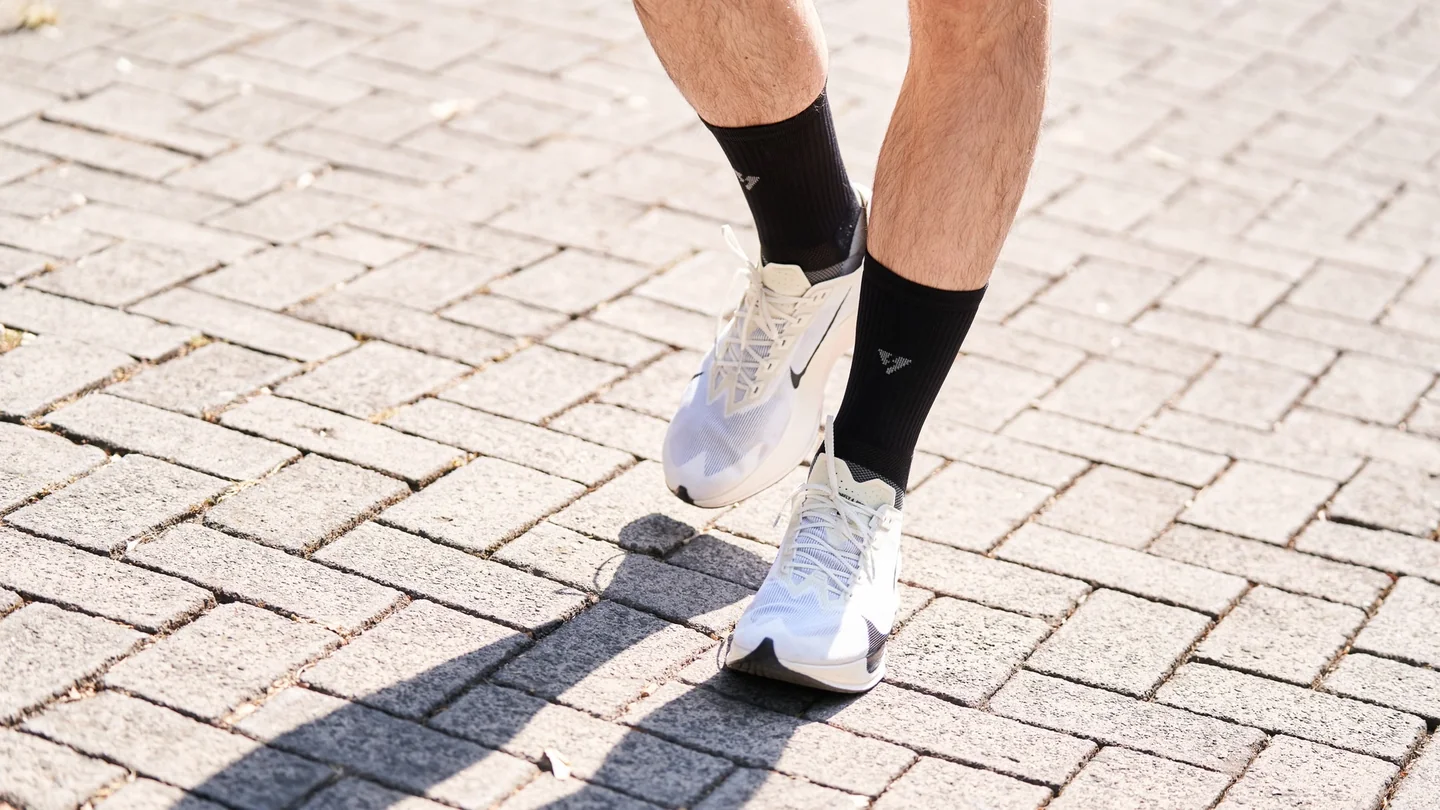
Compression socks for running have gone from being an uncommon accessory to a fixed part of many training and competition outfits. Their presence is explained by a mix of very specific reasons: they help stabilize the muscles, reduce the feeling of heavy legs, and can provide more comfortable recovery after adding up miles or competing on roads, tracks, or trails.
Their success is not based only on aesthetics or a passing trend. Sports compression has spread because it addresses a very basic runner need: keeping the foot and calf firm when impact is repeated thousands of times. In long races, where the stride becomes heavier and the calf works like a fatigued spring, a well-chosen garment can make a tangible difference in sensations.
What they really contribute on a run
Graduated compression applies more pressure in the distal area and gradually reduces it upward, which favors venous return and helps blood circulate more easily from the foot and ankle toward the calf. In simple terms, the goal is for the muscle to work with less oscillation and for the runner to feel less vibration with each foot strike. That detail, almost invisible, is especially noticeable when the terrain is punishing or when the legs have already been accumulating fatigue for hours.
Brands usually associate these garments with better oxygenation, less feeling of heaviness, and faster recovery. Scientific evidence, however, does not paint a uniform picture. Some studies find improvements in perceived exertion and recovery, while others place the benefits on a more modest level. Even so, in running, the lab data matters as much as the real feeling during the run: if a garment improves control and reduces discomfort, its practical usefulness exists, even if the effect is not spectacular for everyone equally.
In long-distance races, marathons, half-marathons, trail running, or endurance runs, their use often makes more sense than in very short efforts. The reason is simple: the longer the body is subjected to impact, vibration, and pace changes, the more likely muscular fatigue is to appear. There, compression acts like a kind of external wiring that organizes movement and gives a feeling of support.
How sports compression works on the leg
Not all garments compress equally. Compression stockings cover the foot and usually reach the knee; knee-high socks work on the lower part of the calf; and sleeves or calf guards leave the foot free to combine with other socks. That difference matters, because each format answers a different need. Those looking for full coverage prioritize stockings; those who want less bulk inside the shoe usually look first at sleeves.
Pressure is measured in millimeters of mercury, abbreviated as mmHg. In the sports world, there are guideline ranges that go from light compression to more intense levels. In some running lines, values from 15 to 30 mmHg are seen, although the exact figure depends on the brand and the design. The important thing is not to chase the highest number by inertia, but to find the fit that offers support without turning the leg into an uncomfortable press.
The feel of the fabric also changes. More technical versions combine elastic fibers with breathable materials to wick sweat and prevent moisture from building up like a sticky second skin. On a hot run, that balance is decisive: compression should not behave like a plastic sleeve, but like a firm wrap that lets the skin breathe and follows movement.
When they can be useful and when they don’t add much
The best situations for this type of garment are usually long runs, hilly races, workouts in which fatigue tends to show up early, and recovery periods after heavy loading. They are also useful for those who spend many hours standing or take long trips after competing, because the feeling of heavy legs does not end when crossing the finish line.
By contrast, in short intervals, speed work, or very explosive training sessions, their perceived impact is usually smaller. The body is already so busy producing force and changing pace that the benefit of compression may take a back seat. That does not mean they are useless, but rather that their value is more obvious when the effort lasts and the muscle begins to pay the toll of repeated impact.
There is another important nuance: they are not a universal solution for pain or injury. They can help in cases of mild overload discomfort, tight calves, or gradual return phases, but they do not replace rest, medical evaluation, or proper training adjustments. When the cause is plantar fasciitis, shin splints, or severe overuse, the garment only accompanies the process; it does not solve the underlying problem.
Size, the most delicate point
Choosing the right size is more important than choosing the color, thickness, or brand. A size that is too big loses its support effect and becomes just another sock; one that is too small squeezes too much and can leave marks, cause numbness, or create the feeling that the muscles are trapped. The correct fit should feel firm, never oppressive.
Many brands ask for calf and ankle circumference measurements, while others combine that information with shoe size or height. In some size charts, runners find letter sizes; in others, foot numbers and leg measurements. The variety can be confusing, but it contains a simple truth: sports compression only works well when it adapts to real anatomy.
It is also worth paying attention to calf length. A tall runner with long calves may notice that a short stocking ends too early or rolls at the top. Conversely, a garment that is too high on a shorter leg may fold over or apply pressure where it shouldn’t. The leg, after all, is not a standard showroom cylinder.
Which format works best depending on use
Long stockings are useful when full coverage, protection from the cold, and a uniform feeling from the foot to below the knee are desired. They are a logical option for those who prioritize overall leg stability or for those training in winter and appreciating an extra layer of warmth. On trails, they also provide more of a barrier against small branches, brush, or constant friction with the terrain.
Knee-high socks are a very popular middle-ground solution. They reduce some material compared with full stockings, but still maintain good support in the arch and ankle. They work well in regular training sessions, road races, and for runners who want a less bulky garment inside tight or competition shoes.
Sleeves or calf guards, meanwhile, have a very clear practical advantage: they let you wear the foot sock that best matches the shoe or personal preference. Some runners prefer an ultra-thin sock on the foot and reserve compression for the calf. In that case, the sleeve is almost a modular solution, like adding a custom piece on top of an already known base.
Which technical details make the difference
The absence of annoying seams in the toe or support areas reduces the likelihood of rubbing and blisters, one of the runner’s great enemies. A fabric without wrinkles, with a well-defined heel and a toe box that doesn’t squeeze, often performs better than a more aggressively compressed model that is poorly finished at the foot. In a race, friction does more damage than theory.
Moisture management also matters. A good sports sock should wick sweat quickly, because a wet foot slips, softens, and becomes exposed to chafing. Some versions add reinforcements at the heel, forefoot, or Achilles tendon to protect recurrent impact zones. Those reinforcements are not a luxury: over long distances, the foot hits, compresses, and expands again and again inside the shoe.
Lightness is another relevant factor. In hot weather or at high paces, a very thick garment can reduce freshness and take up too much space inside the shoe. That is why many running lines combine compression with thin or ultra-light constructions. The challenge is to maintain support without turning the leg into a rigid wrap.
Road running, trail running, and recovery: not everything calls for the same thing
On the road, runners usually value consistent support, vibration control, and comfort during sustained efforts. A well-designed compression stocking or sock can provide stability at half-marathon and long-distance paces, where technique tends to loosen and impact accumulates almost mechanically.
On trails, the terrain changes the script. The leg receives twists, uneven foot strikes, and more stabilizing work. Here, compression garments can make sense because of muscle support and extra protection against rubbing, mud, or mountain cold. They are not armor, but they are a layer that helps keep the calf more contained when the path tilts and the foot stops finding clean surfaces.
In recovery, the focus changes completely. Post-exercise compression garments are often used to promote a feeling of relief after long or intense efforts. Here the runner is not so much looking for immediate performance as for a gentler transition between effort and rest. That use is common among athletes who string together sessions, travel, or consecutive races, and also among those who spend hours sitting after training.
What runners say and what real experience says
Feelings matter a lot in this area. Some runners immediately notice less bounce in the calves, pleasant warmth in winter, or a stability that helps them run with more confidence. Others barely notice any change and prefer to spend their budget on shoes, racing socks, or insoles. Both positions are reasonable, because the body does not respond the same in all cases or at all paces.
The perception of benefit also depends on each runner’s history. Someone who has suffered overload in the soleus or calf will look at compression differently than someone who runs without discomfort and without high mileage. For a person with a tendency toward muscle stiffness, a well-fitted stocking can become a quiet ally; for another profile, it may feel like just another layer with no clear effect.
That is why it is wise to distrust absolute promises. Compression does not turn bad preparation into good preparation, nor does it replace rest, nor does it erase poorly managed overload. But in the wider world of running gear, it can serve a specific function: provide support, add comfort, and soften the punishment of impact when running starts to leave its mark on the legs.
How to read a product sheet without getting lost
Height is the first thing to decode. Invisible, short, mid-calf, knee-high, or calf guard: each format has a purpose. Height determines how much muscle is covered and how much air circulates around the leg. In summer, a shorter model may be more manageable; in winter or over ultra distances, greater coverage may be more practical.
Then comes the fabric. The more technical and breathable it is, the easier it will be to keep the skin dry and reduce the appearance of chafing. It is also worth checking whether the model is designed for road, trail, or recovery, because a garment intended for fast running is not the same as one designed to withstand hours of continuous effort. Specialization matters, just as a racing shoe is not asked to do the same thing as a daily trainer.
Finally, you should review the stated pressure and the sizing system. If the brand explains how to measure the ankle and calf, even better. If it specifies padding zones, instep reinforcement, or an anatomical design for right and left foot, that also adds value. These are clues that what is behind it is not just marketing, but a garment designed to move with the body rather than against it.
A small accessory for a very big problem
The foot and calf are the point of negotiation between the runner and the ground. Every stride begins there, and fatigue also accumulates there. That is why compression socks for running have earned space in closets, drawers, and starting lines: they do not promise miracles, but they do offer perceptible support in one of the places where wear and tear is felt most.
The key is to understand them as one more tool, not as a shortcut. They work best when the body already has a solid base, training is well distributed, and the chosen size truly fits. Then they can add value. Like a rope properly tensioned in a tent, they do not carry the run for you, but they help everything hold together better when the wind picks up.
In an increasingly broad market, runners have more models, more heights, and more compression levels than a few years ago. That variety is good news, but it requires judgment. The right choice does not start in the catalog, but in the shape of the leg, the type of run, and the body’s real response. That is where this garment stops being a flashy accessory and becomes a truly useful piece.
Este artículo contiene enlaces de afiliado: si compras a través de ellos, se genera una pequeña comisión sin coste adicional para ti. Más información.



Reebok runs large or small: a real fit guide

Hoka Challenger ATR 7 GTX: complete review of the all-terrain shoe

How to clean white sneakers without ruining them

Altus Pirineos 40-liter backpack: analysis, use, and key points

20,000 mm waterproof jacket for men: key points to get it right

Under Armour HOVR Sonic 6: complete review of the shoe

incline treadmills: guide to choosing better

Achilles tendonitis: real recovery time

Pain in the Achilles heel: causes, signs, and relief

What to take for calf pain: real relief and when to worry

 Races3 months ago
Valencia Half Marathon 2026: date and registration

 Reviews and Comparisons4 months ago
Asics Gel-Roadmiles 3 for men: review and current price

 Races3 months ago
Valencia Marathon 2026: entry, ballot and course

 Reviews and Comparisons4 months ago
Asics Gel Sonoma 8 Gore-Tex: complete analysis for trail and rain
- Sneakers3 months ago
Saucony Endorphin Pro 4: full review and verdict

 News5 months ago
Strava API 2026: what changes for clubs, challenges and runner apps?

 Reviews and Comparisons5 months ago
Nike Alphafly 3: opinions, sensations, and real key points

 Reviews and Comparisons4 months ago
Under Armour running shoes review 2025-2026: models and key features
- Sneakers4 months ago
Adidas Adizero Boston 13 for men: review and verdict

 Sports Equipment4 months ago
Shoe sizes in cm: a clear guide to getting the right fit for your footwear
- Sneakers3 months ago
Neutral running shoes with lots of cushioning: the best of 2026

 News4 months ago
Where is the Hoka brand from and why was it born in France