Training
Treadmill workouts: how to adjust speed and incline
Convert the treadmill speed into useful paces, understand the effect of incline, and fine-tune your sessions.

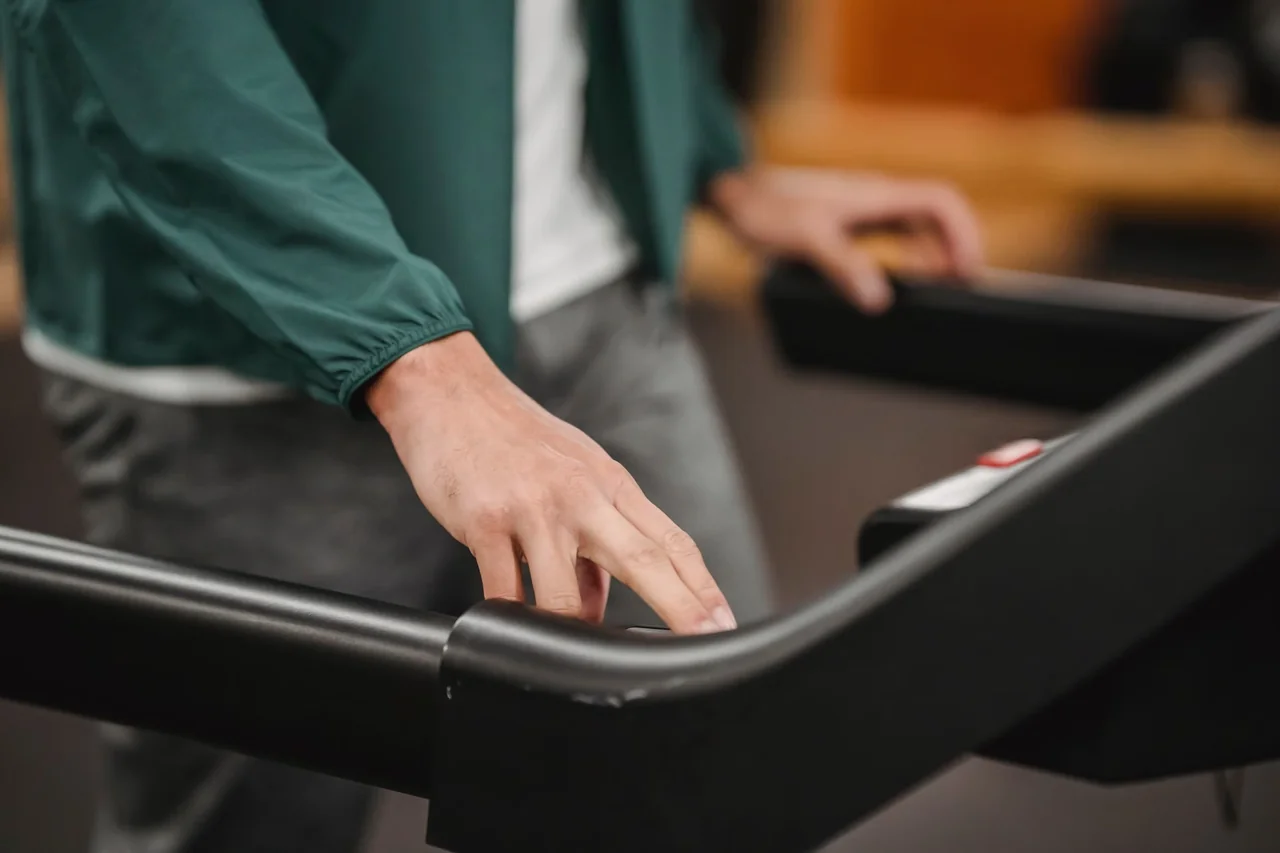
The speed shown by the treadmill does not tell the whole story. At the same kilometers per hour, running indoors usually feels different from running outdoors: air resistance changes, temperature changes, and even your stride mechanics change. That is why runners who train indoors need more than just looking at the screen; they need to translate that number into a real, comparable, and useful effort for their training.
In practice, treadmill paces are understood better when they are related to pace per kilometer, incline, and the goal of the workout. An easy run, a tempo effort, or intervals do not require the same adjustment, and a small difference on the screen can turn into a session that is harder than expected or, on the contrary, too comfortable to create adaptation.
Why the treadmill and the road do not feel the same on your legs
The first difference is almost invisible, but you feel it as soon as you start breathing harder. Outdoors, the body moves against the air; on a treadmill, the belt moves under your feet and the runner does not have to overcome that resistance in the same way. Research on the energetic cost of running suggests that this lack of wind can reduce expenditure by around 2% to 10%, depending on speed. At easy paces the effect is small; when you push harder, it grows quickly.
The surface also changes. A treadmill belt is more stable and uniform than a sidewalk, bike lane, or trail with small changes in elevation. That reduces the demand for stabilization and softens impact, but at the same time it removes part of the work the body does outdoors. The result is a feeling of mechanical ease that, however, does not always match cardiovascular effort. That is why so many runners discover that a pace that feels comfortable indoors becomes demanding outside.
There is another decisive factor: heat. Indoors, if the air does not circulate well, the body dissipates temperature less effectively and heart rate rises even though the pace stays the same. A fan changes the picture quite a bit, because it helps approximate the outdoor feeling and prevents the workout from turning into a thermal battle. Perceived effort and heart rate are usually more reliable than the bare number on the machine.
The 1% incline and its real limits
For years a simple guideline has been repeated: set the treadmill to 1% incline to approximate the effort of running on flat ground outdoors. The idea is useful because it compensates for part of the lack of air resistance and brings the energy cost of the session closer to what you would feel outside. For many easy runs and controlled pace efforts, that adjustment works reasonably well as a starting point.
That said, the number is not universal. Classic studies on the subject placed that 1% as an approximate solution within a specific speed range, and the reality is that running economy changes depending on the runner’s level, weight, technique, and the machine itself. At very easy paces, that incline may be too much; at faster paces, it may fall short. It is not a fixed physical law, but a practical shortcut that should be interpreted with judgment.
In real life, many runners end up using 1% as a reference for aerobic sessions and lower the incline a bit for easy work or raise it for quality segments, especially when they want to simulate hills or an effort equivalent to outdoor running. The usefulness lies in the nuance: a small incline changes little, but enough to fine-tune the session without the treadmill ceasing to be a comfortable and controllable tool.
How to read pace according to the speed shown on the screen
The treadmill speaks in kilometers per hour or miles per hour; the runner, on the other hand, usually thinks in minutes per kilometer. Translating one figure into the other avoids calculation errors that can ruin a workout. At 6 km/h, for example, you are around 10:00 min/km; at 8 km/h, the pace drops to 7:30 min/km; at 10 km/h, you are already close to 6:00 min/km. These are basic equivalents, but very useful for placing the effort.
That change of language matters because runners do not train in the abstract. A marathon plan, a tempo block, or a recovery session is almost always defined in paces, not screen speed. If the treadmill displays km/h, the conversion should be done before starting, not halfway through the workout. In long sessions, an error of 0.5 to 1 km/h can significantly alter the total load and turn an easy day into a session that is too ambitious.
The most common references help ground the reading. Around 5.5 to 6.7 mph or its metric equivalent, the effort usually fits an easy run; between 7.1 and 8.0 mph, tempo work appears; above 8.5 mph, serious intervals begin. The exact number matters less than the context: a treadmill does not understand goals, but your legs do.
What changes in easy runs, tempo efforts, and intervals
Easy runs are the territory where the treadmill shows its best side. With no traffic, no crossings, and no changes in terrain, the runner can sustain a steady effort with fewer distractions. At comfortable paces, the difference between indoor and outdoor running is usually small, so the main goal is to keep breathing stable, the stride relaxed, and the feeling of control. The screen does not command as much as the body does.
In tempo segments, precision becomes more important. Here the runner works close to threshold, in a range where a few seconds per kilometer change the feeling a lot. If the treadmill is set at 0% incline, it may fall slightly short compared to the road; if it is raised to 1%, the adjustment is usually more realistic. These are sessions where it is worth paying attention to temperature, using ventilation, and watching that the stride does not shorten because of the monotony of the effort.
Intervals are another story. In short repeats, the treadmill forces you to be precise with acceleration and recovery, but it also has an undeniable advantage: the belt keeps you honest. You cannot go out too fast out of impulse, nor let the pace drop because of distraction. That consistency is valuable for VO2max work, 5K-pace repeats, or hill blocks, as long as the runner has enough margin to handle the speed change without losing technique or safety.
The most common speeds and what they really mean
It is worth looking at some equivalents with a practical eye, not as if they were a rigid chart. At 4.8 km/h many people are still walking briskly; around 6.4 km/h walking already blends into a very easy jog; at 8 km/h a light run appears that can be sustained for quite a long time in favorable conditions. Once you pass 9.7 km/h, the body enters a clearly continuous running zone.
Higher up, speed begins to speak the language of serious training. At 11.3 km/h you are already at a lively pace, close to 5:19 min/km; at 12.9 km/h you are moving around 4:39 min/km; at 14.5 km/h, the body enters a truly fast effort, and at 16.1 km/h you are clearly in intense territory. Not every runner should use those references, but understanding them prevents the screen from becoming a hieroglyph.
The real usefulness of these equivalents lies in planning. A runner training for a half marathon can use the treadmill to lock in a specific race pace; another, in recovery, can lower speed by several units and still train without punishing joints or tendons. The same machine serves very different stimuli, but only if the runner interprets the number correctly and does not chase a hollow metric.
The detail that often goes unnoticed: calibration
Not all treadmills tell the truth with the same precision. Some home models drift, others suffer belt wear, and in heavily used gyms calibration can vary more than desirable. That means a screen speed of 10 km/h may not be exactly 10 km/h. The difference may be small, but in quality training it can move the needle enough to alter the workout.
That is why anyone who trains frequently on a treadmill quickly learns to trust a mix of signals: pace, heart rate, breathing, and sensations. A watch or foot pod can help detect whether the reading is drifting too far from reality, even though GPS is not reliable indoors. The screen is a reference; perceived effort and physiological response are the real anchor.
This caution is especially useful when combining indoor and outdoor sessions. If a gym treadmill runs a little faster or slower than it shows, the runner who adjusts paces rigidly risks training outside the target zone without knowing it. The keen eye, by contrast, learns to detect the pattern: stride that changes, breathing that spikes too early, or a heart rate that does not match the day’s goal.
How all this translates into a well-done workout
A good treadmill session starts before you press the start button. The speed should be set with a clear idea of the objective: easy run, tempo, recovery, or intervals. If the work is aerobic and continuous, an incline of 1% is usually a logical starting point. If the day aims to simulate a climb, the runner can raise it more; if recovery is the goal, it may be better to keep it very low and prioritize comfort.
It also matters how you get on and off the treadmill. Starting by walking for a few minutes, building up gradually, and avoiding sudden changes helps keep the technique from falling apart. The same applies at the end. Slowing down little by little reduces the feeling of dizziness and avoids clumsy exits, especially in intense sessions where breathing is still high at the finish. Safety is part of performance, even if it is sometimes forgotten.
Posture deserves constant attention. Holding onto the handrails reduces efficiency, alters mechanics, and gives a false sense of ease. The body should run, not lean on the machine. Maintaining a slight natural forward lean, with a stable torso and eyes forward, helps the stride become more efficient and allows the treadmill to do its job without technique falling apart.
What you really gain from training paces indoors
The treadmill has a reputation for being monotonous, and in part it is. But it also offers something hard to get outside: precision. When the goal is to hold a specific pace for 20 or 40 minutes, or to stack very similar repetitions, the stability of the environment becomes an advantage. There are no traffic lights, no headwind, and no downhills that distort the feeling of control.
That orderly environment helps build base fitness, refine cadence, and work with less noise around you. For runners with busy schedules, indoor training makes it possible to stay consistent even on rainy days, in extreme heat, or on cold nights. And for those returning from injury, the continuous and predictable surface can be kinder, as long as volume and intensity are adjusted prudently.
The key is neither to idealize it nor to dismiss it. The treadmill does not completely replace the road, because it does not reproduce terrain, wind, or the decision-making required to run outside. But it can certainly sharpen preparation if you understand its language. Speed, incline, and effort should be read together, like three needles on the same dial.
When the treadmill helps and when it is better to go outside
Some sessions are better indoors: precise intervals, runs on very hot days, recovery blocks, or controlled work during rainy periods. In those cases, the treadmill reduces interference and allows the day’s goal to come into sharp focus. It is a valuable tool precisely because it removes noise from training.
But there are also moments when the road offers what the machine cannot. Long runs outdoors teach you to manage pace independently, read the terrain, and live with small variations that reappear on race day. A runner who only runs on a treadmill may have very refined pace control, but less ease interpreting the real world of asphalt, park paths, or trails.
That is why the best use of the treadmill is not exclusive, but complementary. Indoor work sharpens; outdoor work consolidates. Between the two, a more complete base is built, where the watch’s reference stops being a tyranny and becomes a tool. That is, in the end, the most serious value of treadmill paces: turning a machine into a more precise reading of the body itself.
The treadmill as a useful mirror, not an absolute judge
The runner who learns to use the treadmill with judgment soon discovers that the number on the display is only the beginning. The real pace depends on incline, ventilation, heat, calibration, and the way you run. Even so, when used well, the machine allows training with an accuracy that is hard to replicate in many environments. It is a simple, almost home-style laboratory where effort can be measured without so many interferences.
In that mirror, what matters is not obsessing over a perfect number, but understanding the relationship between intensity and sensation. A good treadmill pace is the one that fits the day’s objective, not the one that looks impressive at first glance on the screen. Sometimes it will be a very controlled jog; other times, a fast interval; other times, a short climb that leaves your legs burning without needing to leave the gym.
The treadmill does not replace asphalt, but it can teach you to run more consciously. And in a sport where seconds matter, that awareness is worth as much as speed. Between the calm of the belt and the noise outside, the runner sharpens their reading of effort. That is the difference between looking at numbers and truly training.
Este artículo contiene enlaces de afiliado: si compras a través de ellos, se genera una pequeña comisión sin coste adicional para ti. Más información.



Reebok runs large or small: a real fit guide

Hoka Challenger ATR 7 GTX: complete review of the all-terrain shoe

How to clean white sneakers without ruining them

Altus Pirineos 40-liter backpack: analysis, use, and key points

20,000 mm waterproof jacket for men: key points to get it right

Under Armour HOVR Sonic 6: complete review of the shoe

incline treadmills: guide to choosing better

Achilles tendonitis: real recovery time

Pain in the Achilles heel: causes, signs, and relief

What to take for calf pain: real relief and when to worry

 Races3 months ago
Valencia Half Marathon 2026: date and registration

 Reviews and Comparisons4 months ago
Asics Gel-Roadmiles 3 for men: review and current price

 Races3 months ago
Valencia Marathon 2026: entry, ballot and course

 Reviews and Comparisons4 months ago
Asics Gel Sonoma 8 Gore-Tex: complete analysis for trail and rain
- Sneakers3 months ago
Saucony Endorphin Pro 4: full review and verdict

 News5 months ago
Strava API 2026: what changes for clubs, challenges and runner apps?

 Reviews and Comparisons5 months ago
Nike Alphafly 3: opinions, sensations, and real key points

 Reviews and Comparisons4 months ago
Under Armour running shoes review 2025-2026: models and key features

 Sports Equipment4 months ago
Shoe sizes in cm: a clear guide to getting the right fit for your footwear
- Sneakers4 months ago
Adidas Adizero Boston 13 for men: review and verdict
- Sneakers3 months ago
Neutral running shoes with lots of cushioning: the best of 2026

 News4 months ago
Where is the Hoka brand from and why was it born in France