Sports Equipment
Snowshoes: how to get it right in the mountains
Boots, sole, fit, and warmth: what matters for walking safely on snow without losing stability or comfort.

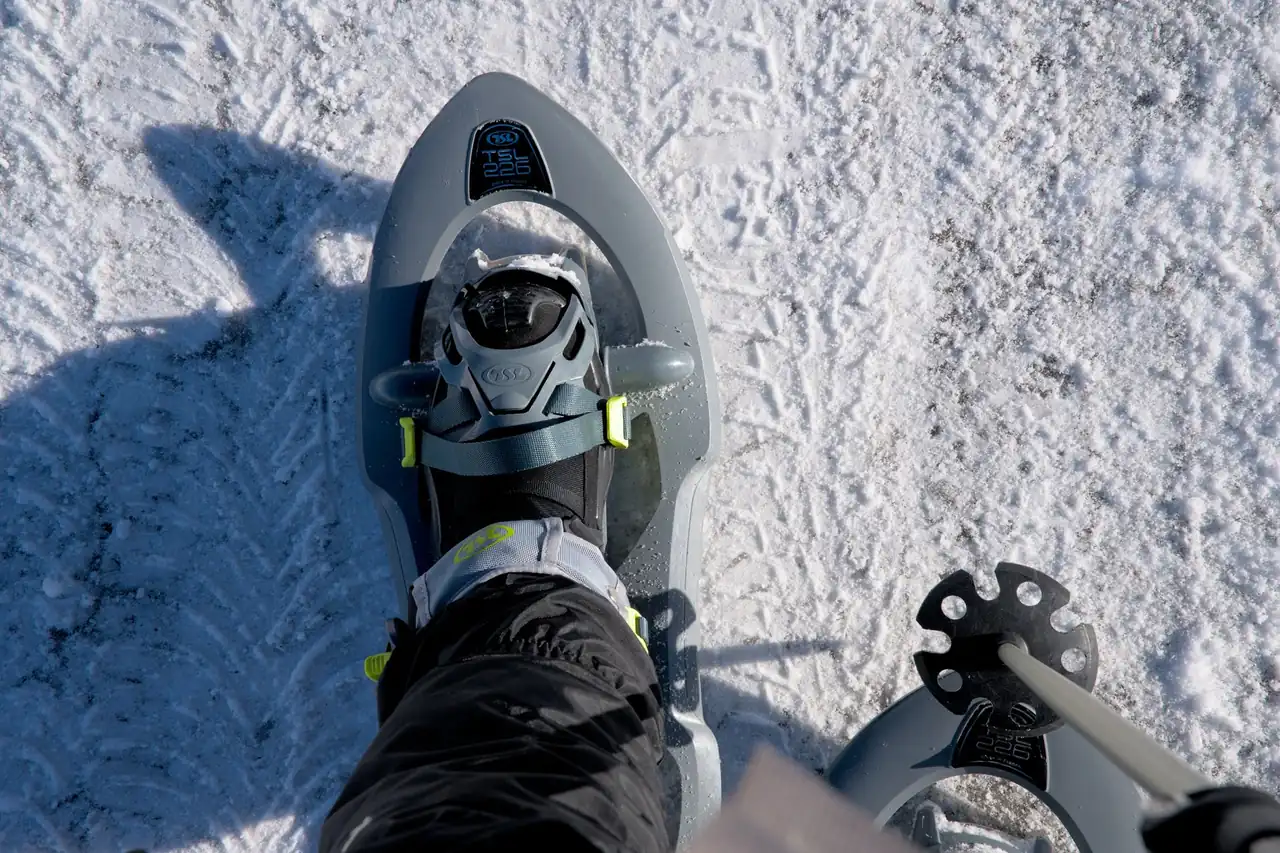
In the snow, the foot does not just move forward: it negotiates every step with the cold, the ice, and the pressure of the boot itself. The right footwear makes the difference between a comfortable outing and a day in which every meter feels like an endless climb. In this terrain, the ideal boot is not measured by aesthetics or fashion, but by its ability to insulate, support, and transmit security to the snowshoe.
The right choice starts with understanding that the snowshoe does not work alone. The set works like a chain: boot, binding, socks, gaiter, and terrain. If one of those links fails, the rest loses effectiveness. That is why, before thinking about brands or colors, it is worth focusing on three very concrete pillars: waterproofing, sufficient rigidity, and real compatibility with the support system.
What the foot really needs on snow
The first condition is keeping the foot dry. Snow may seem soft and harmless, but it quickly turns into water, moisture, and frozen mud. A boot with a waterproof membrane and well-finished seams helps avoid that cold sponge feeling that ruins the walk. On long outings, a damp interior is not just uncomfortable: it chills the foot and multiplies the risk of chafing.
The second requirement is thermal insulation, especially on flat routes, gentle ascents, or windy days. There is no need for an expedition boot for every use, but there does need to be a construction that retains heat without turning each step into a block. Boots that are too thin may seem agile at first; as soon as the temperature drops, they become a portable refrigerator.
The sole also matters. In soft snow, grip does not depend only on the snowshoe’s traction; when walking outside it, when adjusting straps, or when crossing mixed sections, the sole must provide a reliable base. Deep lugs and a grippy compound help, but they do not replace common sense: the more ice there is, the more value a sole with good tread and a stable shaft will have.
Compatibility between boot and binding is no minor detail
Not every boot fits every snowshoe equally. The market offers automatic, semi-automatic, and strap bindings, and each one calls for a different profile. Strap bindings are the most versatile and forgiving; they accept a wide range of hiking boots and even some winter models, provided the last and volume are not excessive. More technical bindings, on the other hand, require a more precise boot and, in some cases, a sole with a toe and heel welt.
The volume of the instep and the width of the shaft also matter. A boot that is too bulky may be poorly secured, move inside the binding, or create uncomfortable pressure points. One that is too narrow, by contrast, may leave the foot with no room for a thermal sock and worsen circulation. In the snow, where the cold bites from below, that lack of room ends up being felt sooner than it seems.
The fit must be firm, but not aggressive. A good test is to walk for a few minutes on flat ground before going uphill. If the heel lifts with every step or if the instep feels compressed, the boot is not working in the user’s favor. The desired feeling is similar to that of a thick glove: it fits, protects, and still lets you move naturally.
Boot models according to the type of outing
For relaxed walks and marked trails, a mid-height snow boot is usually enough. This type of footwear balances warmth, mobility, and compatibility with most strap snowshoes. It tends to work well on family outings, compacted trails, and half-day trips, where the effort is moderate and the terrain does not require extreme protection.
On tougher routes, it is worth stepping up a level. If there is elevation gain, deep snow, hard crusts, or sudden temperature changes, a more structured boot helps stabilize the ankle and better withstand the tension of the binding. That does not mean giving up comfort, but rather choosing a more robust construction, with a well-finished collar and a sole that responds reliably when the ground stops being uniform.
Sports use demands even more precision. Those who head out regularly into the winter mountains usually value boots with less weight, better lateral response, and a feeling of control closer to technical trekking. In that context, every gram matters, but so does every fitting error. A light boot that dances inside the binding ends up tiring you out more than a slightly sturdier one that sits properly in place.
The right size is not chosen like an everyday sneaker
In winter, the size must leave room for the thermal sock and for the foot’s natural expansion. Buying something too snug is one of the most common mistakes. What seems like a good fit in the store can turn into pressure at the toe or numbness on the descent, when the foot slides forward and hits the toe box. That extra margin is not a whim; it is a reserve of comfort and circulation.
The ideal fit holds the heel and frees the toes. If, when trying on the boot, you notice front compression, it is worth checking half a size up or a different last. If the heel lifts clearly, repeated movement will end up punishing the skin. The balance is delicate, because the cold foot changes behavior: it contracts at first and swells later with walking. That is why it is not enough to put on the boots for a few seconds and decide.
It is also wise to think about the sock you will actually wear. A thick wool or thermal-fiber model takes up more space than an everyday sock. Trying on the boot with the full setup avoids surprises. In the snow, the margin for error is small; a poorly calculated size turns into blisters, cold toes, or loss of precision when stepping.
Gaiters, laces, and small details that change a lot
Gaiters do more for comfort than is usually admitted. They block snow from entering at the ankle, protect the lower part of the pants, and reduce moisture accumulating around the shaft. On powder routes or through frozen vegetation, they are almost a natural extension of the boot. Without them, snow gets in wherever it finds a gap and the walk loses cleanliness.
Laces also deserve attention. A quick-lacing system helps adjust tension without fighting with thick gloves. Some boots include hooks or loops that distribute pressure better; others rely on simpler closures. What matters is not sophistication, but that the fit lasts for hours without loosening or creating uncomfortable knots on the instep.
The tongue and front reinforcement are more important than they seem. A well-padded tongue softens rubbing against packed snow and the binding. The front reinforcement protects the foot when the boot touches the snowshoe structure. It is these discreet details that turn a normal outing into a less rough experience, like a well-sewn coat that you do not notice until the wind blows.
Materials that work better in real winter
Treated leather, durable synthetics, and waterproof membranes dominate this segment. Leather provides durability and a certain ability to adapt with use, but it requires maintenance. Synthetic materials, by contrast, usually dry faster and weigh less. In both cases, the key lies in the quality of construction, not just the outer label.
The waterproof membrane is useless if the overall build is poorly finished. A good material can lose effectiveness through a poorly sealed seam or a tongue that lets water in at the edge. Moving snow slips into tiny gaps with almost microscopic patience. That is why, when a boot promises warmth, what matters is the complete system, not a single miracle layer.
Drying afterward is part of the material, even if it is not sewn inside. Leaving the boot wet in a closed backpack turns it into a cold block for the next outing. The best option is to remove the snow, open it up, take out the insole if possible, and let it breathe at room temperature. Excessive heat, on the other hand, can deform adhesives and shorten the footwear’s lifespan.
Common mistakes that end up taking their toll
The first is using running shoes or light hiking boots without enough protection. They may seem comfortable in the store, but on snow they quickly lose all purpose. They offer less warmth, less barrier against water, and in many cases a base that is too flexible. On a snowshoe, that flexibility ends up feeling like a tired hinge.
The second mistake is aiming for an excessively tight fit. Cold and effort do not follow the same logic as city life. A squeezed foot receives blood less well, gets colder faster, and performs worse on descents or uneven footing. The right boot lets you move, but not float. It is a subtle difference, almost like fine carpentry, that becomes very clear in the mountains.
The third mistake is ignoring the usual terrain. The same boot is not needed by someone walking forest tracks and someone tackling icy slopes or variable snow. The problem is not buying too much, but buying the wrong thing for the real context. In the mountains, the right footwear is not the most bulky or the most minimalist; it is the one that matches the specific demands of the outing.
What to look at in the store before deciding
A useful test is to flex, walk, and simulate the pressure of the binding. The boot should follow the foot’s natural movement without collapsing at the toe or opening at the heel. It is also worth noting the shaft height, because a taller shaft can provide extra stability, although at the cost of reducing some ankle freedom.
The weight of the footwear influences a long outing more than it may seem. A very heavy model causes fatigue, especially when the effort of lifting the snowshoe with every step is added. However, cutting weight without judgment also takes its toll. The desirable feeling is that of a balanced setup, like a well-tuned knife: compact, yes, but not fragile.
The relationship between price and durability is usually reasonable in this type of product. In the Spanish market, simple options can be found starting at modest prices, while technical or specialized-brand boots easily rise above 100 euros and, in some cases, are around 150 or 200 euros. The difference is explained by materials, insulation, fitting precision, and resistance to continuous use.
How footwear designed for snow ages well
A pair of well-cared-for boots can last several seasons without losing performance. Healthy aging depends on three basic habits: clean off salt and snow when you get back, dry at a gentle temperature, and store in a ventilated place. Trapped moisture is the silent enemy; leather stiffens, adhesives suffer, and the inside starts to smell of neglect.
It is also worth checking friction zones regularly. The toe, the sides where the binding presses, and the heel take more punishment than the rest. If cracks, open seams, or deformities appear, the boot begins to lose performance even if it still looks acceptable from the outside. Winter wear does not always announce itself dramatically; sometimes it arrives as a small loss of firmness.
Replacement insoles and new laces extend service life. They are humble, almost invisible parts, but they change the feel of the whole setup. Just as a sturdy handrail builds confidence on an icy stretch, an insole that does not flatten and laces that do not slip make the boot continue performing better than many newer but neglected ones.
Snow demands safety before aesthetics
Choosing footwear well for snowshoeing means protecting the foot, the ankle, and your energy. The winter mountains have their own language, made of cold, support, and balance. Well-chosen boots do not promise miracles, but they do reduce wear, improve control, and let you enjoy the landscape without your body spending the entire day fighting the environment.
The best decision is usually the most understated: match the boot to the type of outing, check compatibility with the binding, and give priority to warmth, firmness, and quick drying. In that order. Snow does not forgive improvisation, but it does reward gear that works with it, not against it. And in that silent dialogue between foot and landscape, almost everything is at stake.
Este artículo contiene enlaces de afiliado: si compras a través de ellos, se genera una pequeña comisión sin coste adicional para ti. Más información.



How to prevent thigh chafing: causes and real solutions

Women’s running windbreakers: seven jackets and how to choose

Do more workouts get rid of soreness? A guide for runners

Jaén Half Marathon 2026: Record 3,800 Runners Registered

Men’s short running tights: how to choose the right pair

World Triathlon confirms data breach involving medical data

Izan Edo targets podium at Miyazaki World Cup

María Pérez ranks ninth in World Athletics’ 2026 top ten

Dos Santos, Duplantis and Sawe: World Athlete of the Year finalists

San Silvestre Vallecana 2026: 42,000 places, prices and start times

 Races3 months ago
Valencia Half Marathon 2027: date and registration

 Races3 months ago
Valencia Marathon 2026: entry, ballot and course

 Reviews and Comparisons4 months ago
Asics Gel-Roadmiles 3 for men: review and current price

 Reviews and Comparisons4 months ago
Asics Gel Sonoma 8 Gore-Tex: complete analysis for trail and rain

 Sneakers3 months ago
Saucony Endorphin Pro 4: full review and verdict

 News5 months ago
Strava API 2026: what changes for clubs, challenges and runner apps?

 Reviews and Comparisons5 months ago
Nike Alphafly 3: opinions, sensations, and real key points

 Reviews and Comparisons4 months ago
Under Armour running shoes review 2025-2026: models and key features

 Sports Equipment4 months ago
Shoe sizes in cm: a clear guide to getting the right fit for your footwear

 Sneakers3 months ago
Skechers GO RUN Consistent 2.0 analysis: comfort and limits

 News5 months ago
Valencia Marathon 2026 route: key tips to train and run better

 Sneakers4 months ago
Adidas Adizero Boston 13 for men: review and verdict