News
Road closures for the Cursa El Corte Inglés 2026 in Barcelona
Barcelona activates road closures and detours for the popular race on Sunday, May 10, affecting buses, the TRAM, and traffic.

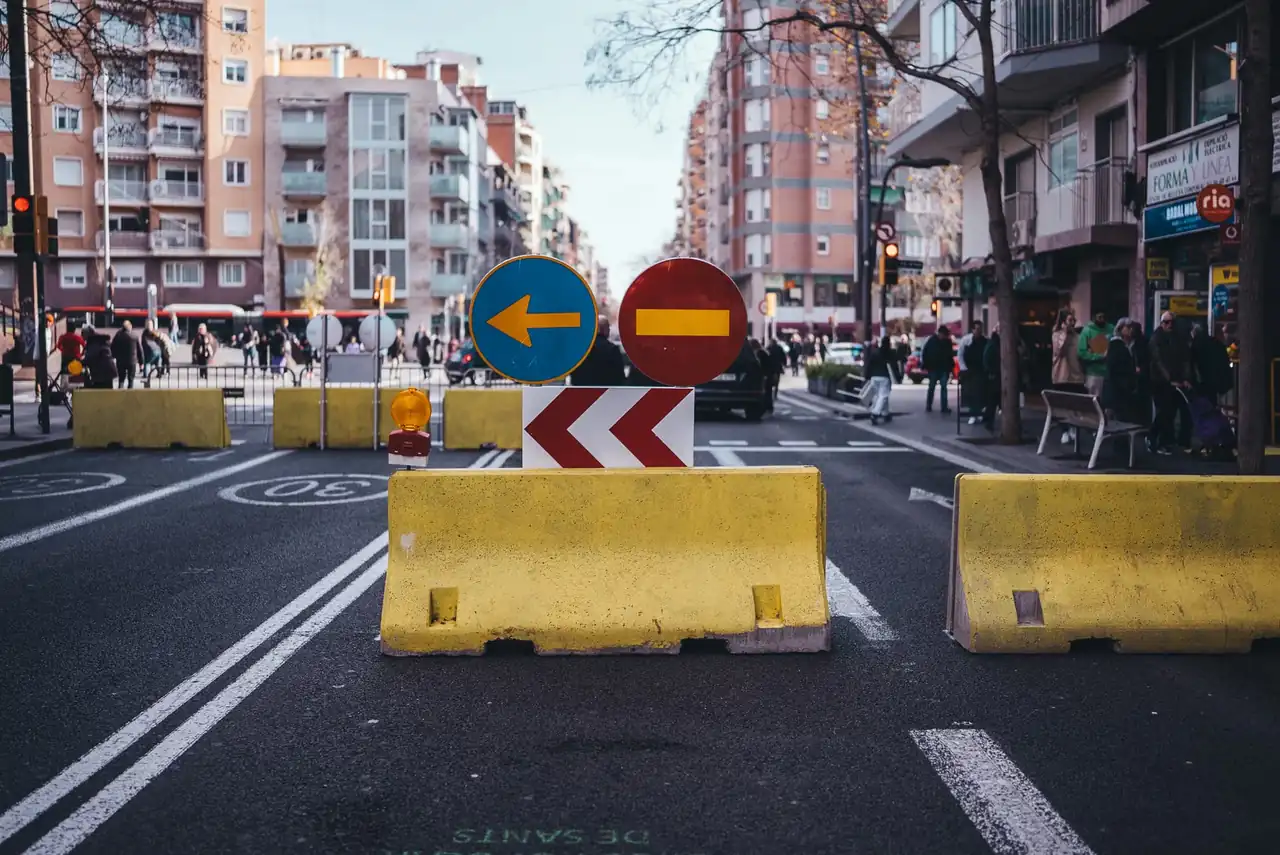
Barcelona will once again feel the pulse of the great popular race from early on Sunday, May 10: streets closed to traffic, buses diverted, and the TRAM affected for several hours. The Cursa El Corte Inglés, with the start on Avinguda Diagonal and the finish in Plaça de Catalunya, not only brings together tens of thousands of runners; it also reorganizes mobility for half the city throughout the morning.
The mobility operation is concentrated between 5 a.m. and 2 p.m., although the actual impact varies depending on the stretch and the mode of transport. Anyone needing to move around the Eixample, the area around Francesc Macià, Passeig de Gràcia, Gran Via, or Plaça de Catalunya will find a familiar scene in Barcelona: barriers, officers managing crossings, altered buses, and pedestrians sharing space with a race that takes over the heart of the city.
The route that determines the closures in central Barcelona
The race starts on Avinguda Diagonal, in front of El Corte Inglés, and heads toward Passeig de Gràcia, one of the most sensitive axes for urban traffic. From there, the route goes down Aragó, passes through Viladomat, and opens onto Gran Via de les Corts Catalanes before turning toward Marina, linking with Casp, and closing the circuit in Plaça de Catalunya. It is a course of about 10 kilometers that crosses wide arteries, but also intersections where any interruption is magnified like a stone dropped into a pond.
The practical takeaway for drivers is clear: this is not a single isolated closure, but a chain of restrictions that sweeps through the city from west to east and from north to south as the pack advances. In urban terms, the race cuts off surface traffic in the Eixample and around Plaça de Catalunya, with particular impact on the access roads connecting the Diagonal with the center.
In this edition, the map of disruptions once again draws the same pattern that is already familiar in the city: a strong start, a central stretch crossing Barcelona’s densest urban fabric, and a finish right in the main hub. For pedestrians, the impact is smaller and more localized; for private vehicles, however, the morning is broken into stretches where getting around can turn into a succession of detours, stops, and closed streets just a few meters apart.
Closed streets and stretches where traffic is blocked
The closure affects key streets in the Eixample and the access roads to Plaça de Catalunya. Among the highlighted points are Avinguda Diagonal, Plaça de Francesc Macià, Passeig de Gràcia, Aragó, Viladomat, Gran Via de les Corts Catalanes, Marina, Ausiàs Marc, Ronda de Sant Pere, and the final stretch in Plaça de Catalunya. This is not a simple linear closure: some stretches are closed on the central roadway, others in specific lanes, and others are directly taken out of circulation while the race passes through.
The most delicate period begins before the starting gun sounds. From 5 in the morning, the first restrictions are already noticeable due to the installation of barriers and the preparation of the circuit, and the effect lasts until approximately 2 p.m., when the situation tends to normalize gradually. In a city like Barcelona, where a single intersection can redistribute traffic from several avenues, a few hours are enough to alter routines, commutes, deliveries, and weekend trips.
The closure of Ronda de Sant Pere, especially on the stretch between Pau Claris and Plaça de Catalunya, concentrates much of the tension in the center. The Besòs and Llobregat carriageways of the square itself are also affected, as is the stretch of Passeig de Gràcia between Gran Via and Plaça de Catalunya. These are points where traffic gets compressed and the detour is not always intuitive, which is why the disruption extends beyond the visible route of the race.
The parking ban accompanies these closures and reinforces the sealing off of the circuit. On streets like Viladomat, Ausiàs Marc, Gran Via, or around Plaça de Catalunya, the restriction not only prevents driving; it also stops parked vehicles from obstructing safety maneuvers, the runners’ passage, and the work of municipal crews. The logic is simple: a race of this scale needs a clear lane, almost like a dedicated corridor within the city.
The bus lines that change their routes
Barcelona’s bus network is the main one affected by the race. TMB expects diversions or restrictions on more than thirty lines, including D40, D50, H6, H8, H10, H12, H16, V3, V5, V7, V9, V11, V13, V15, V17, V19, V21, and also the regular lines 6, 7, 19, 22, 24, 27, 33, 34, 39, 47, 54, 55, 59, 63, 67, 68, 78, 113, and 141, as well as the Barcelona Bus Turístic on its blue and red routes.
The impact of these changes is not limited to the race route. When a line changes its itinerary, it drags along delays, rearranged stops, and longer travel times in other parts of the city. Urban buses, so dependent on traffic lights, traffic density, and room to maneuver, are especially vulnerable on a morning of closures like this one. That is why TMB usually recommends the metro on days with major surface-level disruptions.
In practice, anyone waiting for a specific line may find canceled stops, longer routes, or limited service around the center. Surface mobility becomes subordinate to the race, and that means allowing extra time. It is not enough to leave a few minutes earlier; on a morning with more than thirty altered bus lines, planning should be measured in half-hour blocks, especially if the trip crosses the Eixample or connects with Plaça de Catalunya.
Experience from previous editions shows that buses lose effectiveness not only in the center, but also at the access points. Streets parallel to Diagonal, Aragó, Gran Via, or Ronda de Sant Pere absorb part of the diverted traffic and end up slowing the whole network. The result is an urban board where every piece pushes the next: if one stop changes, the flow of the entire line suffers.
The TRAM is also forced to stop in its central stretch
The TRAM disruption is concentrated on lines T1, T2, and T3, which during the early morning hours will not run between Francesc Macià and Zona Universitària due to the installation work for the perimeter barriers. The service is expected to be restored around 11 a.m., although it is always wise to assume that the recovery may be gradual.
This closure matters because the tram is an essential piece of access to western Barcelona. The Francesc Macià area acts as a hinge between the Eixample, Sarrià-Sant Gervasi, and Les Corts, and when the TRAM is limited the alternative relies even more on the metro and longer walks to other connections. In a city that combines neighborhood mobility with major corridors, this kind of interruption redistributes thousands of people in very little time.
The combination of the race, the barriers, and the setup of the operation turns the Diagonal area into an especially sensitive space from the early hours. The tram closure is not only due to the runners passing through, but also to the need to maintain a safe and orderly perimeter while the temporary infrastructure is being prepared and dismantled. It is a very typical image of major urban events: a modern transport line suspended to make way for another kind of rhythm, that of the stride.
Metro, access points, and the best way to get around without surprises
The metro remains the most reliable alternative throughout the morning. In a context of surface closures, the underground lines maintain better regularity and avoid the bottleneck of diverted vehicles and buses. For the start, the L3 stations at Maria Cristina and Palau Reial concentrate much of the runners’ arrivals; for the finish, Plaça de Catalunya brings together several metro connections and also rail links that ease pressure on the surface.
Maria Cristina station takes on a strategic role for participants, especially because the organization provides 40,000 single tickets to make travel easier on race day. That detail is not minor: in such a huge event, every solution that reduces friction at access points avoids lines, crowds, and delays in an area already saturated by the scale of the event itself.
For those who are not running, the key is to understand that Sunday does not operate like an ordinary day. Trips crossing Diagonal, Passeig de Gràcia, or Plaça de Catalunya require more time and patience, even if the destination seems close on the map. The city contracts and expands at the same time: it closes at street level because of the circuit, but opens underground thanks to the metro, which absorbs much of the demand.
It is also worth remembering that the disruptions are concentrated in the central hours of the morning, not throughout the entire day. By midday, once the operation has cleared, traffic gradually returns to its usual pattern. That detail matters for reading the day accurately: not all Sunday trips are trapped, but those in the early hours do require different planning.
A race that transforms the city for a few hours
The Cursa El Corte Inglés is more than a sporting event; it is a large-scale urban operation that every year reorganizes Barcelona’s mobility. Its 10 kilometers not only bring together thousands of runners, they also trigger a choreography of security, transport, and signage that turns the center into an almost ceremonial space, with the city adapting to the race as it passes through.
The 2026 edition confirms that mass effect once again. The number of participants, the extent of the affected lines, and the role of the TRAM and the metro show just how much a popular race can disrupt the routine of a European capital for a few hours. Barcelona does not stop, but it does change tempo: traffic pulls back, public transport is adjusted, and the urban center becomes a temporary track crossed by thousands of synchronized steps.
In that context, the closures should not be seen as a simple nuisance, but as the visible consequence of an event that has gained weight in the sporting calendar and in the city’s imagination. The cost in mobility is real, but so is the operation’s capacity to organize a complex day. The key, in the end, is knowing where the flow is interrupted and which alternative remains open on either side of the route.
Barcelona knows this kind of Sunday well. Between barriers, discreet sirens, support bicycles, and runners crossing emblematic avenues, the city rehearses another way of standing upright. And for a few hours, urban mobility is measured not by speed, but by the ability to adapt without losing pace.



How to prevent thigh chafing: causes and real solutions

Women’s running windbreakers: seven jackets and how to choose

Do more workouts get rid of soreness? A guide for runners

Jaén Half Marathon 2026: Record 3,800 Runners Registered

Men’s short running tights: how to choose the right pair

World Triathlon confirms data breach involving medical data

Izan Edo targets podium at Miyazaki World Cup

María Pérez ranks ninth in World Athletics’ 2026 top ten

Dos Santos, Duplantis and Sawe: World Athlete of the Year finalists

San Silvestre Vallecana 2026: 42,000 places, prices and start times

 Races4 months ago
Valencia Half Marathon 2027: date and registration

 Reviews and Comparisons4 months ago
Asics Gel-Roadmiles 3 for men: review and current price

 Races4 months ago
Valencia Marathon 2026: entry, ballot and course

 Reviews and Comparisons4 months ago
Asics Gel Sonoma 8 Gore-Tex: complete analysis for trail and rain

 Sneakers4 months ago
Saucony Endorphin Pro 4: full review and verdict

 News5 months ago
Strava API 2026: what changes for clubs, challenges and runner apps?

 Reviews and Comparisons5 months ago
Nike Alphafly 3: opinions, sensations, and real key points

 Reviews and Comparisons4 months ago
Under Armour running shoes review 2025-2026: models and key features

 Sports Equipment4 months ago
Shoe sizes in cm: a clear guide to getting the right fit for your footwear

 Sneakers3 months ago
Skechers GO RUN Consistent 2.0 analysis: comfort and limits

 News5 months ago
Valencia Marathon 2026 route: key tips to train and run better

 Sneakers4 months ago
Adidas Adizero Boston 13 for men: review and verdict