Races
Azkoitia-Azpeitia International Half Marathon 2027: complete guide
The Basque classic combines fast asphalt, a tribute to Diego García, and an atmosphere that turns every kilometer into a bigger date.

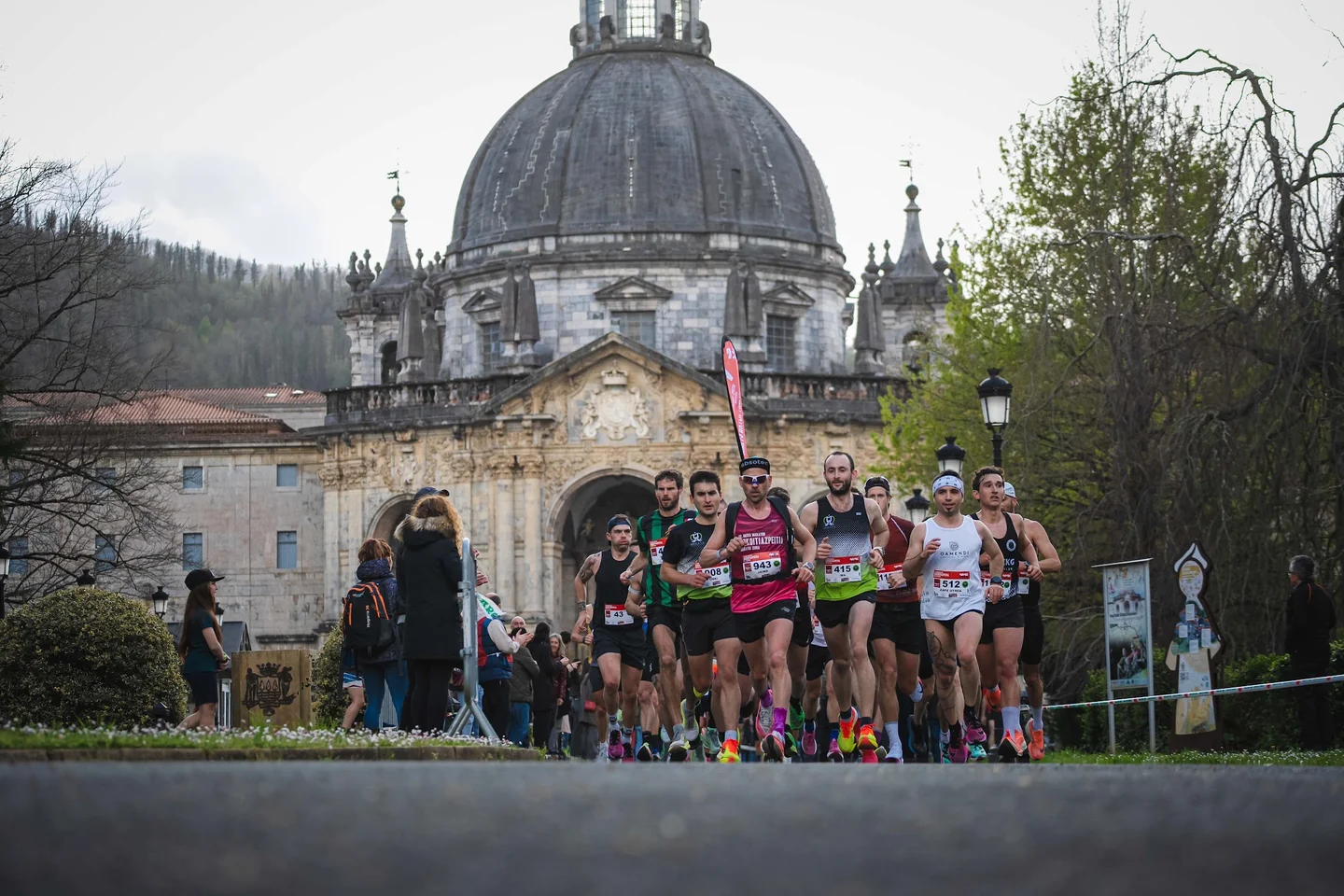
Paso por Loiola, en el kilómetro 12, en la edición de 2025. Foto: Félix Sánchez.
The Azkoitia-Azpeitia international half marathon still holds a singular place in the Spanish calendar. It is not just a fast race or a prestigious event in Gipuzkoa: it is a race with its own identity, tied to the memory of Diego García and to a tradition that blends competitive level, popular warmth, and a course that is very kind to running hard. The 2027 edition is shaping up, as every year, as one of the great references at the start of spring in the north.
The basis of its appeal lies in an unusual combination: a certified course, a favorable profile, start in Azkoitia and finish in Azpeitia, and an atmosphere of a big village that throws itself behind the athletes. Added to that is the short 8-kilometer race, designed to broaden participation, and an organization that has turned the event into a showcase of road running with a Basque stamp.
A classic of the asphalt with the soul of a tribute
Since 1994, the Azkoitia-Azpeitia has grown into one of the most recognizable events in Basque athletics. Its history is closely linked to the name of Diego García, a runner who left a deep mark on Spanish sport and whose memory remains present in every edition. That emotional dimension is not a decorative touch: it is part of the race’s story, of the way it presents itself, and of the loyalty with which the public follows it.
In a season where half marathons with similar talking points abound, this one keeps a clear personality. It does not depend only on the stopwatch, although the stopwatch matters a lot here, but also on the context. Azkoitia and Azpeitia act like two stages of the same play: a start that gives you a push, a route that stretches through the Urola valley, and a finish where spontaneous crowds appear on the sidewalks, at the corners, and at the points where the runner needs a visual reference to keep pushing.
The race has brought together international elites and recreational runners on the same asphalt, something that does not always happen naturally. Here it does. That balance between competitiveness and closeness is part of its prestige. In road distance running jargon, not every race manages to be fast and beloved at the same time; this one does, and that dual condition explains why it keeps generating interest season after season.
A course made for running fast
The route is one of the race’s great arguments. It is a certified half marathon of 21.0975 kilometers, run on asphalt, with an overall downhill profile and few technical demands. That combination makes it a very appreciated event for those chasing a personal best, solid sensations, or a first serious experience at the distance.
The start in Azkoitia and the finish in Azpeitia draw a linear itinerary, easy to understand and very friendly for the runner. There are no big turns or mountain traps: the layout favors a continuous stride, which in a half marathon is almost a form of music. When the ground helps and the terrain does not punish, the body manages effort better, and in this race that is noticeable from the first kilometers.
One of the most recognizable stretches is the area around the Loyola sanctuary, set within a landscape of green valleys and roads that seem tucked between gentle slopes. That contrast between the geometry of the asphalt and the density of the landscape is part of the experience. The race is not lived as a cold straight line, but as a crossing that makes its way through an environment strongly marked by the territory.
Over the years, the organization has adjusted the course to avoid some inclines and bends that could reduce fluidity. The result is a race where speed is not improvised, it is built. That is why it attracts both elite runners and well-prepared recreational athletes: because it offers a real chance to run smoothly, as long as the pace is well measured.
Why this half marathon has such a reputation
Azkoitia-Azpeitia’s reputation does not come from a single factor, but from the sum of several. The presence of international-level athletes, the certified nature of the route, the organizational tradition, and the response from the public create an environment that few Spanish races can match. It is not an event inflated by marketing; its prestige has been built on results, continuity, and loyalty.
For years, the race has been known for very notable times and for a history in which top names have competed. That competitive weight helps, but it does not explain everything. What truly sets it apart is the sense of belonging: taking part here is not just about completing 21.0975 kilometers, but about entering a collective narrative that brings together memory, territory, and road running.
There is also an important detail to understand its appeal: the atmosphere. The so-called Running Festa sums up the spirit of the event very well. It is a way of saying that sport is not presented here with distant solemnity, but as a shared celebration. The crowd cheers intensely, the streets fill with sound and visual references, and the runner feels that support like a current that keeps going even when the legs begin to fade.
In a half marathon, the context weighs almost as much as the preparation. A cold start can dull sensations; a lively start can sustain them. Azkoitia-Azpeitia belongs to that second group, the one of races that lift the mood from the roadside and turn suffering into something more bearable, almost ritual.
The 2027 edition and the calendar around it
The organizers have confirmed that the 34th edition will be held on Saturday, March 20, 2027. The race thus keeps the privileged place it usually occupies in the run-up to spring, and stands once again among the month’s major events.
The timetable for the day is now final. The tribute opens the afternoon at 16:05; at 16:15 the short race sets off from the same point in Azkoitia; and at 16:30 the half marathon is started. The AZKOITIAZPEITIA is therefore an afternoon race, an unusual format in the Spanish calendar that is part of its character and shapes the runner’s day: an early lunch, a long wait, and temperatures that tend to ease off as the race goes on.
This is no small detail for those planning their season. March in northern Spain usually brings variable conditions: cool mornings, humidity, the possibility of wind or light rain, and a temperature that can be very favorable for performance if the day cooperates. For a fast half marathon, that kind of weather can be almost an ally. The race also arrives at a time when many runners are looking for their first big goal of the year or a benchmark time before the spring block.
The organization has already announced that the race remains included in the calendars of the athletics federations of Gipuzkoa, Euskadi, and the RFEA, a previous step before requesting inclusion in the World Athletics calendar. That institutional presence reinforces its status as a serious event, with a real international ambition and not just a nominal one. In distance running, those seals matter because they certify standards, certification, and projection.
The day also includes the short race, which in 2027 reaches its 15th edition and keeps the course of recent years: exactly 8.06 kilometers, starting from the same point in Azkoitia. The half marathon remains the center of gravity, but that additional distance opens the door to a wider range of participants and helps the day have a longer life in time and on the streets.
The start, the finish, and the value of the surroundings
Azkoitia and Azpeitia are not just two points on a map. In this race they function as two narrative poles between which all the action moves. The start in Azkoitia places the runner in a town with its own tradition and pulse, while the finish in Azpeitia concentrates the final emotion in a municipality that usually welcomes participants with very recognizable energy.
The Urola valley provides a backdrop that does not distract, but accompanies. Green mountains, roads tucked in between, a clean and sober landscape. There is no visual grandiosity; there is identity. That gives the race a very Basque texture, understood not as a cliché, but as a way of being in the territory while running.
The passage through Loyola adds one of the most photogenic moments of the route. Not only because of the uniqueness of the place, but because it introduces a contrast between heritage, landscape, and sporting effort. In half marathons with history, these points become small markers of memory: the runner does not always remember the exact kilometer, but does remember the place where the route seems to open up or tighten, where the crowd multiplies, or where the mood changes gear.
The finish in Azpeitia usually concentrates much of the emotional story of the day. After 21 kilometers of racing, the final straight is not just a line on the ground: it is the culmination of an effort that has unfolded between sound references, pace control, and fatigue management. That is why the finish matters so much. It is crossed not only to record a time, but to close an experience that the surroundings help amplify.
2027 entries, places and prices
Entries have been open since 1 November 2026 on the Kronoak platform, and in the first week 35% of places were already taken, according to the organisers. There are two races: the 34th AzkoitiAzpeitia International Half Marathon, with 1,200 places, and the 15th Short Race of 8.06 km, with 600 places.
The price goes up in tiers as places fill:
| Half marathon | Price | Short race | Price |
|---|---|---|---|
| Entries 1-300 | €25 | Entries 1-150 | €18 |
| 301-600 | €30 | 151-300 | €20 |
| 601-900 | €35 | 301-450 | €22 |
| 901-1,200 | €40 | 451-600 | €24 |
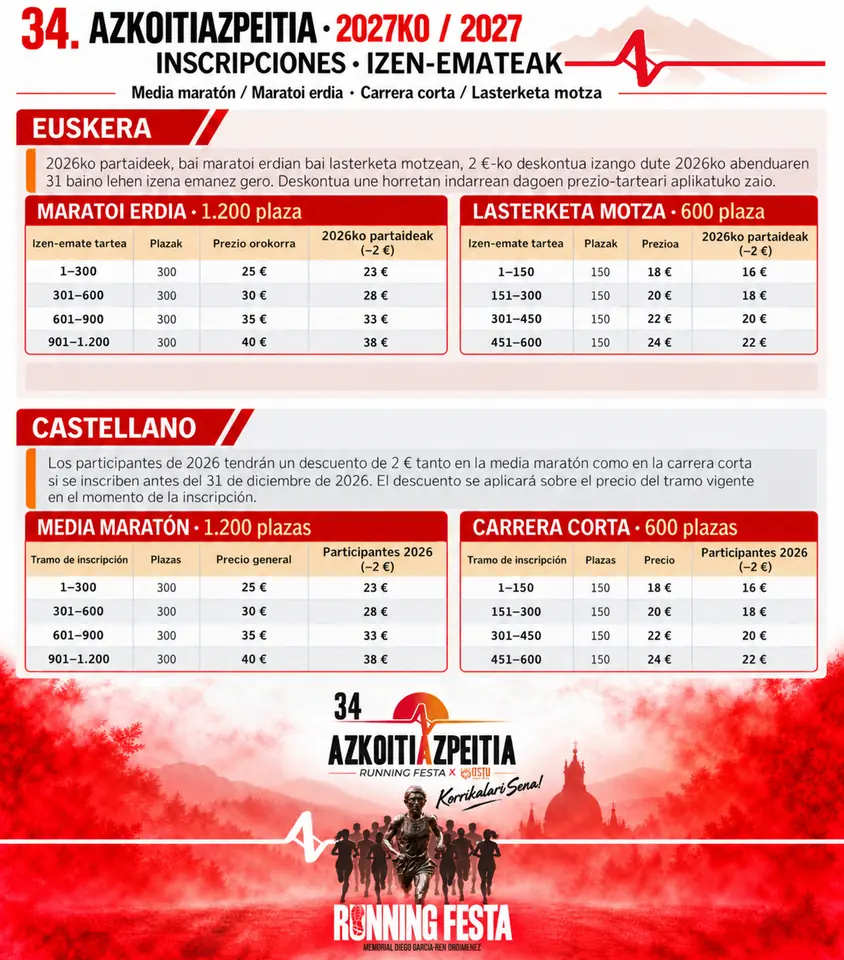
2026 participants get a €2 discount on both races if they enter before 31 December 2026, applied to the current tier price. In the half marathon, runners with an athletics licence accepted for the race pay €3 less, as they don’t need the one-day insurance.
The entry includes an official OTSO SPORT T-shirt, which this year comes in red or white. Before 31 December you can add a second T-shirt for €15 and Diego’s headband, back as a tribute to Diego García, for €5. This year’s motto is «Korrikalari sena! Running instinct!».
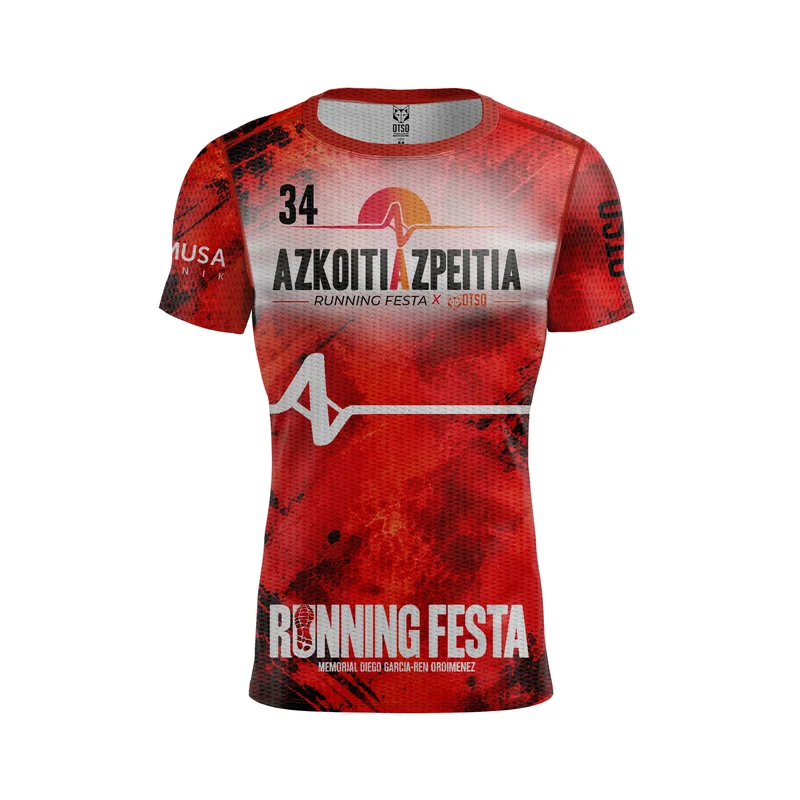
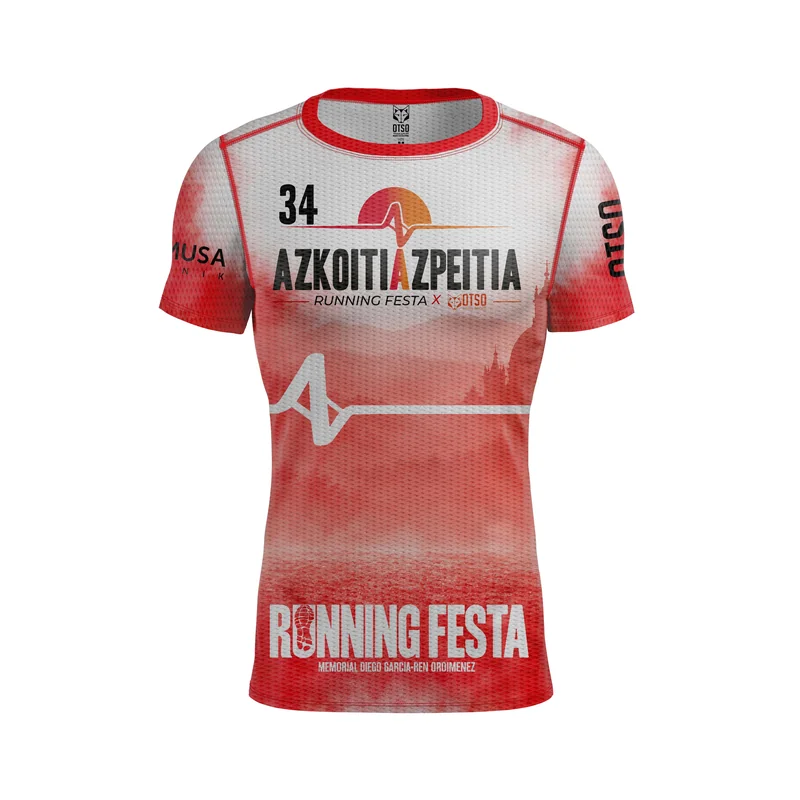

Draft designs of the OTSO SPORT T-shirts and Diego’s headband. Images: AzkoitiAzpeitia.
- Half marathon entry
- Short race entry
- Course maps on the official website
What kind of runner fits this event best
The Azkoitia-Azpeitia is a half marathon that suits very different profiles. The fast runner appreciates it for its favorable route and its ability to sustain pace. The experienced recreational runner values it for the atmosphere and the organization. And someone making their debut at the distance finds a setting in which the race is more welcoming than others, without giving up its real demands.
The race does not forgive improvisation, but it also does not punish with unnecessary harshness. That makes it especially interesting for those looking for a serious time in an environment less hostile than other half marathons with a more broken profile. If training has been consistent, the course can return a sense of control. If it has not, the asphalt makes that clear quickly too. That competitive honesty is part of its sporting value.
The downhill profile should not be confused with absolute ease. In a half marathon, the kilometers weigh just as much on a gentle course as on a hard one; only the way they show up changes. Here the challenge is not to go out too eagerly, to let the race run without the runner burning out too early. The best times are usually born from well-managed patience, not from an impulsive start.
That is why this event has become a kind of form barometer for many athletes. Those who arrive in good shape usually leave with a solid read on their season. Those who arrive just right quickly learn that speed without endurance does not last long. And those who simply run it for the atmosphere find an experience that leaves a mark, one of those remembered for the mix of effort and celebration.
The weight of Diego García’s memory in the race
Diego García’s name is not a decorative appendix in the title. It is the emotional center of a race that was born and grew around his memory. The race keeps him alive not through a one-off gesture, but through continuity. Each edition updates that memory with a naturalness that makes it part of the local sporting landscape.
That memory has an exact moment and a time of its own. At 16:05, before any start, the day stops to pay tribute to Diego García, Alejandro Gómez, and Jone Basterra, a handbike athlete who also died some years ago. Bibs 1, 2, and 3 are handed to their families: the first to Diego García’s family, the second to Paula Hernández, who was Alejandro Gómez’s wife, and the third to Jone Basterra’s parents. The ones handing them over, together with the bouquets, are Diego’s own friends, who come back to the event year after year.
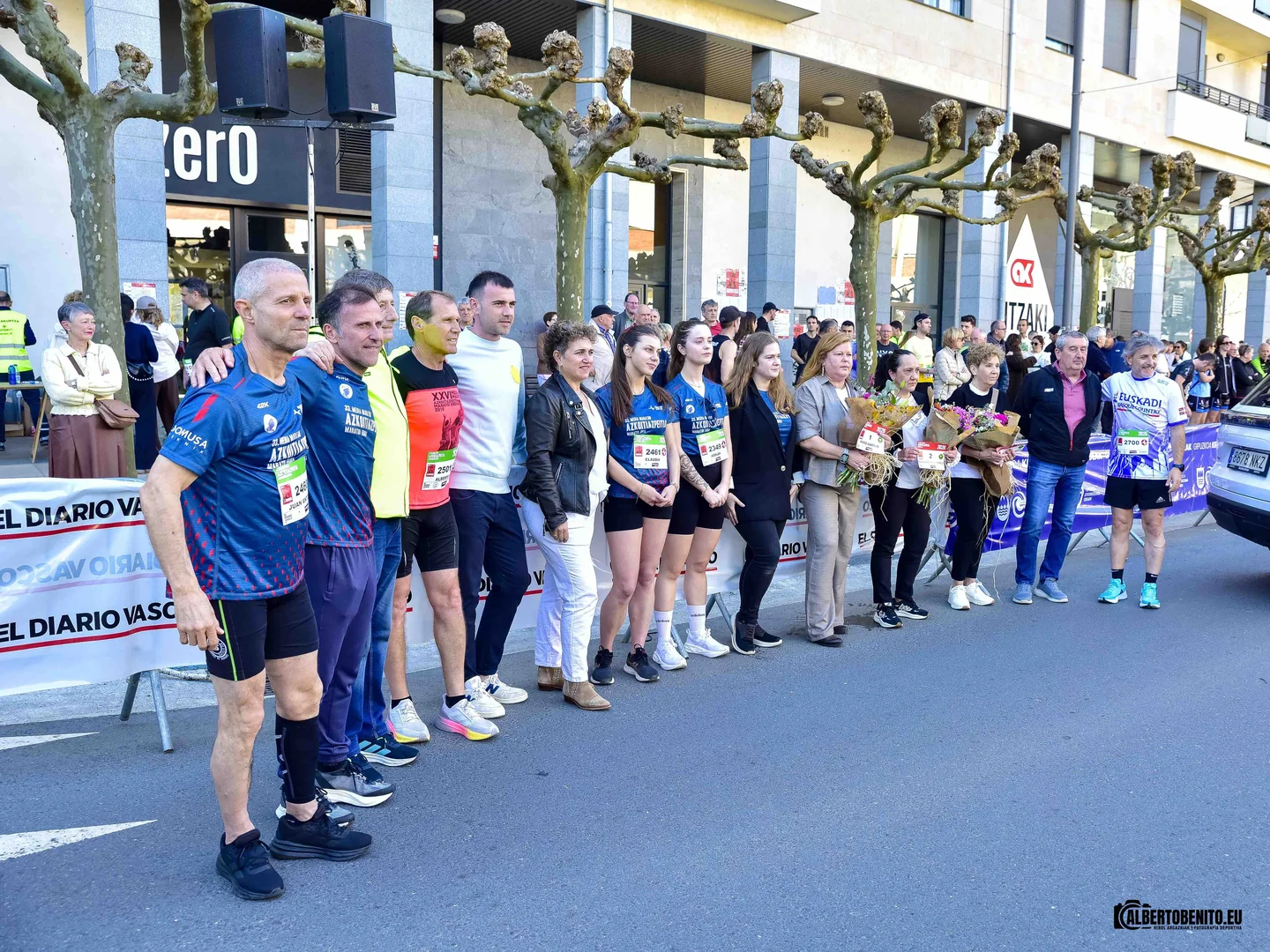
That tribute is especially important in a sport where memory sometimes dissolves among calendars and times. Here the opposite happens. The athlete’s personal story becomes collective heritage. The result is a race with roots, something increasingly valuable in a calendar full of correct but interchangeable events.
The symbolic dimension also helps explain why the race commands so much respect outside the Basque Country. It is not just about competing on a fast course, but about being part of a tradition that links generations of runners, organizers, and fans. That kind of continuity is felt in the small details: the way the race is talked about, the way the route is presented, the pride with which its history is mentioned.
One detail captures the character of the day: there is no minute of silence here. The organizers replaced it with a cultural act, and the idea came from the family itself. Josefa Corales, Diego’s mother, recalled how much her son loved music and folklore, and was glad to trade silence for dancing. Since then the tribute takes a different shape every year: an aurresku of honor, the community of trikitilaris, a local singer. In 2026 it was Sahatsa Dantza Taldea, marking its 50th anniversary, which followed the dance of honor with traditional dances from Gipuzkoa.
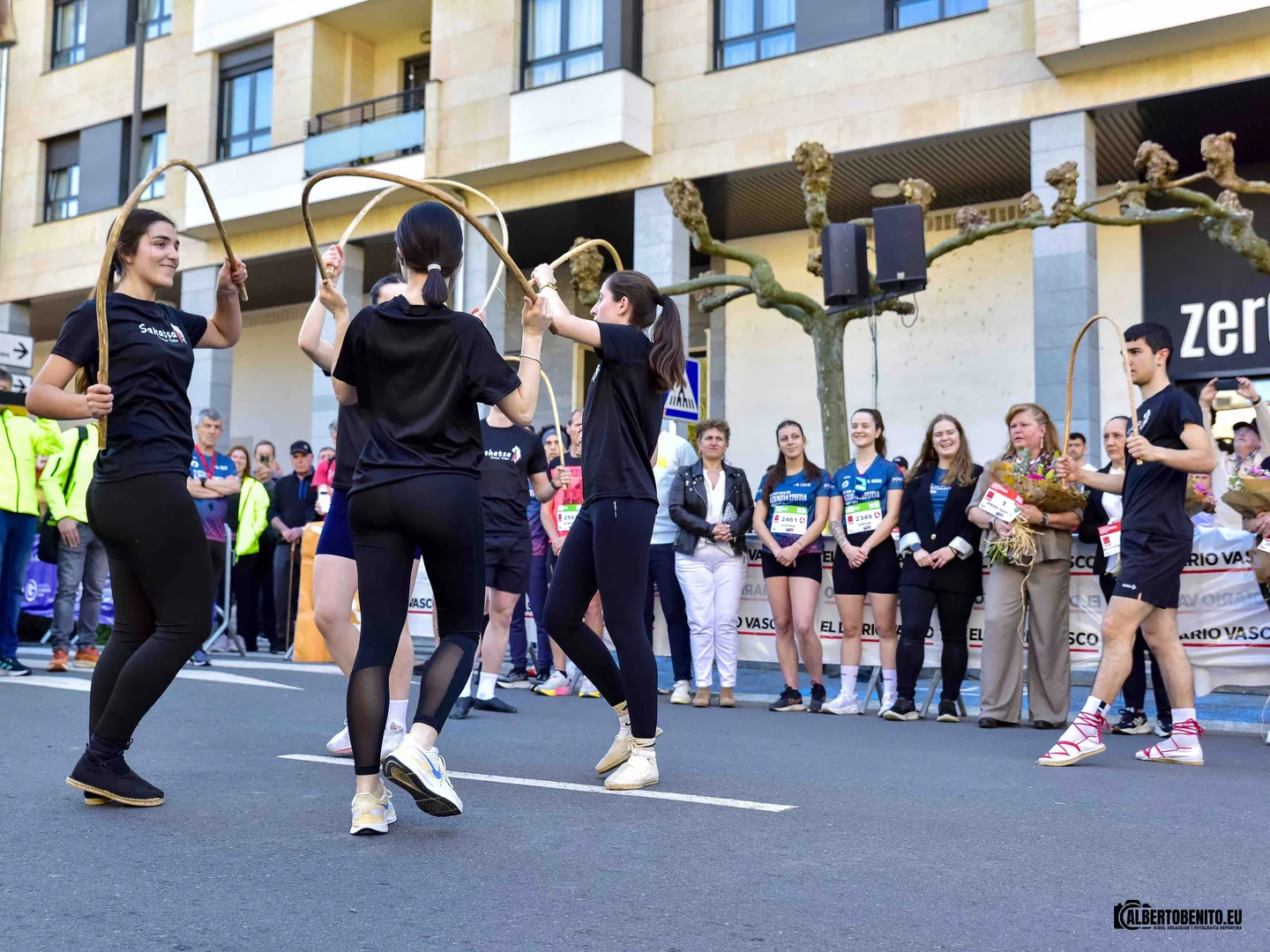
Behind all of it there is an entirely volunteer-run organization, and the family is still part of it. Manuel, Diego’s brother, drives the clock car; Carmen, his sister, spends the previous weeks packing the runners’ bags, shirt by shirt and bib by bib. It is a very physical way of understanding memory: not as something mentioned once a year, but as work that someone actually does.
In journalistic terms, few half marathons combine performance and memory so clearly. That is perhaps the key that sets it apart. There are fast races; there are emotional races; there are races with crowds. This one tries to be all of that at once and, for many years, has done so with remarkable solidity.
An event that still measures the pulse of Spanish distance running
The Azkoitia-Azpeitia international half marathon remains a useful mirror of the state of distance running in Spain. When a race keeps its relevance for decades, it does not do so by inertia. It does so because it still offers something necessary: a well-designed race, a recognizable identity, and an environment that does not reduce the runner to a simple bib number.
In 2027 it will once again move between those three axes: performance, memory, and atmosphere. And it will do so with the same logic that has kept it alive since 1994, supported by asphalt, territory, and a community that understands athletics as a celebration with demands. That makes it more than a half marathon: it makes it a reference.
In an increasingly crowded calendar, the races that endure are the ones that know how to stand out without artifice. The Azkoitia-Azpeitia does so with a favorable course, a recognizable organization, and a story that does not age. That is why it continues to generate interest among elite and recreational athletes alike, and why its next edition once again sits among the marked dates on the Spanish scene.
If road running has places where time seems to move differently, this is one of them. There the asphalt does not just measure kilometers: it also measures memory, character, and a way of understanding competition in which the crowd, the landscape, and tradition all push in the same direction.
The 2027 edition arrives with that legacy intact. And that, in a race, is worth as much as a bib and a stopwatch.
Where to stay in Azkoitia
Hotels available 18–21 March 2027.
Affiliate links: if you book through this map we earn a commission, at no extra cost to you.



How to prevent thigh chafing: causes and real solutions

Women’s running windbreakers: seven jackets and how to choose

Do more workouts get rid of soreness? A guide for runners

Jaén Half Marathon 2026: Record 3,800 Runners Registered

Men’s short running tights: how to choose the right pair

World Triathlon confirms data breach involving medical data

Izan Edo targets podium at Miyazaki World Cup

María Pérez ranks ninth in World Athletics’ 2026 top ten

Dos Santos, Duplantis and Sawe: World Athlete of the Year finalists

San Silvestre Vallecana 2026: 42,000 places, prices and start times

 Races4 months ago
Valencia Half Marathon 2027: date and registration

 Races4 months ago
Valencia Marathon 2026: entry, ballot and course

 Reviews and Comparisons4 months ago
Asics Gel-Roadmiles 3 for men: review and current price

 Reviews and Comparisons4 months ago
Asics Gel Sonoma 8 Gore-Tex: complete analysis for trail and rain

 Sneakers4 months ago
Saucony Endorphin Pro 4: full review and verdict

 News5 months ago
Strava API 2026: what changes for clubs, challenges and runner apps?

 Reviews and Comparisons5 months ago
Nike Alphafly 3: opinions, sensations, and real key points

 Reviews and Comparisons4 months ago
Under Armour running shoes review 2025-2026: models and key features

 Sports Equipment4 months ago
Shoe sizes in cm: a clear guide to getting the right fit for your footwear

 Sneakers3 months ago
Skechers GO RUN Consistent 2.0 analysis: comfort and limits

 News5 months ago
Valencia Marathon 2026 route: key tips to train and run better

 Sneakers4 months ago
Adidas Adizero Boston 13 for men: review and verdict