Races
Chicago Marathon 2027: date, drawing and fees
On 10 October 2027, the marathon of world records. The drawing has closed; results on 8 December: dates, fees and qualifying times.

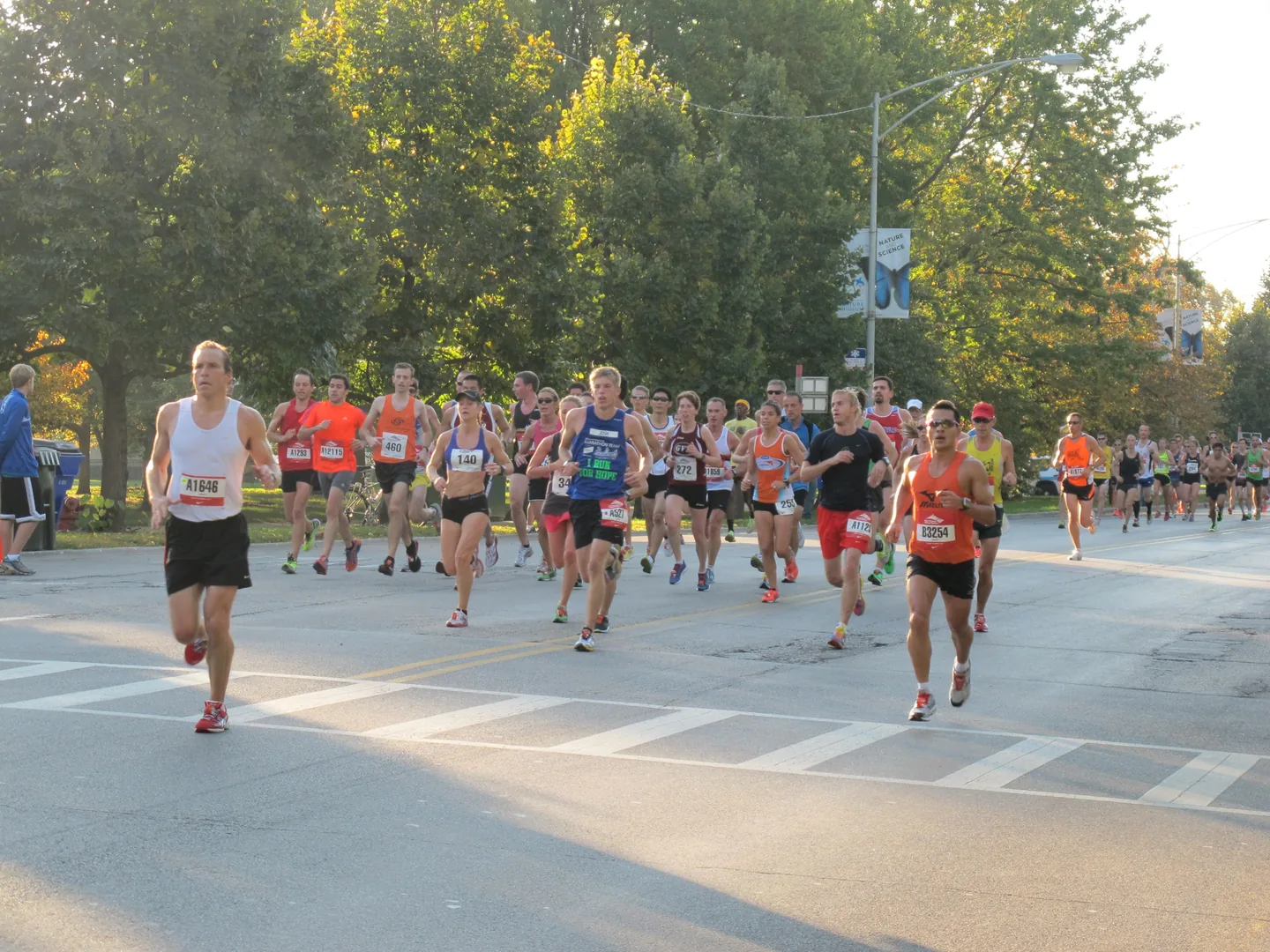
Photo: Benjamin Lipsman from Chicago, IL, USA / Wikimedia Commons (CC BY 2.0).
The 2027 Bank of America Chicago Marathon is on Sunday 10 October, its 49th running. It is one of the seven Abbott World Marathon Majors and probably the fastest of them all: flat, starting and finishing in Grant Park by Lake Michigan, and the scene of the last two marathon world records.
The drawing is now closed: the application window ended on Thursday 29 October 2026 at 2 p.m. Chicago time.
Key facts for 2027
- Date: Sunday 10 October 2027.
- Distance: 42.195 km (26.2 miles), a loop starting and finishing in Grant Park.
- Fee: $250 for US residents and $260 for everyone else. Applying is free: you only pay if you are selected.
- Organiser: Bank of America Chicago Marathon (chicagomarathon.com).
The dates that matter
- Applications: open from 8 October 2026 until 29 October 2026 at 2 p.m. Central Time.
- Guaranteed entries: approved applicants must pay by 10 November 2026.
- Drawing results: emailed on Tuesday 8 December 2026.
- Payment for selected runners: by Tuesday 15 December 2026, or the bib is lost.
Applying more than once does not help: duplicates are removed before the draw, and every application received in time has the same chance.
How to get a bib
- Drawing: for everyone without a guaranteed entry. The number of places is not fixed: it depends on how many guaranteed entries are issued first.
- Time qualifier: guaranteed entry with a time from a certified marathon run between 1 January 2025 and 29 October 2026. For ages 16 to 34, 2:50:00 for men and 3:20:00 for women and non-binary runners; the standards ease with age.
- Other routes: legacy runners with many finishes, the Chicago Distance Series, charity places and packages from authorised international tour operators.
Why it is so fast
The course is practically flat and runs through 29 neighbourhoods, from Lincoln Park to Chinatown, with few tight turns and wide avenues. In 2023 Kelvin Kiptum set the men’s world record here with 2:00:35, and in 2024 the women’s world record fell here too (2:09:56). For everyday runners, the key is the weather: in early October Chicago can be hot or cold, and the wind off the lake makes itself felt.
A practical tip: among the downtown skyscrapers, GPS watches go haywire in the first kilometres. Trust the distance markers and the pace bands more than your watch.
Logistics for international runners
- Bib collection: at the runners’ expo in the days before the race. In person.
- Where to stay: downtown, the Loop and South Loop are a short walk from the start. We will publish an accommodation guide with real prices a few months before the race.
- When to arrive: Thursday or Friday, to collect your bib and adjust to the time difference.
From north to south: the shape of the course
The route passes through different areas of Chicago before returning to the finish park. Its loop heads north along Sheridan Road, turns west along Damen Avenue and reaches as far south as 35th Street. It is a useful way to place the race on the map, although the route details should be checked against the final map for the event.
The neighbourhoods it passes through include Lakeview, Greektown and Pilsen. The course offers a chance to see different parts of the city while running, but the name of a neighbourhood alone does not tell you exactly which street the race will take or where you can cross. Those details depend on the map and access information published by the organisers.
For family and supporters, the map also helps with planning journeys between viewing points. It is worth distinguishing the runners’ route from the access routes available to the public and checking transport and road closure information before deciding where to watch.
A favourable elevation profile that still calls for consistent pacing
A profile with few significant hills makes it easier to maintain a relatively steady effort, but it does not eliminate the fatigue of a marathon. Without major climbs and descents constantly changing the effort required, runners spend a long time repeating the same movement and sustaining a similar load. Endurance at a steady effort therefore becomes especially important.
The density of runners can also affect how you execute your race, especially at the start. Not having enough space to run at exactly your planned pace does not mean you have to make up the time immediately: sudden changes in speed and constant overtaking can add to the effort. It is better to assess how the race develops as the field begins to spread out.
Your planned pace should remain a guide, not an unchangeable obligation. If conditions on the day make it difficult to maintain, paying attention to your perceived effort can help you make decisions. A race on favourable terrain still requires you to save energy for the final stages.
Guaranteed entries: what to check before applying
The entry programmes include an option for those who can provide evidence of five finishes in Chicago in ten years. A route related to the cancellation of a 2026 entry is also mentioned. In both cases, it is important to check the conditions and whether the application has been accepted, rather than assuming your race entry is confirmed simply because you believe you meet the requirements.
Charity places have their own conditions, which should be checked directly before making a commitment. For operators, it is worth checking that they are listed as authorised agencies and understanding how registration is handled: the operator may manage it, or the runner may need to complete the process following their instructions.
An accepted application and a completed registration are not necessarily the same step. Checking your status on the relevant portal and keeping your communications helps distinguish between having started the process and having a confirmed place. An additional processing fee is also mentioned alongside the entry fee, so it is worth checking the breakdown before paying.
How to prepare to sustain marathon pace
Preparation can start from your recent training volume, without automatically copying a plan used for another race. Easy runs, the long run, specific sessions and recovery serve different purposes; their combination should suit each runner’s experience and training consistency, not just the time they hope to achieve.
Marathon-pace blocks are sections of training in which you practise running at a speed close to your planned race pace. They help you become familiar with that effort and observe how well you sustain it as the kilometres add up. There is no need to turn every run into a test of your goal: comfortable runs are also part of preparation.
The long run also provides an opportunity to rehearse race-day decisions, from clothing to how you drink on the move. Training can include a start with limited space to practise a controlled beginning, without relying on being able to find your desired pace from the first few metres.
Training in summer without losing sight of effort
Preparation for an October race can coincide with the warmest months in Spain. In that context, the same speed does not always require the same effort as it would on a cool day. Adjusting the session to the conditions is a way to preserve its purpose, not a sign that your race goal is no longer valid.
Heart rate and how you feel can provide information alongside pace, although no single measure fully describes how a runner is responding. Heat, rest and accumulated training load are all part of the context. That is why it is more useful to observe how training develops than to draw conclusions from one demanding session.
Choosing cooler times of day and adapting the route are general options for training more comfortably. If you experience symptoms or discomfort that cause concern, general information is no substitute for an assessment by a healthcare professional. Pushing through a session to meet a number on your watch should not take priority over your health.
Fuel and hydration: practise beforehand and check the map
Practising hydration on long runs helps you learn what it is like to drink while running and which products you normally tolerate. The same applies to fuelling: trying what you plan to use beforehand reduces the need to improvise during the race. There is no universal approach that suits everyone equally.
The locations of the aid stations and the services available should be checked in the information specific to 2027. The official map will be the reference for finding them and planning how to use the drink stations. Until it is published, it is best not to assume that the layout or products will be identical to those at another edition.
Reasonable planning combines what you have practised in training with the actual conditions on the day. If you have questions related to digestive problems, health or particular nutritional needs, consult a healthcare professional: general advice is no substitute for individual guidance.
Timings, access and decisions before the trip
The available information puts the start at 7:30 and mentions a limit of 6 hours and 30 minutes. Both details should be checked against the current 2027 rules, especially because times and limits may depend on the category or instructions applicable to each participant.
Before booking travel, it is prudent to check that your race entry has been accepted and review the cancellation terms of any services you book. It is also worth checking the documentation needed to enter the United States and keeping your travel and registration confirmations accessible.
Closer to the race, the access map, bag drop arrangements and official timings will help complete your plans for the morning. Preparing your journey and the kit you will take in advance leaves the day before free for rest, without having to resolve last-minute questions that depend on the organisers.
Chicago in the history of the Majors
The Abbott World Marathon Majors series began in 2006 with the aim of promoting marathon running and increasing interest in the distance. For those travelling to Chicago as part of a project involving several international races, each event requires attention to its own entry process and logistics, as well as preparation for the kilometres.
The Six Star Finisher Medal recognises those who complete the original series of six races. It is an award linked to that group of marathons, not to your placing in Chicago. The conditions and scope of the awards should be checked in the series’ current information, which may evolve as new races are added.
Frequently asked questions
When is the 2027 Chicago Marathon?
Sunday 10 October 2027.
Can I still apply for the drawing?
No. Applications closed on Thursday 29 October 2026 at 2 p.m. Chicago time. Results arrive on 8 December.
How much does it cost?
$260 for runners who do not live in the US. Applying is free.
Dates, fees and conditions may change: the official race website is always the reference.



How to prevent thigh chafing: causes and real solutions

Women’s running windbreakers: seven jackets and how to choose

Do more workouts get rid of soreness? A guide for runners

Jaén Half Marathon 2026: Record 3,800 Runners Registered

Men’s short running tights: how to choose the right pair

World Triathlon confirms data breach involving medical data

Izan Edo targets podium at Miyazaki World Cup

María Pérez ranks ninth in World Athletics’ 2026 top ten

Dos Santos, Duplantis and Sawe: World Athlete of the Year finalists

San Silvestre Vallecana 2026: 42,000 places, prices and start times

 Races3 months ago
Valencia Half Marathon 2027: date and registration

 Races3 months ago
Valencia Marathon 2026: entry, ballot and course

 Reviews and Comparisons4 months ago
Asics Gel-Roadmiles 3 for men: review and current price

 Reviews and Comparisons4 months ago
Asics Gel Sonoma 8 Gore-Tex: complete analysis for trail and rain

 Sneakers3 months ago
Saucony Endorphin Pro 4: full review and verdict

 News5 months ago
Strava API 2026: what changes for clubs, challenges and runner apps?

 Reviews and Comparisons5 months ago
Nike Alphafly 3: opinions, sensations, and real key points

 Reviews and Comparisons4 months ago
Under Armour running shoes review 2025-2026: models and key features

 Sports Equipment4 months ago
Shoe sizes in cm: a clear guide to getting the right fit for your footwear

 Sneakers3 months ago
Skechers GO RUN Consistent 2.0 analysis: comfort and limits

 News5 months ago
Valencia Marathon 2026 route: key tips to train and run better

 Sneakers4 months ago
Adidas Adizero Boston 13 for men: review and verdict