Races
The Doñana Challenge: complete guide to the Matalascañas triathlon
The Andalusian event once again brings together swimming, biking, and sand in a triathlon of enormous toughness and a unique landscape.

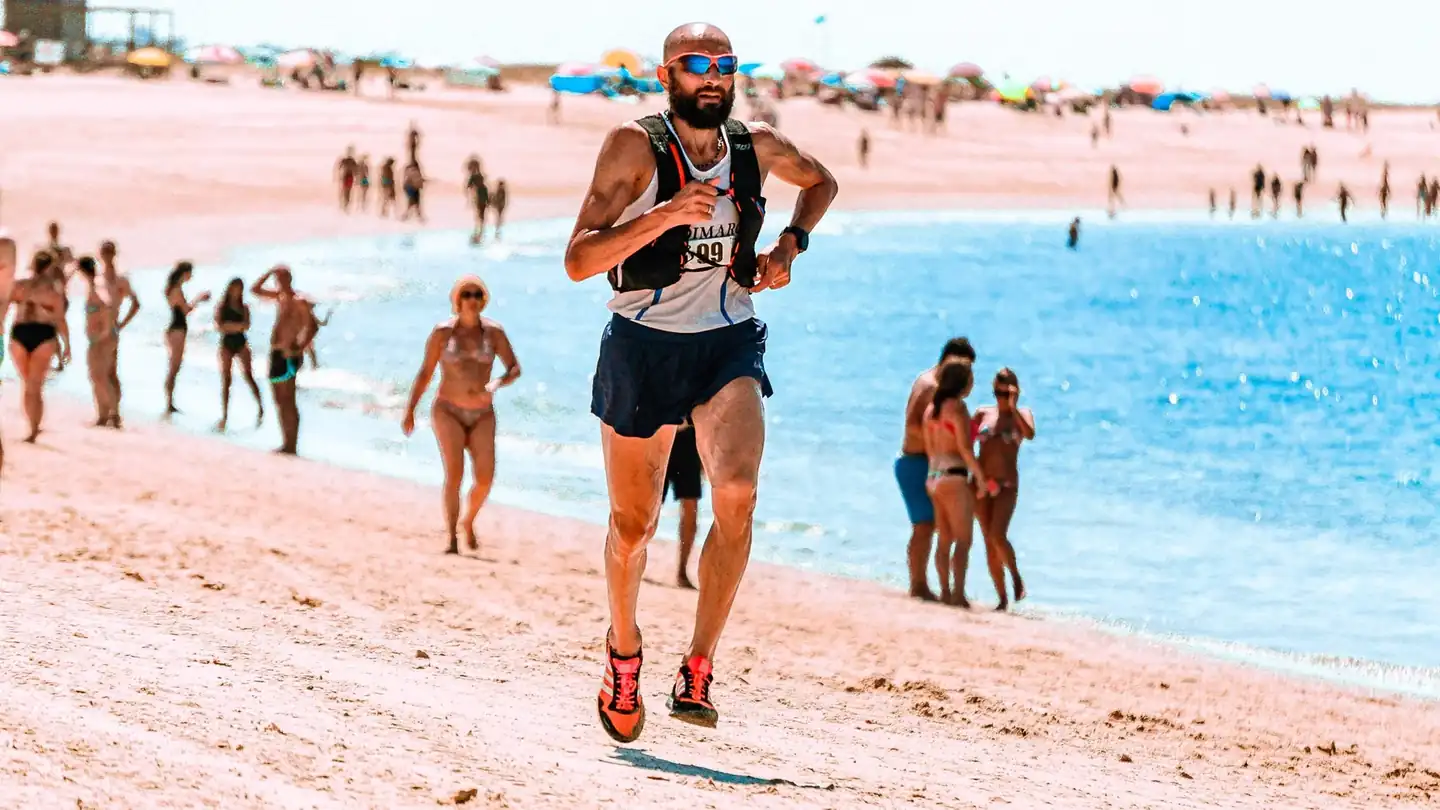
Desafío Doñana has established itself as one of the most unique triathlon events in Spain: tough, scenic, and with a very strong identity shaped by the territory that hosts it. The start on the Huelva coast, the cycling section through the countryside of Cádiz, and the final run over the sand of Matalascañas draw a course unlike any other competition on the national calendar.
Its appeal lies not only in the sporting challenge. There is also the symbolic value of competing on the edge of a protected area, with Doñana National Park as a backdrop, in an event that mixes heat, wind, humidity, sand, and strategy. In 2025, the race once again left a highly recognizable image: a middle-distance triathlon that demands a cool head and strong legs from the very first kilometer to the last meter.
A competition with its own identity in Spanish triathlon
The uniqueness of this competition comes from its format and its setting. It is neither a conventional triathlon nor a race that simply aims to rack up kilometers. The sequence of disciplines, the coastal environment, and the constant presence of sand turn each edition into a kind of sports survival test, where effort management matters as much as raw power.
The event was born in 2009 and has since remained a benchmark for Andalusian and Spanish triathlon. Over the years, the course has changed, adapted to different organizational and weather conditions, and modified sections to improve safety and logistics, while never losing its essence. That continuity explains why the event’s name has become associated with a very specific experience, almost a signature within the calendar.
The 2025 edition once again put the spotlight on Matalascañas, with a course that combined swimming, cycling, and running in an environment of immense environmental harshness. Heat was one of the decisive factors, as is often the case in a competition held in an open, exposed landscape with very little room for mental rest. Here every detail matters: hydration, pacing, navigation, and the ability not to burn out too early.
A course that punishes and seduces in equal measure
The profile of this race explains much of its reputation. The competition has varied in distance depending on the edition, but its competitive logic has always been the same: start with a demanding swim, continue with a fast but treacherous cycling segment, and finish with a run in which the sand completely changes the equation. The body responds one way, but the terrain forces another.
In 2025, the swim took place on a circuit near Torre de la Higuera, with 1.9 kilometers in the water. Then came the bike, with 74 kilometers over two laps on the road between Matalascañas and Mazagón. The finish was 20 kilometers on foot along the beach of Matalascañas and through Doñana, a stretch in which the high tide, the temperature, and the texture of the ground multiplied the strain. Running on soft sand not only hurts pace; it also forces constant muscular tension that drains the legs as if each stride weighed more than the last.
Historical editions have featured longer courses and other transition formats, but the common trait has always been the same: the bike and the run are designed to test real endurance, not just speed. In the early years, the cycling leg was much longer and hillier, passing through Arcos de la Frontera, before the organizers eventually settled on a more stable format better suited to the current coastal area. That evolution helps explain the maturity of the event, which has refined its identity without losing it.
Sanlúcar, Matalascañas, and the landscape as part of the race
The territory here is not just scenery; it is an active part of the outcome. The history of Desafío Doñana is linked to Sanlúcar de Barrameda, the Guadalquivir estuary, and the Atlantic strip that separates and connects Cádiz and Huelva at the same time. It is a route where the landscape truly matters: brackish water, crosswinds, the sticky humidity of the coast, and the wide stretches of sand all force athletes to read the environment carefully.
Matalascañas beach adds another layer of difficulty. At first glance it may seem like an open and easy stretch, but in reality it requires a very specific running technique. Footstrike changes, the ankle works overtime, and stride economy quickly falls apart. In a marathon or half marathon on asphalt, the runner fights fatigue; here, they also fight the ground. And that nuance explains why the second half of the race is often so unpredictable.
The competition also has a very powerful visual dimension. Images of triathletes moving across wet sand with the Atlantic horizon in the background are now part of Andalusian sporting imagery. It is no coincidence that the race attracts athletes, families, visitors, and fans alike. The landscape sells itself, yes, but it also demands respect. Competing there means understanding that the spectacle depends on a fragile ecosystem that does not forgive carelessness.
The 2025 edition: heat, toughness, and hard-earned victory
The 2025 race followed a familiar script for anyone who follows middle- and long-distance triathlon: measured effort at the start, natural selection on the bike, and a final run where good legs are no longer enough because the environment gradually takes them away. Emilio Tizón won the men’s category in a time of 3:45:29, while Patricia Bueno repeated her victory in the women’s race with 4:32:05.
Beyond the times, the day was defined by the environmental conditions. The heat made the run into an especially harsh part of the triathlon. When the tide comes in, the sand changes consistency and the effort multiplies. Added to that was the presence of spectators along the coast, a factor that brought some color and support to a stretch that, by its nature, is usually quite solitary.
The men’s podium was completed by Christian Villazala and Alejandro Cañas, while in the women’s race María del Pilar Ayuso and Rocío Muñoz joined Bueno on the podium. That combination of names confirms a common pattern in this competition: victory does not go to the athlete who pushes hardest at the start, but to the one who manages accumulated fatigue best. In a race of this kind, the final clock measures not only speed; it also measures patience, tolerance to heat, and the ability to keep going when the legs are already asking for relief.
The role of middle distance and its recent evolution
Middle distance suits the character of Desafío Doñana because it allows for a prolonged endurance race without falling into the extreme length of other long-distance events. It is a format that demands aerobic base, but also tactical awareness. The triathlete must pace their energy over several hours and, at the same time, preserve something for the final section, the one that usually decides positions and sensations.
In 2025, the field brought together 148 triathletes, a smaller number than in some other stages of the race’s history, but enough to maintain a high competitive level and significant organizational demands. Previous editions had shown larger numbers, with men’s, women’s, and relay participation, although the event has evolved to fit different contexts. That flexibility is part of its survival.
The Andalusian Triathlon Federation itself classifies it as middle or long distance depending on the year’s context, and that reflects something important: this is not just a race, but an event that has known how to reshape itself. Modern triathlon is full of formats, but few have such a clear identity. Here, distance serves above all to amplify the experience of the terrain.
What changes on the bike and why speed is not everything
The cycling segment often seems the most forgiving from the outside, especially because it takes place on asphalt and in a relatively flat area. However, that apparent ease can be misleading. In Matalascañas and its surroundings, wind, heat, and the lack of major visual references turn the bike into a phase of constant wear. Going fast does not always pay off; sometimes the key is going hard enough without emptying the tank before the sand.
The 2025 edition was contested over 74 kilometers of cycling in two laps, a format that helps structure the race but does not make it any less demanding. In previous editions, the course has varied across different configurations, with a major change compared with the early years, when the route was longer and harder due to elevation gain. That transformation brought competitive stability without erasing the race’s personality, which remains more selective than other middle-distance events.
In triathlon, the bike usually acts as the bridge between the swim and the run. In Desafío Doñana, that bridge is especially sensitive because the effort that follows does not take place on a neutral circuit, but on sand. A triathlete who pushes too hard on the asphalt pays for it twice later. That is why this race rewards those who understand the language of fatigue better than the language of immediate spectacle.
The run: where the race reveals its true face
The final stretch on the beach is the moment when the competition shows its harshest side. Aerobic capacity is not enough. You have to maintain balance, find the firmer band of sand, and accept that the ideal asphalt pace simply does not work here. The stride shortens, the calf and soleus muscles load up sooner, and the body enters into a constant negotiation with the terrain.
In several editions, the organizers have adapted the course to an out-and-back format to reduce the impact of the wind and allow for a greater spectator presence at certain points. That decision, besides being logistical, also makes competitive sense: it helps make the race more legible for spectators without taking away its difficulty. The beach is still the beach, with its changing textures, uneven moisture, and unstable surface.
Anyone who reaches this section in a good position does not have victory guaranteed, but they do have a real chance to hold on. Anyone who arrives broken must manage every meter. That is why Desafío Doñana is so memorable: because in the final part there is no artifice, only a harsh conversation between athlete and sand. Few events offer such a clear metaphor for triathlon as a sport of total endurance.
An event that also matters to the local economy
The impact of Desafío Doñana goes beyond the competition itself. Holding the event usually means business for hotels, restaurants, and local services, especially in Matalascañas and Almonte. In 2025, the authorities present highlighted precisely that economic return during a time of year when tourist traffic is lower than in peak summer.
That effect is common in sporting events that combine tourist appeal and media exposure. The athlete arrives, but so does their entire circle: families, coaches, companions, fans, and the curious. A triathlon like this does not just move stopwatches; it moves bookings, occupancy, and public conversation. In an area with such strong natural value, that relationship between sport and destination carries particular weight.
The coexistence of competition and environment is, in fact, part of the race’s narrative. Respect for Doñana National Park and its surroundings is not a decorative label, but a condition of legitimacy. That is why the event repeatedly emphasizes awareness and responsible behavior among participants. The image of a spectacular race only holds if the landscape is still there to support it.
What makes racing in Doñana so difficult
The real difficulty does not come from a single factor, but from the sum of many small obstacles. The heat dries you out early, the humidity is oppressive, the bike wears you down through accumulation, and the final run removes any remaining comfort. Even the presence of spectators, which in other races can be a constant boost, appears only intermittently here because of the nature of the course.
There is also the sense of isolation in some sections. The beach, beautiful as it looks, can become a very long mental straightaway. The triathlete does not find as many external stimuli as in an urban circuit or as many references as in a road race. That demands near-surgical concentration. A pacing mistake, overexertion on the bike, or poor hydration management is paid for with interest on the final stretch.
That is why Desafío Doñana holds special prestige among specialists. It is not just about finishing; it is about surviving with technical dignity in an environment that gives nothing away. In a discipline full of tough races, this one still stands out for the way it turns the landscape into both adversary and protagonist.
Desafío Doñana’s place in the Spanish calendar
Its importance on the calendar is explained by its ability to bring together three qualities that rarely appear together so strongly: difficulty, beauty, and symbolism. It is neither a mass participation event like other urban races nor a purely extreme challenge. It occupies a very valuable middle ground, that of competitions that show fans just how much triathlon depends on context.
In 2026, moreover, the national calendar of the Spanish Triathlon Federation once again placed the Matalascañas event in a prominent position, as the Spanish championship of long distance and aquabike, within the framework of Desafío Doñana itself. That kind of recognition does not happen by chance. It reflects the consolidation of a race that is now more than a date: it is a major benchmark in Spanish triathlon.
The race also serves as a showcase for Andalusian triathlon. It brings together athletes, institutions, and federations in an environment that neatly sums up the region’s sporting diversity: coast, climate, natural heritage, and an organizational tradition that has matured over the years. Few competitions manage to make the territory weigh so heavily in the memory of the result.
A race remembered for what it forces you to feel
Desafío Doñana leaves no neutral impression. Those who experience it from within usually remember the heat, the wind, the unforgiving sand, and the feeling that the finish line gets a little farther away every time the ground softens. Those who follow it from the outside mostly retain the image of a very physical triathlon, very open, and almost elemental in its relationship with nature.
That is perhaps its greatest journalistic and sporting virtue: it needs no embellishment to explain why it matters. The combination of history, setting, and toughness is enough to place it among the most recognizable events in Spanish triathlon. And as long as the calendar continues to reserve it a place, Matalascañas will remain a place where endurance is measured not only in watts, strides, or heartbeats, but in the ability to live with a landscape that demands, watches, and decides.
In the end, that is the reason the race retains so much personality. It does not merely measure times; it measures adaptation. And in triathlon, as in few other disciplines, adapting to the terrain is almost the same as understanding it.



How to prevent thigh chafing: causes and real solutions

Women’s running windbreakers: seven jackets and how to choose

Do more workouts get rid of soreness? A guide for runners

Jaén Half Marathon 2026: Record 3,800 Runners Registered

Men’s short running tights: how to choose the right pair

World Triathlon confirms data breach involving medical data

Izan Edo targets podium at Miyazaki World Cup

María Pérez ranks ninth in World Athletics’ 2026 top ten

Dos Santos, Duplantis and Sawe: World Athlete of the Year finalists

San Silvestre Vallecana 2026: 42,000 places, prices and start times

 Races3 months ago
Valencia Half Marathon 2027: date and registration

 Races3 months ago
Valencia Marathon 2026: entry, ballot and course

 Reviews and Comparisons4 months ago
Asics Gel-Roadmiles 3 for men: review and current price

 Reviews and Comparisons4 months ago
Asics Gel Sonoma 8 Gore-Tex: complete analysis for trail and rain

 Sneakers3 months ago
Saucony Endorphin Pro 4: full review and verdict

 News5 months ago
Strava API 2026: what changes for clubs, challenges and runner apps?

 Reviews and Comparisons5 months ago
Nike Alphafly 3: opinions, sensations, and real key points

 Reviews and Comparisons4 months ago
Under Armour running shoes review 2025-2026: models and key features

 Sports Equipment4 months ago
Shoe sizes in cm: a clear guide to getting the right fit for your footwear

 Sneakers3 months ago
Skechers GO RUN Consistent 2.0 analysis: comfort and limits

 News5 months ago
Valencia Marathon 2026 route: key tips to train and run better

 Sneakers4 months ago
Adidas Adizero Boston 13 for men: review and verdict