Races
Hyatlón H6 La Nucía 2026: date and registration
Two days of running and strength in Alicante: confirmed event details and what competitors still need to check.

La Nucía will host a Hyatlón competition on October 24 and 25, 2026, using the H6 format at the announced venue, La Nucía Combat Sports Center, next to the Camilo Cano sports complex. Saturday is designated for individual competitors, with doubles and relays on Sunday. ParaHyatlón is also included in the event announcement, although the available information does not specify its schedule.
The event combines running with functional exercises inside a sports venue. This is neither a conventional road race nor a triathlon involving swimming and cycling: its demands come from alternating endurance and strength. The H6 format is described as six one-kilometer runs and six workout stations. Start times, division-specific weights and other operational details still need confirmation in the documents for this particular event.
The location deserves attention because some secondary listings place the event in Polop or describe it as a race taking place only on October 24. The organizer’s announcement instead identifies La Nucía as the host municipality and sets out a two-day program. When arranging travel, the most reliable reference is the named sports center, rather than the town assigned by a race calendar aggregator.
There is also a distinction between the Arena name appearing in some searches and the venue identified in the announcement. The supplied information explicitly names the Combat Sports Center; it does not establish that another facility with a similar name is the competition venue. In a municipality with several sports facilities, that detail can make the difference between finding the event and arriving at the wrong entrance.
The calendar clearly separates the commitments for each type of participant. Saturday, October 24 is allocated to individuals, with doubles and relays on Sunday, October 25, according to the published program. That distinction matters when booking accommodation, planning arrival and coordinating a partner or team. The available material does not confirm a start time, so it cannot support a reliable estimate of when competition will finish either.
The absence of a timetable does not mean every division will start together, nor does it reveal how starts will be organized. In an event with shared workout stations, access to the course affects both the competition experience and the logistics. Start-slot allocation, accreditation collection and any preliminary checks are separate from the overall event date: knowing which day to compete is not the same as knowing the full schedule.
Hyatlón is presented as a hybrid sport included in the calendar of the Spanish Triathlon Federation. That connection places the event within a federation sporting framework, but it does not justify importing rules from other gym-based competitions. Stations may look very similar across different sports; divisions, valid movement standards and the way work is shared can still differ from one discipline to another.
For a regular runner, the difference becomes apparent as soon as the first running segment ends and the strength work begins. In a continuous race, pace may settle over several kilometers; here, each station introduces a different muscular and breathing demand. The six kilometers of running described for H6 should not be treated like a road 6K: they belong to a sequence in which athletes return to running after pushing, jumping or carrying weight.
The secondary description of the format adds a finishing sprint to those six segments. Without a stated distance for that final effort or a definitive course map, it would be inaccurate to present an exact overall distance. The useful baseline is six one-kilometer running segments, alternating with functional work. The indoor layout, station approaches and instructions governing movement around the venue will also shape how the competition unfolds.
The station order in the reference information begins with 1,000 meters on the SkiErg, followed by a 50-meter sled push and 80 meters of burpee broad jumps. It then lists 1,000 meters of rowing, 100 meters of sandbag lunges and 100 wall balls. These are measurements from the described format, not a guarantee of the weights or adaptations that will apply to every competitor in La Nucía.
The SkiErg is an exercise machine that reproduces a pulling motion similar to cross-country skiing. It brings arm and trunk work into a competition in which running plays a major role. The 1,000 meters on the ergometer refer to the distance recorded by the machine, rather than travel across the sports hall. The same distinction applies to rowing and helps make sense of the published quantities.
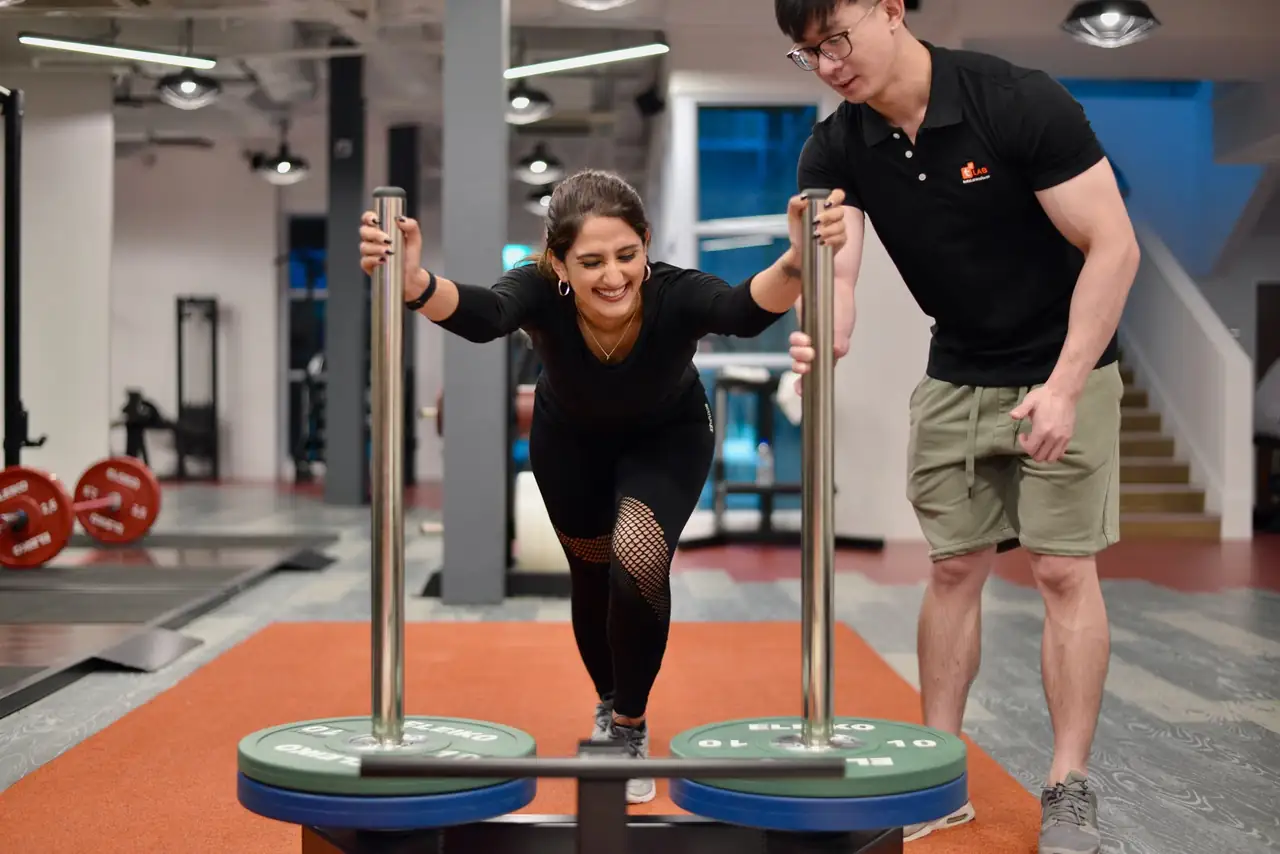
The sled push presents a different task: moving a load across the floor with the hands on a frame and the body leaning forward. The stated 50 meters describe how far it must travel, not how much it weighs. The weight assigned to each division is essential to assessing the actual difficulty. Weight alone does not determine the effort either, because contact between the sled and the surface affects resistance.
Burpee broad jumps combine a movement down to the floor with a forward jump. Unlike a station measured only in repetitions, the H6 description sets an 80-meter distance here. Fatigue is not limited to the legs: repeated changes of position and whole-body involvement increase the demand. Valid movement standards depend on the rules, so requirements concerning contact points, lines or penalties should not be invented.
At the rowing station, the 1,000 meters are again measured on an ergometer. The movement uses the legs, trunk and arms and comes after several accumulated efforts. To someone accustomed to running, it may look like a break because the impact of foot strikes disappears; that is not necessarily the case. The cardiovascular work continues, even as posture and muscle involvement change. The next run will reveal how much effort was spent there.
Sandbag lunges add 100 meters of loaded movement in the described format. Distance alone is not enough: the applicable weight and the execution standards set by the organizer also matter. Wall balls combine a leg-bending movement with throwing a ball toward a target. The 100 prescribed repetitions must be understood alongside the technical requirements; counting attempts is not always the same as completing valid repetitions.
The event announcement includes individual, doubles, relay and ParaHyatlón options, but these are not interchangeable. In the individual event, the athlete tackles the competition as a solo participant. The references also mention Open, Elite and age groups, without providing all eligibility requirements. Choosing a division affects both entry and the interpretation of the challenge; a recent five- or ten-kilometer race time cannot settle that choice on its own.
For doubles, the available official description states that both partners compete together throughout the course and jointly complete running segments, access sections, stations and the finish. This should not be confused with a format in which each person takes part only during one section. Competing as a pair requires coordination, but the supplied material does not explain how every set of repetitions is divided or which specific rules apply at each station.
Relays are presented as a team format, with clubs, gyms and other groups among the intended participants. However, the available information does not establish team size or assign a particular distance or station to each member. The division of work within a team must follow the rules for this event. Assuming that it works like a track relay or another hybrid competition could lead to entering on the basis of incorrect conditions.
ParaHyatlón is explicitly included among the announced options and described as a format for athletes with disabilities under established technical and competition criteria. That confirms its inclusion but does not specify classifications, adaptations, permitted assistance or scheduling. Adapted participation requires dedicated information: it would be inaccurate to assume that every station is performed identically or that a particular adaptation is permitted without supporting documentation.
The available entry fees come from a secondary reference dated July 29, 2026: individual entry from €69, doubles from €119 and relays from €129. These are historical indicative prices, useful for framing a budget but not verified current charges. The word from does not guarantee that every division costs the same, nor does it establish that those prices will remain available during October.
For doubles and relays, the supplied information does not adequately clarify the charging unit or everything included. It would therefore be inappropriate to automatically divide €119 between two people or split €129 among an assumed number of teammates. The final entry price depends on the conditions displayed by the registration platform when selecting a format and division. There is also no reliable basis for adding discounts, processing charges or supplements.
Hyatlón’s general announcement advertises open registration, but the available material does not provide a specific, current check of places in each La Nucía division. There is no verifiable entry deadline or confirmed number of remaining race places. Availability within each format must be distinguished from the overall calendar status; an announced event does not guarantee that every start slot or division is still accepting entries.
Specific conditions for entry transfers, refunds, required documentation and any federation-related eligibility requirements are also missing. The connection with the Spanish Triathlon Federation does not establish that a particular license is mandatory or that a one-day license is included in the price. Participation requirements must be grounded in the rules and registration process, rather than assumptions based on other events in the same sporting environment.
The announced venue places the competition next to the Camilo Cano sports complex in La Nucía, within Alicante province. This is the most consistent geographical reference for planning travel from elsewhere in the Valencian Community. The supplied documents do not confirm a specific entrance, reserved parking or an event transport arrangement for participants. The complex name locates the area but does not replace operational directions issued for the competition.
Some secondary references give distances and journey times from Alicante or Valencia that should not be treated as dependable arrival calculations. Starting point, route and traffic can substantially change the journey. It is more useful to distinguish between location and travel time: the former is announced, while the latter depends on personal circumstances and conditions on the day. There is insufficient evidence to promise a public transport connection to the venue entrance either.
The two-day schedule affects Saturday competitors differently from those taking part on Sunday. A doubles pair must coordinate both partners’ attendance; a relay team must bring together everyone required by its format. Without accreditation or start times, the necessary logistical buffer remains uncertain. Booking solely from a listing that mentions October 24 could overlook Sunday, the very day allocated to doubles and relays.
A sports venue offers a different setting from an urban road race, but it does not remove every environmental variable. Travel, waiting periods and outdoor areas remain exposed to late-October weather. Indoors, ventilation and the concentration of participants also matter. There is no verifiable weather forecast in the supplied documents, so attaching a specific temperature to the weekend would add apparent precision rather than confirmed information.
From a training perspective, this event tests the ability to resume running after muscular effort. A continuous-race result provides evidence of endurance but cannot predict the outcome on its own. A fast runner may struggle to move the sled, while an athlete familiar with heavy loads may lose time on every kilometer. The transition between efforts is the thread connecting the stations and explains much of the format’s identity.
Pace takes on a different meaning too. A speed that feels comfortable during the opening kilometer of a conventional race may become unsustainable after jumps, lunges and pushes accumulate. Conversely, spending too long at the stations extends the event even when the running segments are fast. Managing accumulated effort matters more than an isolated watch reading, and there is no universal pace recommendation that can be made without knowing the athlete.
With competition approaching, sessions involving unfamiliar movements and heavy loads can add fatigue or discomfort without guaranteeing useful improvement. Technical familiarity, recovery and individual tolerance of exertion make more sense than trying to compress an entire preparation period into a few days. This is a general consideration, not a personalized prescription. Pain that changes movement, dizziness or symptoms such as chest pain should not be treated as a normal part of the competitive challenge.
Personal equipment also needs to be considered in light of the event’s mixed demands. A shoe that feels comfortable for running does not necessarily offer the same stability during a push or a loaded lunge. That tension between cushioning and support explains why equipment choices cannot be based on mileage alone. Even so, there is no confirmed mandatory equipment list in the supplied information, nor a basis for claiming that gloves or other accessories are permitted.
La Nucía therefore offers a clearly identifiable event for runners seeking a different kind of competition: two days of activity, six stations as the H6 reference and several participation formats. The essentials have been announced; conditions directly affecting each entry still require specific reading. The value of confirmed information lies in separating those layers: date and venue establish the event, while the rules and final schedule explain what each competitor must do after crossing the start line.



How to prevent thigh chafing: causes and real solutions

Women’s running windbreakers: seven jackets and how to choose

Do more workouts get rid of soreness? A guide for runners

Jaén Half Marathon 2026: Record 3,800 Runners Registered

Men’s short running tights: how to choose the right pair

World Triathlon confirms data breach involving medical data

Izan Edo targets podium at Miyazaki World Cup

María Pérez ranks ninth in World Athletics’ 2026 top ten

Dos Santos, Duplantis and Sawe: World Athlete of the Year finalists

San Silvestre Vallecana 2026: 42,000 places, prices and start times

 Races4 months ago
Valencia Half Marathon 2027: date and registration

 Races4 months ago
Valencia Marathon 2026: entry, ballot and course

 Reviews and Comparisons4 months ago
Asics Gel-Roadmiles 3 for men: review and current price

 Reviews and Comparisons4 months ago
Asics Gel Sonoma 8 Gore-Tex: complete analysis for trail and rain

 Sneakers4 months ago
Saucony Endorphin Pro 4: full review and verdict

 News5 months ago
Strava API 2026: what changes for clubs, challenges and runner apps?

 Reviews and Comparisons5 months ago
Nike Alphafly 3: opinions, sensations, and real key points

 Reviews and Comparisons4 months ago
Under Armour running shoes review 2025-2026: models and key features

 Sports Equipment4 months ago
Shoe sizes in cm: a clear guide to getting the right fit for your footwear

 Sneakers3 months ago
Skechers GO RUN Consistent 2.0 analysis: comfort and limits

 News5 months ago
Valencia Marathon 2026 route: key tips to train and run better

 Sneakers4 months ago
Adidas Adizero Boston 13 for men: review and verdict