Races
New York City Marathon 2027: date, drawing, fees and how to get a bib
On 7 November 2027, the biggest marathon in the world. When the drawing opens, what it costs and the other ways to get a bib.

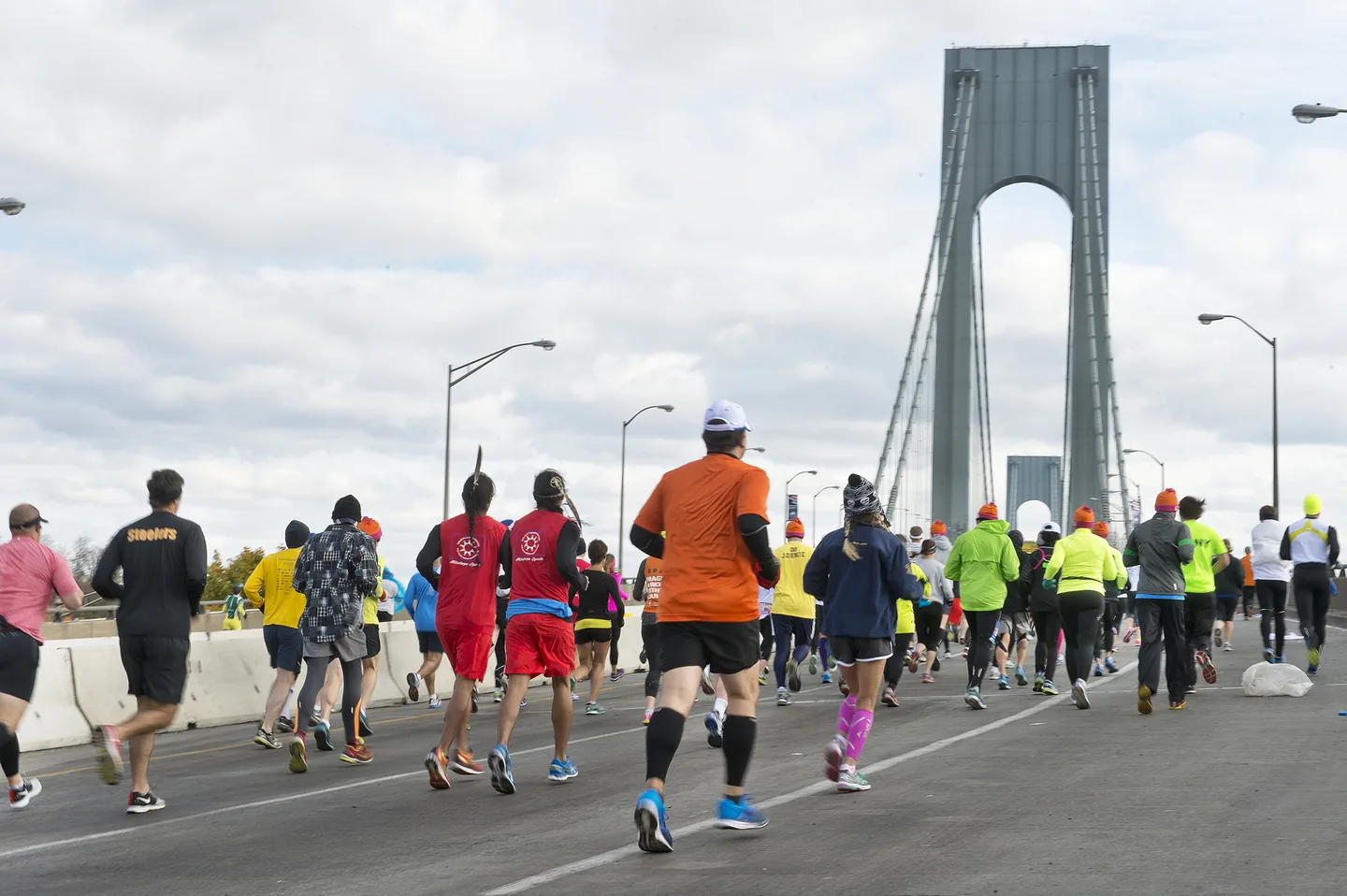
Photo: Metropolitan Transportation Authority of the State of New York / Wikimedia Commons (CC BY 2.0).
The 2027 TCS New York City Marathon is on Sunday 7 November. It is the largest marathon in the world by number of finishers —more than 55,000 in recent editions— and the only one that runs through all five boroughs: it starts on Staten Island, crosses Brooklyn, Queens and the Bronx, and finishes in Central Park, Manhattan.
Getting a bib is the hard part. The organisers, New York Road Runners (NYRR), have not yet announced the 2027 drawing dates; in 2026 it opened in February and received more than 240,000 applications, a record.
Key facts for 2027
- Date: Sunday 7 November 2027.
- Distance: 42.195 km (26.2 miles), from Staten Island to Central Park.
- Start: at Fort Wadsworth, Staten Island, at the foot of the Verrazzano-Narrows Bridge, in waves through the morning.
- Finish: in Central Park, by Tavern on the Green.
- Organiser: New York Road Runners (nyrr.org). It is one of the seven Abbott World Marathon Majors.
- Published 2027 fee: $269.66 for NYRR members and $333.11 for non-members; runners from outside the US pay more.
How to get a bib
There are four routes, and it pays to know which one is yours well in advance:
- Drawing: free to apply; if you are selected, the entry fee is charged straight away. It usually opens in February and is decided in early March. The odds are very low: with more than 240,000 applications, only a small share get in this way.
- Time qualifier: the qualifying window for 2027 runs from 1 January to 31 December 2026, with demanding standards by age and sex.
- Charity: with an official charity partner. With Team for Kids, the basic commitment is to raise $3,000, plus a $125 programme fee and the entry fee.
- Official travel partner: authorised operators sell packages that include a bib, more expensive but with no drawing. For international runners it is often the most realistic option.
NYRR’s 9+1 programme, which gives guaranteed entry to runners who complete nine qualifying races and one volunteer shift, is designed for people who live in New York.
The course: five boroughs and five bridges
The start is one of the most famous moments in mass-participation running: thousands of runners crossing the Verrazzano-Narrows Bridge with New York Bay on one side. Then come about 20 kilometres through Brooklyn, with crowds lining Fourth Avenue and Bedford Avenue; the stretch through Queens; the Queensboro Bridge, long, quiet and with a climb you feel around kilometre 25; First Avenue in Manhattan, where the noise comes back all at once; a short loop into the Bronx and the final run down Fifth Avenue into Central Park.
It is not a fast course. The bridges and the rolling sections on Fifth Avenue and in Central Park add climbing in the second half, just when it hurts most. Plan for a realistic goal rather than a personal best.
Logistics for international runners
- Getting to the start: almost everyone stays in Manhattan. The transfer to Staten Island happens before dawn, by ferry or on the organisers’ buses, and the wait in the start village is long and usually cold: bring warm clothes you can leave there.
- Bib collection: at the runners’ expo in the days before the race. It has to be done in person.
- When to arrive: Thursday or Friday is sensible, to collect your bib calmly and adjust to the time difference.
- Accommodation: November is high season in New York and marathon weekend shows it. We will publish an accommodation guide with real prices a few months before the race.
From the park to the five boroughs: the history of the race
The first edition of the marathon was held entirely in Central Park. 127 runners started and 55 finished; the winner was Gary Muhrcke, in a time of 2:31:38. That race, confined to the park, was on a very different scale from the event that runs through the city today.
The move to the five boroughs came as part of the United States bicentennial celebrations, from an idea by Ted Corbitt. Since then, the marathon’s sporting history has featured names such as Grete Waitz and Bill Rodgers, winners on nine and four occasions respectively. Their careers help place the event in the history of both elite athletics and mass-participation marathon running.
What the 2025 results showed
In the 2025 edition, 59,662 runners started. Among those who finished were 18,660 international participants from 132 countries. The combination of strong local participation and runners arriving from abroad explains why the race attracts such a wide range of people, from professionals to amateurs taking on their first marathon.
In the elite competition, Benson Kipruto won the men’s race in 2:08:09 and Hellen Obiri won the women’s race in 2:19:51, a course record. Marcel Hug and Susannah Scaroni won the wheelchair races. These are results from one particular edition: they offer an insight into the race’s recent history, not a prediction of what 2027 will bring.
The bridges that shape the route
After the Brooklyn section, Pulaski Bridge leads into Queens and coincides with the halfway point of the race. It is a useful landmark for getting your bearings on the route: from there, further borough crossings and elevated sections still lie ahead, so reaching halfway does not mean the main challenges are behind you.
Further on, runners enter the Bronx via Willis Avenue Bridge, before returning to Manhattan via Madison Avenue. Each crossing breaks up the continuity of the avenues and changes the terrain underfoot. When studying the route, it is worth looking at these crossings alongside the streets that follow, rather than treating them as isolated obstacles.
A profile that demands attention all the way to the park
The route does not concentrate all its demands in a single climb. Bridges, descents and undulating sections alternate with long avenues, so the effort can feel different even when the pace on your watch seems steady. In particular, the approach to the park via Fifth Avenue includes a climb, an important detail when studying the final section.
When preparing for a marathon with this profile, it is useful to get familiar with varied terrain without turning every training session into a demanding test. Hills change how you distribute your effort, and descents also put strain on your legs. Preparation should be adapted to each runner’s experience and circumstances, rather than simply copying the pace from another race.
How to interpret pace on a changing course
On a climb, maintaining the same pace as on the flat can require considerably more effort. The opposite is true on a descent, but making the most of it does not mean you should stop paying attention to your stride. A target time is useful; it is even more useful when considered alongside perceived effort and the characteristics of each section.
The organisers mark the course in miles, a unit that may be less familiar to those who usually train in kilometres. The official markers help runners locate themselves on the course and check the information on their watches, whose measurements may not match the race distance exactly. Reviewing these markers beforehand makes them easier to read during the marathon.
Race number collection and pre-race formalities
The information available for the previous edition places the expo at the Jacob K. Javits Convention Center and says that a time slot must be booked to attend. This is a reference point for planning, not confirmation of the venue or procedure for 2027: both should be checked when the organisers publish the relevant instructions.
The information also mentions presenting identification and confirmation to collect the race number. Before travelling, it is worth checking the collection requirements for the edition you have entered and keeping the relevant documents accessible. This avoids relying on guidance from previous years, which may change.
What to check for each entry route
Documentation of a qualifying time is just as important as the time itself. As well as checking that it was achieved within the qualifying window for 2027, runners should review the verification conditions and the places available. The guide for the previous edition states that these were limited and allocated to the fastest runners in each category; that procedure should not automatically be assumed to apply to a new entry period.
For tour operators, the essential check is that they appear on the official NYRR list. It is also important to distinguish the package terms from the entry terms: what is included and what commitments the runner accepts should be clear before completing the purchase.
Travel is part of the preparation too
For those travelling from Spain, organising the trip goes beyond choosing how to get to the start. It is worth checking the entry documents required for each traveller in advance and consulting current requirements through official channels. The race confirmation, travel details and identification are especially useful when kept easy to find during the journey.
Luggage deserves the same attention as the formalities. Taking your running shoes and planned race clothing in your hand luggage means you will have your race kit to hand if there is a problem with your checked bag. It is also a good opportunity to separate what you need before the start from what you will use during the race, rather than leaving that decision until the final morning.
Frequently asked questions
When is the 2027 New York City Marathon?
Sunday 7 November 2027.
When does the drawing open?
NYRR has not yet published the 2027 dates. In recent years it has opened in February and been decided in early March.
How much does it cost?
For 2027, $269.66 for NYRR members and $333.11 for non-members living in the US; international runners pay a little more. Travel-partner packages, which include a bib, cost considerably more.
Dates, fees and conditions may change: the official New York Road Runners website is always the reference.
Where to stay in Nueva York
Hotels available 5–8 November 2027.
Affiliate links: if you book through this map we earn a commission, at no extra cost to you.



How to prevent thigh chafing: causes and real solutions

Women’s running windbreakers: seven jackets and how to choose

Do more workouts get rid of soreness? A guide for runners

Jaén Half Marathon 2026: Record 3,800 Runners Registered

Men’s short running tights: how to choose the right pair

World Triathlon confirms data breach involving medical data

Izan Edo targets podium at Miyazaki World Cup

María Pérez ranks ninth in World Athletics’ 2026 top ten

Dos Santos, Duplantis and Sawe: World Athlete of the Year finalists

San Silvestre Vallecana 2026: 42,000 places, prices and start times

 Races3 months ago
Valencia Half Marathon 2027: date and registration

 Races3 months ago
Valencia Marathon 2026: entry, ballot and course

 Reviews and Comparisons4 months ago
Asics Gel-Roadmiles 3 for men: review and current price

 Reviews and Comparisons4 months ago
Asics Gel Sonoma 8 Gore-Tex: complete analysis for trail and rain

 Sneakers3 months ago
Saucony Endorphin Pro 4: full review and verdict

 News5 months ago
Strava API 2026: what changes for clubs, challenges and runner apps?

 Reviews and Comparisons5 months ago
Nike Alphafly 3: opinions, sensations, and real key points

 Reviews and Comparisons4 months ago
Under Armour running shoes review 2025-2026: models and key features

 Sports Equipment4 months ago
Shoe sizes in cm: a clear guide to getting the right fit for your footwear

 Sneakers3 months ago
Skechers GO RUN Consistent 2.0 analysis: comfort and limits

 News5 months ago
Valencia Marathon 2026 route: key tips to train and run better

 Sneakers4 months ago
Adidas Adizero Boston 13 for men: review and verdict