Races
Porto Half Marathon 2025: route, schedule, and prices
The Porto event combines a fast circuit, an international atmosphere, and two distances for all profiles.

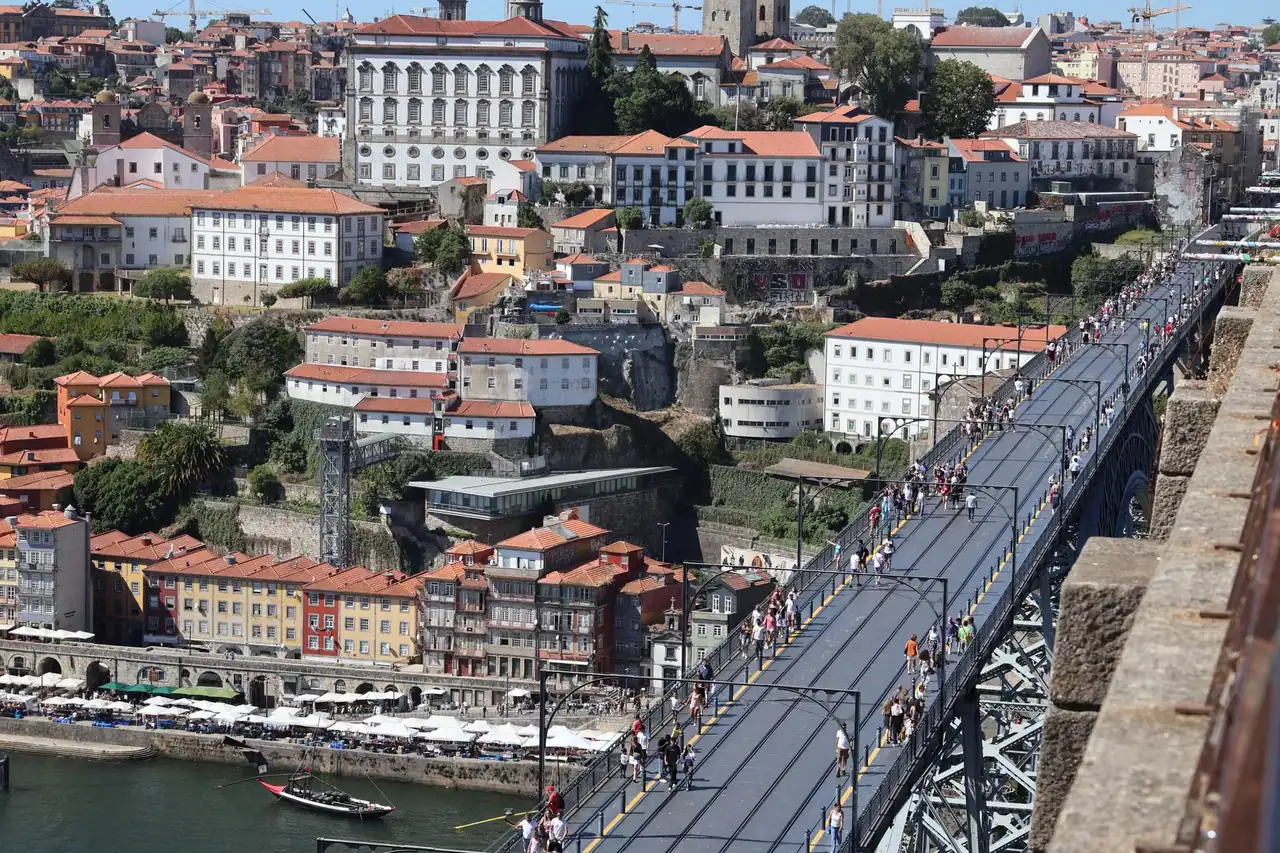
The Porto Half Marathon 2025 once again stood out as one of the most attractive races on the Iberian calendar for a simple reason: it combines a fast course, urban scenery, and an organization designed to appeal to both elite runners and first-timers. The edition held on 14 September 2025 reinforced that profile with two distances, 21.097 kilometers and 5 kilometers, and a start near Avenida D. Carlos I, right by the Atlantic and the Douro.
Interest in this race is not explained by its route alone. Its international character, the ease of the circuit, and the image of a city that you cross on foot while bridges, quays, promenades, and historic facades come into view also play a role. Porto is not seen here as a static postcard, but as a strip of living asphalt, open and noisy, where the runner moves forward accompanied by the river’s humidity and by a crowd that turns the event into a September scene with its own identity.
A race that combines speed, tourism, and big-city atmosphere
Porto’s great sporting value lies in its profile. Organizers and specialized platforms agree in describing the route as mostly flat, with very few abrupt pace changes, something that makes it favorable for personal bests and also for those looking to complete a half marathon without technical surprises. That combination has placed it among the most appealing events for closing the competitive summer with good feelings.
The 2025 edition followed in the footsteps of previous years: high participation, with more than 12,500 runners across the two distances, and a very notable international presence, to the point that more than half of the entrants came from outside Portugal according to information released by the organizers. In a city with its own tourist weight, that is no small detail. The race works as a sporting showcase and as a gateway to a weekend that, for many participants, also becomes a city visit.
The calendar helps too. September in Porto usually offers milder temperatures than the height of summer, around a comfortable range for running if the day cooperates, and that translates into a friendly race feel, less punishing than other major European half marathons. For the runner, the whole package matters as much as the final time: reasonable weather, experienced organization, and an environment that lets you run without the strain of overly demanding courses.
The 21.097-kilometer route: an out-and-back along the Douro
The half marathon course starts near Avenida D. Carlos I and unfolds as an out-and-back route hugging the Douro riverbank. That layout has an immediate effect: it makes orientation easier, reduces uncertainty for runners, and allows the race to be read as a series of urban landmarks rather than as an abstract sequence of kilometers. Arrábida Bridge, the Foz area, Passeio Alegre, Rua do Ouro, and the surroundings of Luis I Bridge appear as reference points that organize the effort.
Starting and finishing in the same area reinforces a very specific feeling: that of running at the edge of a city spread out like an amphitheater. The runner does not cross Porto chaotically, but with a fairly clean, almost linear progression that traces the coast, the river channel, and the return to the finish. That clarity in the route helps maintain pace, especially in a race where the terrain invites thinking in splits rather than mere survival.
The profile is especially appreciated by those looking for a fast half marathon. This is not a mountain race or a leg-breaking event. The key is that the wear and tear comes less from long climbs than from the sustained pace and the constant exposure to wind, humidity, or small changes in the route. So, while the clocks usually smile, the race demands serious effort management: going out too hard by the sea can take its toll later, when the body is no longer negotiating speed so well.
Start, schedule, and the rhythm of a September morning
The starting signal was given at 9:00 a.m., a typical time for an urban race of this kind because it helps avoid the day’s most uncomfortable heat and allows enough margin to organize logistics. The start point on Avenida D. Carlos I places runners in a recognizable and functional setting, with relatively clear access and a backdrop that mixes traffic, the seafront promenade, and the visual closeness of the river.
The 21.097-kilometer distance had a time limit of 3 hours, a margin that makes the spirit of the race clear: competitive, yes, but also accessible. Alongside it, the 5-kilometer race served as a more flexible entry point, with no time limit and open to a wide audience, from casual runners to families or participants who prefer a less demanding experience.
The start time is no minor detail when analyzing a race like this. In a coastal city with open stretches, the early morning still affects the perceived temperature, and runners can encounter changing conditions between the first and second halves of the course. That transition, so typical of September, is part of the race’s physical story: you begin with cool air and finish with the city already awake, noisier and warmer.
Prices, bibs, and registration access
Registration for 2025 followed a tiered structure that rewarded early commitment. The price started at 30 euros in the early-bird rate until March 31, rose to 35 euros until August 31, increased to 55 euros until September 8, and reached 60 euros in the final hours at the expo, always subject to bib availability. The logic is the usual one in major European races: the longer you wait to decide, the more expensive it becomes to secure a spot.
The fact that the event sold out its 12,500 entries ahead of time in 2025 confirmed very strong demand. That pressure on places is explained not only by the race’s reputation, but also by the balance between accessibility and competitive appeal. Not every urban half marathon can boast such a favorable course for fast times while also being so attractive to the sports traveler who wants to make the most of a weekend in a city with enormous personality.
At the same time, the organizers kept bib pickup concentrated at Alameda Shopping on September 11 and 12, from 10:00 a.m. to 11:00 p.m. That kind of wide window makes staggered arrivals easier and helps avoid bottlenecks, especially useful when such a high proportion of entrants comes from abroad and needs to sort out accommodation, transport, and race kit collection without losing half a day in lines.
Two distances for different audiences, one identity
The half marathon was the main event, but the 5-kilometer mini race was not just a commercial add-on. It served a real purpose within the event: broadening the range of participant profiles and reinforcing the idea that Porto is not only a race for specialists, but a sporting event open to different entry points. On the same morning, the runner chasing a personal best, the debutant, and the participant who simply wanted to be part of the atmosphere all shared the experience.
That two-distance model helps explain why the race has gained importance. It does not force a choice between challenge and participation. The 21.097 kilometers offer a complete test, with pace, strategy, and endurance; the 5 kilometers, by contrast, make it possible to enter the scene without taking on the toughness of a half marathon. The event stretches and shrinks intelligently, as if it knew that the city, too, is built on nuance rather than on big feats alone.
The minimum age for the half marathon was set at 18 years, while the shorter distance had no restrictions. That difference fits the logic of safety and the type of effort each race requires. This is not a bureaucratic detail, but a way of organizing participation according to the real physical load of each format.
A course designed to run fast, but not to lose focus
Porto is usually sold as fast, and for good reason. A flat course favors steady pacing, energy efficiency, and heart-rate control. However, that does not make the race a formality. An urban half marathon may seem gentle on paper and still demand discipline at every stage. Consistency, more than impulse, makes the difference between a good time and a finish in no-man’s-land.
The stretch between km 5 and km 7 was noted as one of the few points where the route becomes slightly more demanding, though without breaking the overall character of the course. From there, the race follows a logic that strongly favors the patient runner, the one who knows that in this kind of event, meters are also won by comparison with the surroundings: a wide avenue, a straight by the river, the sound of the crowd, the breathing that matches every footfall.
Because of its layout, the race suits runners who prefer asphalt, clear visual references, and an experience where the tourist element does not diminish the sporting seriousness. Porto’s setting offers more than just a pretty backdrop: it gives continuity to the effort and turns progress into a succession of moving postcards. Running there is reading the city with your legs, a phrase as simple as it is accurate.
Porto’s role as a sports and urban destination
The Porto Half Marathon does not exist apart from the place that hosts it. Its tourist impact is real, and in a way part of the event’s success rests on that duality between competition and an urban getaway. The city offers bridges, wine cellars, viewpoints, restaurants, and a historic fabric that greatly expands the appeal of the trip beyond Sunday morning. The race, in this sense, does not exhaust the experience; it opens it up.
The route does not directly cross all the most densely historic parts of the center, but it does leave a recognizable mark along the riverbank and at the more symbolic access points in the eastern and seaside areas. That encourages many runners to discover the rest of the city afterward, when the effort is over and the body asks for another pace, slower and more observant. Porto works especially well in that second reading: the one done on foot, by tram, on a terrace, or crossing the Douro at sunset.
That is also why the race retains such a strong identity within the Portuguese calendar. It does not compete only on times or participant numbers; it competes on narrative. The runner knows they are not going to a neutral race. They are going to a stage where the city’s name carries weight, where the bridge is not just a crossing but a symbol, and where the finish does not erase the journey before it, but completes it.
What the 2025 edition left behind and why it still matters
The 2025 edition confirmed that this event remains alive and capable of growing even when logistics impose limits. The organizers acknowledged that the course cannot simply be expanded because of urban restrictions and works in the Gaia area, but they also made clear that, when that situation changes, the event could accommodate much larger numbers. That tension between success and capacity gives a pretty accurate measure of its current moment.
Beyond the numbers, the race’s appeal still lies in its formula. A clean course, a city with its own magnetism, a recognizable start, a well-measured main distance, and a second race that broadens the event’s reach. With that package, Porto has earned a stable place among the reference half marathons for those who want to run hard without giving up a destination with soul.
In a calendar crowded with similar events, the differentiating value lies in the details you remember afterward: the river beside you, the friendly profile, the noise of the crowd, the return along the same line of scenery, the feeling of having run inside a city that does not merely accompany the race, but shapes it. That is Porto’s true strength: not in promising epic drama, but in offering a clear, well-run competition with an identity that remains once the bib is gone.



How to prevent thigh chafing: causes and real solutions

Women’s running windbreakers: seven jackets and how to choose

Do more workouts get rid of soreness? A guide for runners

Jaén Half Marathon 2026: Record 3,800 Runners Registered

Men’s short running tights: how to choose the right pair

World Triathlon confirms data breach involving medical data

Izan Edo targets podium at Miyazaki World Cup

María Pérez ranks ninth in World Athletics’ 2026 top ten

Dos Santos, Duplantis and Sawe: World Athlete of the Year finalists

San Silvestre Vallecana 2026: 42,000 places, prices and start times

 Races3 months ago
Valencia Half Marathon 2027: date and registration

 Races3 months ago
Valencia Marathon 2026: entry, ballot and course

 Reviews and Comparisons4 months ago
Asics Gel-Roadmiles 3 for men: review and current price

 Reviews and Comparisons4 months ago
Asics Gel Sonoma 8 Gore-Tex: complete analysis for trail and rain

 Sneakers3 months ago
Saucony Endorphin Pro 4: full review and verdict

 News5 months ago
Strava API 2026: what changes for clubs, challenges and runner apps?

 Reviews and Comparisons5 months ago
Nike Alphafly 3: opinions, sensations, and real key points

 Reviews and Comparisons4 months ago
Under Armour running shoes review 2025-2026: models and key features

 Sports Equipment4 months ago
Shoe sizes in cm: a clear guide to getting the right fit for your footwear

 Sneakers3 months ago
Skechers GO RUN Consistent 2.0 analysis: comfort and limits

 News5 months ago
Valencia Marathon 2026 route: key tips to train and run better

 Sneakers4 months ago
Adidas Adizero Boston 13 for men: review and verdict