Races
Vienna City Marathon 2027: date, course and waiting list
On 18 April 2027, from the Danube to the Burgtheater. Bibs sold out in September: the waiting list, the course and the logistics.

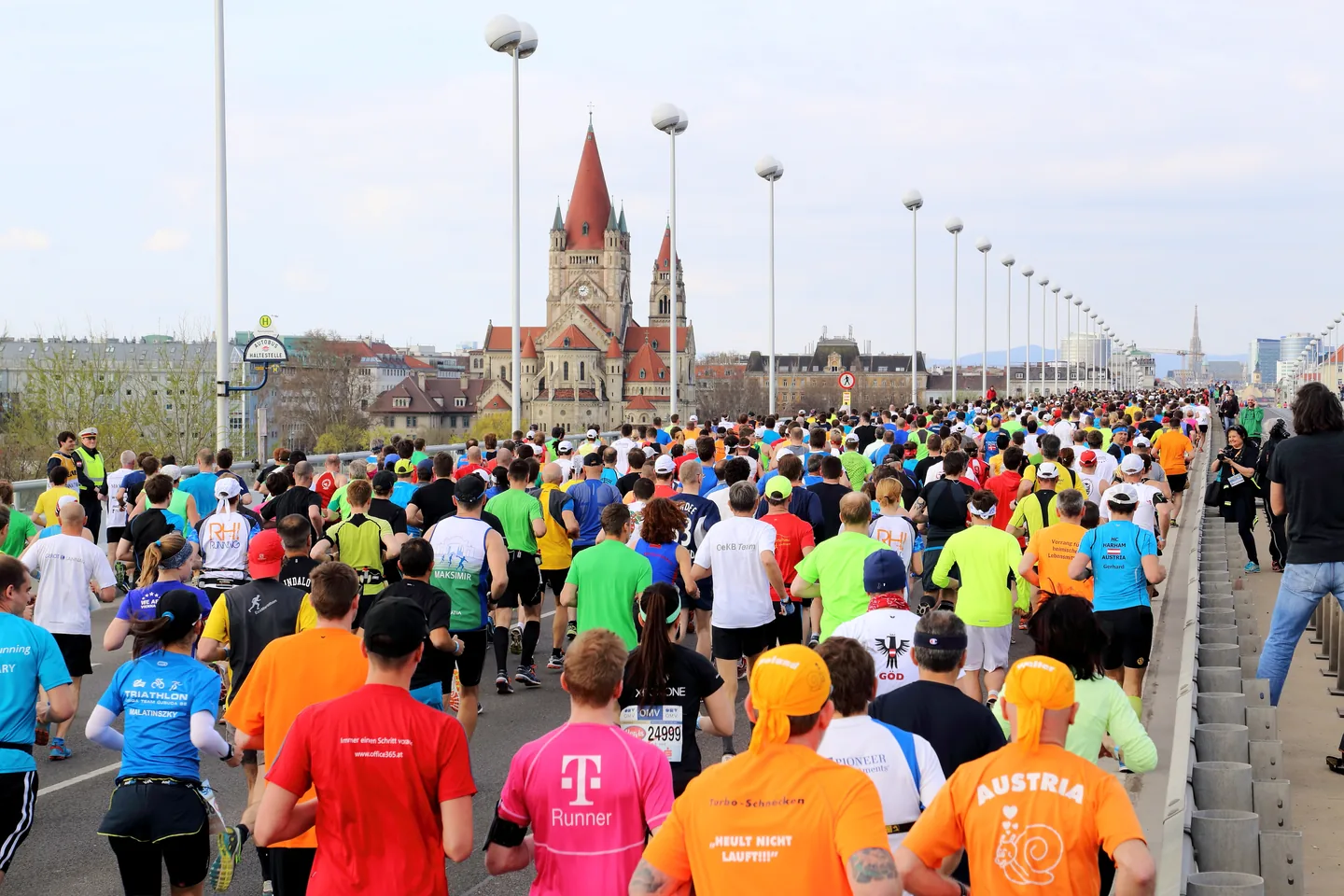
The 2027 Vienna City Marathon is on Sunday 18 April, with wave starts from 9:00. It is one of Europe’s big spring marathons and one of the prettiest: it starts by the Danube on the Reichsbrücke bridge, passes the Prater, Schönbrunn Palace and the Ringstrasse, and finishes in front of the Burgtheater.
If you do not have a bib yet, you are late: marathon places sold out on 20 September 2026, earlier than ever in the history of the race. There is an official waiting list, which can move until 7 March 2027.
Key facts for 2027
- Date: Sunday 18 April 2027.
- Start: Wagramer Strasse, by the Reichsbrücke bridge, in waves from 9:00.
- Finish: on the Ringstrasse, in front of the Burgtheater, next to Heldenplatz.
- Time limit: six and a half hours.
- Minimum age: 18 on race day.
- Entry: first come, first served, with no ballot; marathon places sold out in September 2026. Published fee: €155.
- Organiser: Vienna City Marathon (vienna-marathon.com).
The course
After crossing the Danube on the Reichsbrücke, the marathon runs down the Prater’s main avenue, heads west along Mariahilfer Strasse, loops round Schönbrunn Palace and returns to the centre along the Ringstrasse, the boulevard that circles the old town, with the Opera, Parliament and City Hall. It is a flat course with the odd gentle rise, and big crowds in the centre.
Logistics for international runners
- Bib collection: at the runners’ expo in the days before the race.
- Getting to the start: the Reichsbrücke area, on the Donau City side, is well served by the U1 metro line.
- Where to stay: the centre (Innere Stadt) and the districts along the Ringstrasse keep the finish within walking distance and the start a few metro stops away. We will publish an accommodation guide with real prices before the race.
What it means to run a marathon with a gentle profile
The Vienna course has a difference of 44 metres between its lowest and highest points. That figure describes the altitude difference between the two extremes, not the total of all the climbs during the race. It is an important distinction: even on a course without steep gradients, changes in incline can briefly alter how hard the effort feels.
In a long race, the absence of major climbs does not remove the need to manage your energy. Maintaining a sustainable pace means paying attention to how the effort feels as it develops, not just to the speed on your watch. The urban tarmac also means repeated impact throughout the distance, so it helps to have trained on similar surfaces beforehand.
Aid stations and personal bottles
The course has eight official aid stations, located approximately every 5 kilometres, with water and Powerade. Bananas are added from kilometre 15. Coca-Cola is also available along the course, although you should not assume that every product will be available at every table.
These stations are supplemented by 15 additional water points, some staffed by volunteers and others self-service. Marathon participants can hand in their own bottles when collecting their race number: they must be clearly labelled and cannot be made of glass. They are placed in the second position at each aid station, but the organisers cannot guarantee that runners will find them.
The availability of drinks and food during the race is no substitute for testing beforehand in training what agrees with you. Drinking or eating while exerting yourself and moving can feel different from doing so at rest. Individual needs vary and, if you have questions about health or nutrition, consult a healthcare professional rather than turning general advice into a personal plan.
The expo and documents for race number collection
The expo takes place at Marx Halle, Karl-Farkas-Gasse 19, on 16 and 17 April 2027. Opening times are yet to be confirmed. The organisers do not plan to distribute race numbers on Sunday, a detail that affects travel plans: arriving in Vienna with enough time to visit the venue is part of the logistical preparation.
To collect your race number, you must present identification and the collection confirmation email sent by the organisers. If you have not received it, you can request it again. Someone else can also collect it for you, although it is worth checking the required documents and authorisation before travelling; in the relay, one team member can collect the race numbers for the whole team.
Visiting the expo also gives you a chance to resolve any practical questions about documentation in advance. Keeping the confirmation email accessible and checking your registration details avoids a last-minute search. This is separate from the waiting list: signing up does not mean you have a race number until your place is confirmed.
Half marathon: where the courses separate
The half marathon shares part of its course with the longer race. The split comes at kilometre 20.3: half marathon runners turn right onto Bellariastrasse, while marathon participants continue straight ahead. For those travelling with companions entered in different distances, that point marks where they stop following the same route.
The organisers allow someone entered in the marathon to finish the half marathon without prior notice, although they ask that this option be reserved for special circumstances, such as those relating to health. The runner receives the medal and appears in the half marathon results, with no refund of the difference in entry fees. Switching in the other direction, from the half marathon to the marathon, is not permitted.
This option should not be confused with an automatic tactical decision. If worrying symptoms appear, the priority is to stop and seek medical attention, rather than focusing solely on reaching a finish line. The race has a medical centre; its professionals are responsible for assessing any specific problem.
How the marathon relay works
The team event uses the same course as the individual marathon, but divides the effort among four people. The published legs are 15.5 kilometres for the first runner, 8 for the second, 7 for the third and 11.695 for the last. The distances are not equal, so a team can take each member’s experience and preferences into account when deciding its line-up.
In the relay, the race is not just about running your assigned leg: each participant also needs to arrive prepared at their exchange zone. Checking the organisers’ instructions on the relay points helps coordinate travel and clarifies where one runner’s responsibility ends and the next runner’s begins.
The first relay runner can also complete the marathon or half marathon, provided they are registered for both races and wear both race numbers. After the relay handover, they can continue their individual race. This option requires a clear distinction between the two entries, because being part of a team does not automatically include a runner in the individual standings.
Other distances over the weekend
The programme includes a 10-kilometre race on Sunday, starting at 8:00. There is a checkpoint: participants must pass the first 5.7 kilometres before 8:55 to continue, and the finish closes at 9:30. When choosing this distance, it is therefore not enough to consider the final time limit; the intermediate cut-off also matters.
The Vienna 5K takes place on Saturday, with two waves from Schottentor, at 18:15 and 18:30. You can take part running or walking, with or without timing, and the finish closes at 19:30. The route passes along the Ringstrasse and through the old town, offering a shorter alternative to Sunday’s effort.
Saturday’s programme also includes the children’s races Daily Mile 800 and Daily Mile 1,600. Their times and other details for the 2027 edition have not yet been published, so conditions from previous years should not be taken as definitive for participants and their families., so conditions from previous years should not be taken as definitive for participants and their families.
Transport and race tracking
The race number is valid as a ticket for Wiener Linien public transport on race day for a defined period around the start. It is worth checking that time window and the current conditions before using it: it does not necessarily cover every journey during the trip or the journeys of those accompanying the runner.
The race app offers live tracking and results. Split times are also recorded every 5 kilometres and at the half marathon point. For family and friends, this information helps them follow a participant’s progress without relying solely on seeing them on the course; for the runner, it provides a way to review afterwards how their effort was distributed.
The logistics of an urban race also include meeting up afterwards. The start and finish are in different areas, so it is practical to agree on a recognisable meeting place after the race and keep the information needed for the return journey accessible. Simple planning prevents looking for companions from becoming another task after several hours of sustained effort.
Vienna and the two-hour barrier
The marathon in the Austrian capital has been organised since 1984. Its history is linked to that of a city with a distinctive place in long-distance athletics: Eliud Kipchoge completed the marathon distance in Vienna in under two hours, with a time of 1:59:40, in a specially arranged attempt.
That performance and the Vienna City Marathon are separate events. Kipchoge’s attempt should not be presented as a time achieved in an edition of this race, even though both share the city and the surroundings of the Prater. The distinction matters both when discussing results and when comparing the conditions of a race open to participants with those of a challenge organised specifically to break a historic barrier.
Preparing for the effort beyond the course profile
A course without steep gradients may tempt runners to focus solely on their target time, but preparation still depends on the endurance to sustain the effort. In training, long runs help you become familiar with time on your feet and with the feeling of running as fatigue sets in. Progression should be adapted to each person’s starting point, without assuming that the same volume suits everyone.
It is also useful to test the kit you intend to use on race day. Road running shoes and clothing should feel comfortable during a prolonged effort, not just on a short run. Preparation includes rest and attention to any discomfort: if you experience persistent pain or worrying symptoms, the right decision is to see a healthcare professional for an individual assessment.
In Vienna, as in any marathon, the course profile is only part of the experience. Pace management, tolerance of drinks and food, and well-planned logistics all affect how the distance feels. Having realistic reference points helps you interpret your splits without turning every change on your watch into an obligation to speed up: the aim is to finish with your effort well managed.
Frequently asked questions
When is the 2027 Vienna City Marathon?
Sunday 18 April 2027.
Are there any bibs left?
Not for the marathon: they sold out on 20 September 2026. There is an official waiting list until 7 March 2027.
What is the time limit?
Six and a half hours.
Dates, fees and conditions may change: the official race website is always the reference.



How to prevent thigh chafing: causes and real solutions

Women’s running windbreakers: seven jackets and how to choose

Do more workouts get rid of soreness? A guide for runners

Jaén Half Marathon 2026: Record 3,800 Runners Registered

Men’s short running tights: how to choose the right pair

World Triathlon confirms data breach involving medical data

Izan Edo targets podium at Miyazaki World Cup

María Pérez ranks ninth in World Athletics’ 2026 top ten

Dos Santos, Duplantis and Sawe: World Athlete of the Year finalists

San Silvestre Vallecana 2026: 42,000 places, prices and start times

 Races3 months ago
Valencia Half Marathon 2027: date and registration

 Races3 months ago
Valencia Marathon 2026: entry, ballot and course

 Reviews and Comparisons4 months ago
Asics Gel-Roadmiles 3 for men: review and current price

 Reviews and Comparisons4 months ago
Asics Gel Sonoma 8 Gore-Tex: complete analysis for trail and rain

 Sneakers3 months ago
Saucony Endorphin Pro 4: full review and verdict

 News5 months ago
Strava API 2026: what changes for clubs, challenges and runner apps?

 Reviews and Comparisons5 months ago
Nike Alphafly 3: opinions, sensations, and real key points

 Reviews and Comparisons4 months ago
Under Armour running shoes review 2025-2026: models and key features

 Sports Equipment4 months ago
Shoe sizes in cm: a clear guide to getting the right fit for your footwear

 Sneakers3 months ago
Skechers GO RUN Consistent 2.0 analysis: comfort and limits

 News5 months ago
Valencia Marathon 2026 route: key tips to train and run better

 Sneakers4 months ago
Adidas Adizero Boston 13 for men: review and verdict