Routes
Ruins of Arlekia Castle: route, history, and views in Irati
Forest, medieval ruins, and open views: a short excursion through Irati with lots of history and few crowds.

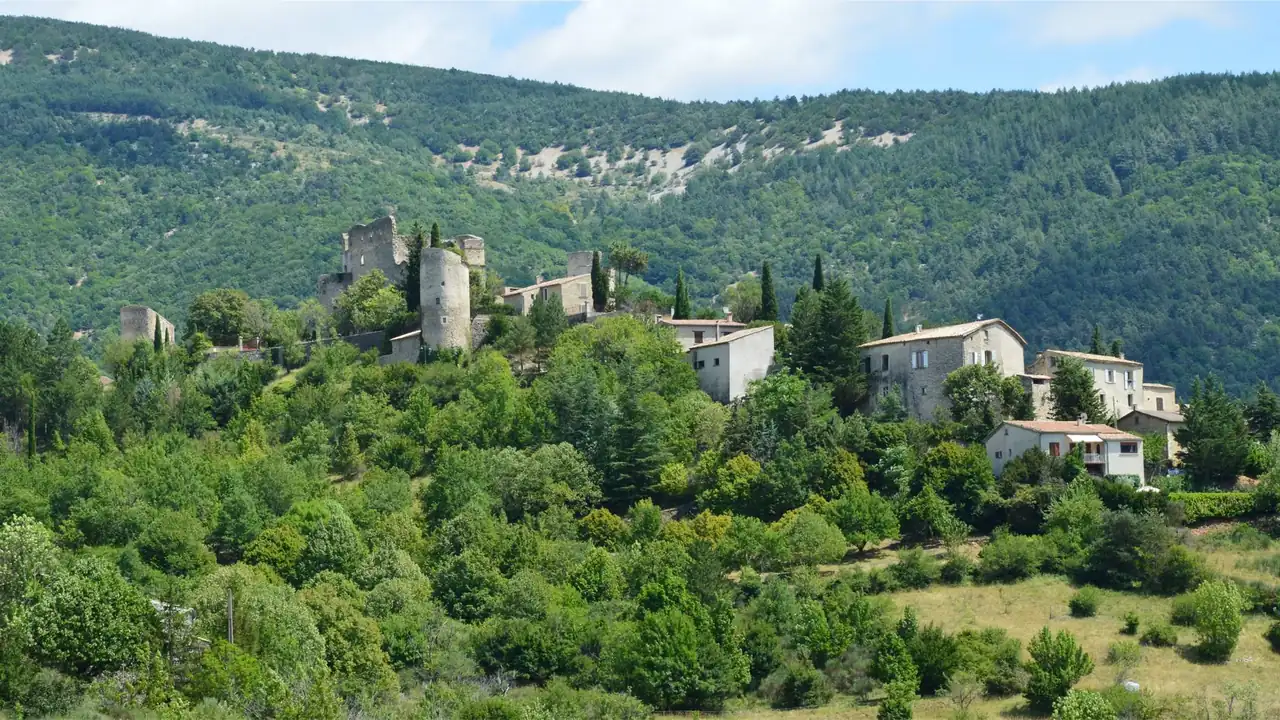
The ruins of Arlekia Castle have become one of those discreet spots that completely transform a trip to the Irati Forest. It is not a great monument or a restored fortress, but rather a watch post perched above the valley, with surviving walls, steep slopes, and a visual reward that justifies the climb: access to the former Orbaizeta Arms Factory, the dense forest, and, on clear days, the silhouette of Mount Orhi.
Its appeal lies precisely in that blend of heritage and landscape. The visit is not a typical monumental outing, but rather a short walk that enters an environment of beech trees, ferns, and ancient paths, where the castle appears like a stone apparition. A few minutes from the starting point, the path makes it clear that the mountain is in charge here: damp ground, steep stretches, and a constant feeling of entering a place with memory.
A discreet fort in the heart of Aezkoa
Arlekia was, прежде всего, a strategic outpost. Its location on the hillside is not the result of whim, but of visual control over a key enclave in the valley. From the ruins, the surroundings of the factory and part of the natural corridor that rises between forests and mountain passes can be overseen. In that sense, the site still preserves intact a very medieval idea of power: to watch, anticipate, and protect from above.
Today, stone walls and remnants of the old watch castle still stand, enough to imagine its function without the need for grand mental reconstructions. This is not a perfectly legible walled enclosure, but rather a vestige that blends into the mountain with the naturalness of something that has been there for centuries. The moss, vegetation, and slope do the rest; the whole seems more like a found ruin than a built one.
That sober character has a clear advantage for the visitor: there is no tourist artifice. The experience relies on walking, silence, and reading the terrain. Anyone looking for an outing with layers, where history blends with the landscape without fuss, will find here one of the most interesting references in the area.
Where to stay near Ochagavía
Accommodation in the area, with prices. Choose your dates on the map.
Affiliate links: if you book through this map we earn a commission, at no extra cost to you.
The route from the Orbaizeta Arms Factory
The best-known access starts at the Orbaizeta Arms Factory, one of the valley’s major landmarks and a very fitting starting point for an outing of this kind. The factory, with its industrial and historical weight, provides context from the very first step: metal, water, productive ruin, and forest. Few routes make the beginning and end so well connected to the middle stretch.
The usual trail is marked as SL-NA 59B and runs over a distance of between 7.8 and 8.9 kilometers depending on the route consulted, with a cumulative elevation gain of around 220 to 585 meters and an estimated time of approximately 1 hour and 30 minutes to 2 hours and 15 minutes, although the actual walk may take longer if you visit the fort and nearby caves at a leisurely pace. It is a short route in appearance, but demanding enough to feel serious.
The first section follows tracks and forest paths, with a gradual climb that eventually opens toward the Arlekia turnoff. The ascent to the castle is the most physically demanding part of the route, with a steep incline in the final stretch. In return, the reward is immediate: the views widen, the forest drops a little below, and the ruin rises like a stone balcony over one of Irati’s most recognizable landscapes.
What you see during the climb and why it is worth it
The path offers not only a destination, but a sequence of settings. First come the farmhouses and the vicinity of the factory, then the enclosed beech forest, later the clearings and fern-covered areas, and finally the more open terrain of the upper section. This transition is one of the route’s strengths, because it turns a short excursion into a small reading of the Pyrenean forest.
Along the way, narrow paths, logging tracks, and passages among boxwoods and beech trees alternate. The vegetation shapes the walker’s pace; this is not a stroll with open horizons from the start, but a climb that is earned little by little. That is why the ruins are so suggestive: they appear after crossing a landscape that seems to close in on purpose so the final appearance has more force.
From the clearing near the castle, the view opens toward the Irati Forest and, on many days, toward Mount Orhi. That perspective is one of the most sought-after images for those who make it here. It is not just a postcard; it is a way of understanding the fort’s position in the local geography, like a stone eye placed to watch the passage of time and territory.
Lutoa Caves and the section that extends the hike
Most routes do not stop at Arlekia. The itinerary usually continues to the Lutoa caves, which add a more mysterious component to the whole. Access is not always comfortable and in some places the ground narrows or becomes steeper, but the visit adds variety and rounds off the outing with another type of relief, darker and more mineral than the forest surrounding it.
The caves appear like a crack or a discreet opening among the vegetation, and that discretion is part of their charm. They are not a monumental space or easy to explore, but rather a corner that is sensed before it is seen. On damp or foggy days, the place gains even more presence, because the contrast between rock and beech forest becomes more pronounced and the route takes on an almost legendary feel.
The combination of ruin and cave explains why this excursion has become one of the most attractive in the area for those looking for hiking with heritage. In just a few kilometers, it concentrates fortification, forest landscape, rocky formations, and the kind of gentle solitude that characterizes Irati away from the busiest trails.
History, landscape, and mythology: the symbolic weight of the place
Arlekia’s value is not only archaeological or scenic. In the local imagination, this setting is associated with a territory where legends, mythical beings, and mountain memory all have a place. It is not hard to understand why: the enclosed forest, frequent mist, and elevated ruins create a setting that invites one to read the place with an almost narrative sensitivity.
Local oral tradition mentions lamias, basajaun, and basandere, names that continue to give density to the landscape. Although the route can be enjoyed without carrying that background, knowing it adds layers to the experience. The castle is no longer merely an abandoned structure; it becomes part of a cultural territory where the boundary between history and legend has never been entirely clear.
This crossing between the tangible and the symbolic is one of the most valuable traits of the Irati Forest. The walk to Arlekia is not limited to adding kilometers; it allows one to read a fragment of the mountain as a living archive. Stone, forest, water, and story coexist without apparent effort, and that explains why the place continues to attract interest beyond its modest physical scale.
Difficulty, signage, and the real profile of the excursion
It is not a technical route, but neither is it a simple urban stroll. The trail markings help with orientation, although at some junctions it is worth staying alert, especially where tracks and paths connect or where the slope changes. The final climb to the castle and the access to Lutoa are the trickiest sections because of the incline and uneven ground.
In terms of effort, the route falls into a moderate range, suitable for regular hikers with at least a minimum level of fitness. Families accustomed to walking in the mountains can tackle it without major problems if they keep a steady pace and pay attention to the state of the ground. The beech forest’s moisture, possible mud, and the incline make mountain shoes advisable rather than casual sneakers.
The route changes quite a bit depending on the season. In spring and autumn, the forest shines with special intensity, while in summer the climb can feel heavier because of the heat. In winter, the atmosphere becomes more austere and the castle’s stone stands out with a different, almost bare force. Each season changes the reading of the place, and that is another reason why Arlekia does not get old after a single visit.
The Orbaizeta Arms Factory as a starting point
Starting at the Arms Factory is no minor detail. The industrial complex, now a heritage landmark of the valley, places the route in a broader historical context. Before climbing toward the castle, the visitor has already passed walls, buildings, and traces of an activity that made use of water, iron, and the strategic position of the site.
That contrast between industry and fortification works especially well. The factory speaks of a specific economy; Arlekia, of an older defensive logic. One looks toward production and the other toward surveillance. Together they explain that this valley has been, for centuries, a worked and watched space, never just a postcard backdrop.
From a practical point of view, the site makes it relatively easy to organize the outing, although it remains a mountain area and it is wise to arrive prepared. Parking, the proximity of the Orbaizeta village center, and the network of trails make it possible to plan a half-day excursion that can be extended if you want to spend time reading the surroundings or visiting nearby places.
What makes this ruin different from others in Navarre
Its main difference is scale. While other fortified remains offer larger or better-known structures, Arlekia works through suggestion. It does not impose a massive architectural presence; it lets the landscape finish telling the story. That makes it especially attractive for those who enjoy ruins not as isolated objects, but as part of a broader natural scene.
Its location in a very photogenic setting also helps, yet without the overcrowding of other more popular destinations. There is no mass influx here or oversized staging. There are forest, stone, elevation, and silence. That combination gives the excursion the feeling of a discovery, as if the castle were still intentionally hidden among the slopes of Irati.
Unlike places that are consumed in a few minutes, Arlekia requires walking, observing, and accepting that part of its interest comes from what is not fully visible. The ruin functions as a threshold: whoever reaches it has not only climbed a hill, but also crossed a succession of landscapes that prepare the eye to understand the valley better.
A short excursion with a long memory
The ruins of Arlekia Castle sum up the character of Irati very well: powerful landscape, sober history, and an atmosphere that needs no embellishment. The excursion links a ruined factory, a dense beech forest, a forgotten fortification, and, if continued, caves that expand the sense of moving through a territory with several layers of time.
The result is an outing that is easy to organize, yet rich in nuance. It does not require complex logistics or a full day, although it does ask for respect for the mountain and the terrain. In return, it offers one of those experiences remembered more for the quality of the atmosphere than for the number of kilometers. Arlekia does not compete in size; it competes in presence.
That is why it continues to appear among the most suggestive routes in the Aezkoa Valley. It is not just a point on a map or a detour toward some old stones. It is a way of entering Irati with open eyes, letting the forest lead to a ruin that, even broken, still retains its ability to tell the story of the mountain.



How to prevent thigh chafing: causes and real solutions

Women’s running windbreakers: seven jackets and how to choose

Do more workouts get rid of soreness? A guide for runners

Jaén Half Marathon 2026: Record 3,800 Runners Registered

Men’s short running tights: how to choose the right pair

World Triathlon confirms data breach involving medical data

Izan Edo targets podium at Miyazaki World Cup

María Pérez ranks ninth in World Athletics’ 2026 top ten

Dos Santos, Duplantis and Sawe: World Athlete of the Year finalists

San Silvestre Vallecana 2026: 42,000 places, prices and start times

 Races3 months ago
Valencia Half Marathon 2027: date and registration

 Races3 months ago
Valencia Marathon 2026: entry, ballot and course

 Reviews and Comparisons4 months ago
Asics Gel-Roadmiles 3 for men: review and current price

 Reviews and Comparisons4 months ago
Asics Gel Sonoma 8 Gore-Tex: complete analysis for trail and rain

 Sneakers3 months ago
Saucony Endorphin Pro 4: full review and verdict

 News5 months ago
Strava API 2026: what changes for clubs, challenges and runner apps?

 Reviews and Comparisons5 months ago
Nike Alphafly 3: opinions, sensations, and real key points

 Reviews and Comparisons4 months ago
Under Armour running shoes review 2025-2026: models and key features

 Sports Equipment4 months ago
Shoe sizes in cm: a clear guide to getting the right fit for your footwear

 Sneakers3 months ago
Skechers GO RUN Consistent 2.0 analysis: comfort and limits

 News5 months ago
Valencia Marathon 2026 route: key tips to train and run better

 Sneakers4 months ago
Adidas Adizero Boston 13 for men: review and verdict