Routes
Route to the Pozo de los Humos: trails, views, and tips
Two access routes, two landscapes, and a roaring waterfall in Arribes del Duero. Key tips for visiting it well.

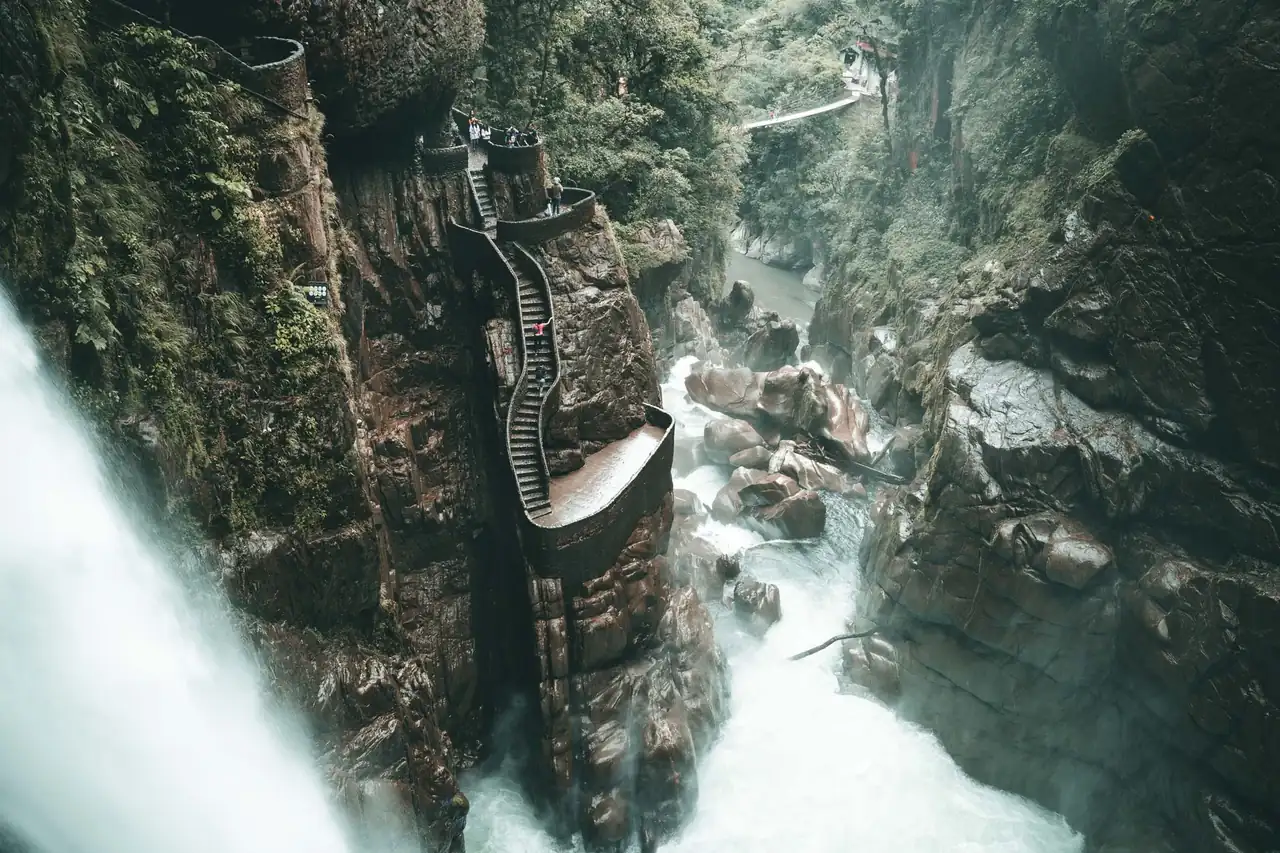
Pozo de los Humos cannot be understood at a single glance. From Masueco, it appears in profile, with the water crashing near the edge and the roar filling the gorge; from Pereña de la Ribera, the full scene opens up, as if the canyon were raising a stone curtain to reveal the entire waterfall. That double perspective explains why this route has become one of the most sought-after nature getaways in Salamanca and all of Arribes del Duero.
The reward, moreover, changes with the calendar. In winter and spring, when the Uces River gains strength after the rains and snowmelt, the waterfall reaches its most photogenic moment: a drop of about 50 meters, mist, spray, and sometimes a rainbow halo that appears and disappears with the wind. In summer, by contrast, the landscape remains powerful, but the flow can drop a lot and the waterfall lose part of its visual impact.
Two access points for the same waterfall
The site’s fame rests on a very welcome rarity for travelers: there are two short, complementary routes. No major preparations or high-mountain days are needed to reach the viewpoints, although it is worth keeping in mind that this is not an urban stroll. The terrain is natural, there is a slope, and mud can appear easily if it has rained in the previous days.
The route from Masueco is the closest to the visual base of the waterfall. The one from Pereña de la Ribera offers a broader, less close, and more panoramic view. Together they provide a complete reading of the landscape: one shows the detail of the drop, the other places it within the canyon and allows you to understand the scale of the surroundings. Doing both in the same day is not an extravagance, but a very sensible way to make the most of the trip.
Both options are short, suitable for inexperienced walkers, and very popular with families and weekend visitors. The gradient is gentle at first and more noticeable on the return, especially in Masueco, where the slope is felt on the way back when your legs have already taken the downhill section on the knees. The secret is to treat the route as a small excursion and not as a quick stop at the viewpoint.
Where to stay near Masueco
Accommodation in the area, with prices. Choose your dates on the map.
Affiliate links: if you book through this map we earn a commission, at no extra cost to you.
The route from Masueco, the closest face of the waterfall
The access from Masueco is usually the most memorable because it leads to a series of natural balconies and walkways located very close to the start of the waterfall. From there, you do not see the full image of Pozo de los Humos, but rather a more intense and physical version: the water falls right in front of your eyes, the noise dominates the air, and the rock seems to vibrate with every impact of the flow. It is a scene you hear before you understand it.
The distance for this variant is around 3 kilometers round trip, taking about one hour of walking if done without rushing. The access track is usually in good condition, although rain can make it dirty and uncomfortable for low-clearance cars. The final downhill stretch presents no technical difficulties, but it does require attention, especially because the ground may combine loose soil, gravel, and the occasional more slippery area.
This route has a very powerful sense of approach. You descend little by little, as if the landscape were narrowing as you get closer to the void. The viewpoints appear in stages, and at the closest point, the water plunges with such energy that the body receives a kind of invisible jolt. It is the access point that impresses most because of its proximity, though not because of its breadth.
The return requires the same path, but in reverse, and that is where it is wise to save your strength. The climb is felt in the legs and in the breathing, especially if it is hot or if the ground is wet. It is not a long route, but it is one of those excursions where the last stretch weighs more than the kilometers suggest.
The route from Pereña de la Ribera, the full panorama
If Masueco shows the heartbeat, Pereña de la Ribera reveals the anatomy of the waterfall. From this side, the walk follows a comfortable track that leads to a natural edge from which the waterfall can be seen in full, framed by the canyon and the stepped walls of Arribes. The scene is broader, calmer, and, for many visitors, easier to photograph.
The total distance is around 4 kilometers round trip, with an approximate duration of an hour and a half. Here too, the route is simple in technical terms, although the path follows dirt tracks that can become demanding if it has rained or if the season has left its mark in the form of mud and potholes. The gradient is concentrated especially on the return, which requires retracing a comfortable but steady descent.
Pereña’s big advantage is the landscape reading. From here, it is easier to understand the relationship between the Uces River, the geological drop, and the great wall over which the water falls. It is the most useful option for seeing the waterfall in context, for understanding the scale of the canyon, and for pausing in silence without the pressure of the edge. If Masueco is a close-up, Pereña works as a wide shot with breathing room.
There is another detail many visitors appreciate: from Pereña, the route also begins to the Pozo Airón, a longer linear excursion, about 7 kilometers round trip. It is not the same experience nor does it pursue the same goal, but it broadens the range of trails in the area and confirms that Arribes del Duero is not just a waterfall, but a network of paths stitching together canyons, streams, and viewpoints.
When it is most worth going
The best version of Pozo de los Humos appears when there is plenty of water. Spring is usually the most rewarding season, and so is late autumn and winter after several rainy days. At those times, the Uces River runs full and the waterfall gains thickness, sound, and mist. At times, the drop seems more like a moving curtain than a simple fall of water.
Summer changes the experience completely. The landscape remains attractive, with the canyon, vegetation, and relief as the main features, but the waterfall can shrink to a thread or even become barely visible. It is not that the place stops being worth visiting; it is that expectations must be adjusted to the season. It is best to go knowing that in July or August the great postcard view may not be available.
If the goal is to see the waterfall in full force, the conditions after heavy rains are the most favorable. That does not mean rushing out without checking the weather. A rainy day can improve the waterfall, but it can also make access and footing more difficult. The balance is in choosing a date when the flow is alive and the path remains reasonably passable.
What kind of hiker this visit suits best
The route to Pozo de los Humos is ideal for those looking for a mid-morning or afternoon outing without undertaking a long hike. It also works well for travelers who want to add nature to a getaway in Salamanca, or for those touring Arribes del Duero and needing a clear, recognizable point of interest with manageable access. You do not need to be an expert hiker to enjoy it, but it is wise to have some habit of walking on uneven terrain.
Families often choose it precisely for that reason: because it does not require special preparation and because the visual reward appears quickly. That said, with small children it is important to remember that the terrain is not a paved promenade. There are slopes, dust when dry, mud when wet, and areas near the edge where caution matters. The experience works best when you go without rushing and with time to stop.
Travelers looking for photography will find a very rewarding setting here. The combination of dark rock, falling water, and riverside vegetation offers strong contrasts, especially on cloudy days or after rain. The side light of early morning or late afternoon usually shapes the canyon’s relief better and makes the waterfall’s spray take on volume, almost like living mist.
How the path feels on the ground
Anyone arriving expecting something almost urban may be in for a surprise. The area remains accessible, yes, but it has the character of the rural paths of Arribes: dirt tracks, gentle curves, modest parking areas, and a constant feeling of entering a landscape shaped by water and not by human hands. Nature rules every meter.
That imprint is also felt in the sounds. Silence is never truly silent: there are insects, wind, footsteps on gravel, and, as you get closer to the waterfall, the sound of the water begins to dominate everything else. On days with strong flow, Pozo de los Humos can be heard before it is seen. It is one of those experiences where hearing leads the way for sight.
The descent, in either version, invites you to take it slowly; the climb back, to conserve your legs. It is not a highly difficult route, but it is a trail that punishes more than it appears when visitors get overconfident. The accumulated elevation gain is small in numbers and large in sensation. That difference explains why the return often feels longer than the outward leg.
Other landscapes that complete the getaway
Arribes del Duero is not exhausted by the waterfall. Nearby are viewpoints that have made the natural park famous for the canyon’s verticality and for the way the river fits between rock walls. Aldeadávila de la Ribera and Mieza contain some of the best-known balconies, with names often repeated by those familiar with the area: Mirador del Fraile, Picón de Felipe, La Code, or Colagón del Tío Paco.
The visit also becomes more interesting when you think about the villages as a whole. Masueco and Pereña de la Ribera are the logical starting point, but Fermoselle, already in the province of Zamora, often appears on any serious route through the park for its vernacular architecture, steep streets, and its role as a quiet base for sleeping, eating, or linking excursions. Everything is relatively close, but the time between one point and another is better measured in roads than in kilometers.
Those with a full day can add other plans tied to the area, such as viewpoints, river cruises in authorized stretches of the Douro, or longer routes like Camino de Hierro. The central idea is simple: Pozo de los Humos works best as part of a broader getaway, not as an isolated and rushed visit. The surroundings have enough landscape density to deserve more than a quick photo stop.
What you should know before stepping onto the trail
The gear does not need to be mountaineering-level, but it should be sensible. Closed shoes with good soles make a difference, especially if it has rained or if the ground is covered with loose dust. Water also matters, because although the routes are short, the return costs more than it seems and the Salamanca sun is not usually generous with breaks.
The visit works best when a basic rule is assumed: do not leave the path or improvise shortcuts. The closeness to the edge may tempt you to look for a better photo, but the terrain is not designed for risking safety. The landscape is more powerful when viewed calmly and not when a risky perspective is forced.
It is also worth remembering that the access track can be more worn than usual after weeks of use or after rainy spells. Some travelers arrive in a high-clearance car without trouble, others prefer to park earlier than expected. In both cases, the key point is to avoid improvisation and allow enough time to walk the final stretch comfortably.
The power of a waterfall that changes with the seasons
Pozo de los Humos is a short excursion, but not a minor place. It has something of geological revelation and something of a theatrical scene: water, rock, emptiness, and vapor. Its beauty depends on the time of year, the flow, and the chosen perspective, but even on its quietest days it retains that ability to leave an image etched in memory.
That is why the route has become such a solid reference within Salamanca and Arribes del Duero. It does not offer a single version of the landscape, but several; it does not ask for an exhausting hike, but for attention; it does not give a fixed postcard, but an experience that changes with the light, the rain, and the season. That is a large part of its magnetism: it never presents itself exactly the same way.
Between Masueco and Pereña, between closeness and panorama, between the sound of the water and the stillness of the canyon, visitors find one of those routes that justifies a trip on its own and, at the same time, invites them to linger a little longer in the region. Pozo de los Humos is not just a waterfall; it is the way the Salamanca landscape reminds us that water, when it has space and time, also writes its own architecture.



How to prevent thigh chafing: causes and real solutions

Women’s running windbreakers: seven jackets and how to choose

Do more workouts get rid of soreness? A guide for runners

Jaén Half Marathon 2026: Record 3,800 Runners Registered

Men’s short running tights: how to choose the right pair

World Triathlon confirms data breach involving medical data

Izan Edo targets podium at Miyazaki World Cup

María Pérez ranks ninth in World Athletics’ 2026 top ten

Dos Santos, Duplantis and Sawe: World Athlete of the Year finalists

San Silvestre Vallecana 2026: 42,000 places, prices and start times

 Races3 months ago
Valencia Half Marathon 2027: date and registration

 Reviews and Comparisons4 months ago
Asics Gel-Roadmiles 3 for men: review and current price

 Races3 months ago
Valencia Marathon 2026: entry, ballot and course

 Reviews and Comparisons4 months ago
Asics Gel Sonoma 8 Gore-Tex: complete analysis for trail and rain

 Sneakers3 months ago
Saucony Endorphin Pro 4: full review and verdict

 News5 months ago
Strava API 2026: what changes for clubs, challenges and runner apps?

 Reviews and Comparisons5 months ago
Nike Alphafly 3: opinions, sensations, and real key points

 Reviews and Comparisons4 months ago
Under Armour running shoes review 2025-2026: models and key features

 Sports Equipment4 months ago
Shoe sizes in cm: a clear guide to getting the right fit for your footwear

 Sneakers3 months ago
Skechers GO RUN Consistent 2.0 analysis: comfort and limits

 News5 months ago
Valencia Marathon 2026 route: key tips to train and run better

 Sneakers4 months ago
Adidas Adizero Boston 13 for men: review and verdict