Sneakers
Puma Fast-RB Nitro Elite: price, design, and running feel
Three plates, lots of foam, and an exclusive price: this is how Puma’s most radical sneaker moves.

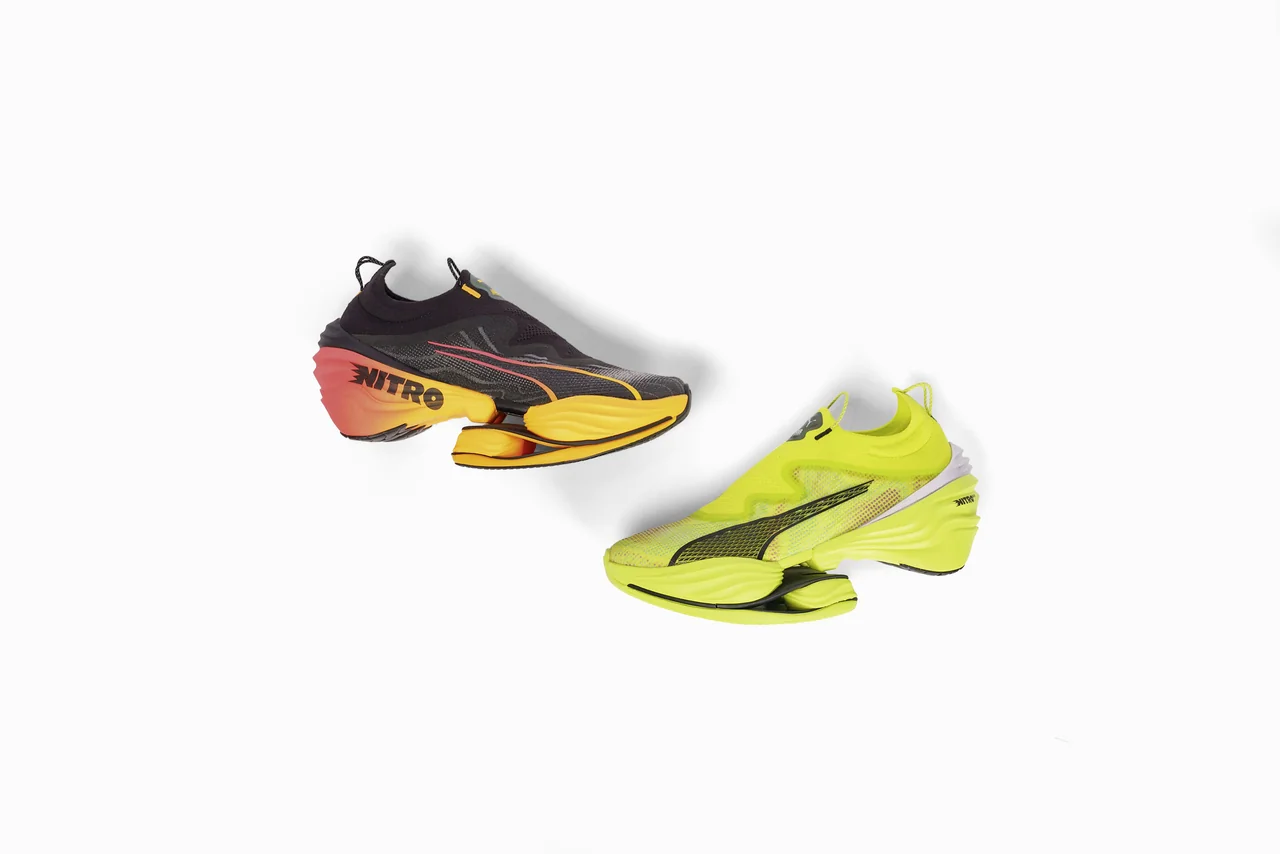
Image: PUMA
Puma has taken its racing lineup into terrain that is unusual even for the super shoe market. The Fast-RB Nitro Elite is born as a high-voltage experiment: a shoe created to push rebound to the limit, with a construction that goes beyond World Athletics rules and that, for that very reason, looks unlike almost anything that currently dominates the roads. Its calling card is anything but discreet: three plates in the midsole, a very high stack, and a silhouette that looks more like a lab piece than a conventional racing model.
The interest around this model is explained not only by its rarity, but by what it promises in motion: a very springy feel, an exaggerated takeoff, and a geometry designed to return energy with every stride. In return, the runner is met with a shoe that is heavy for its category, less stable than a legal racer, and priced among Puma’s most exclusive launches. The result is a proposition that fascinates with its audacity, even if it is not meant for everyone or for every course.
A shoe born to break the mold
The RB designation leaves no room for ambiguity: Rule Breaker. Puma conceived it as a shoe meant to explore what happens when design is pushed beyond regulatory limits. Instead of respecting the usual combination of a single plate and a restrained stack height, the model raises the technical and visual ambition several notches. In essence, it is a statement of intent.
In practice, that means a midsole split by several rigid elements and a structure that prioritizes a trampoline effect over moderation. The Fast-RB Nitro Elite does not aim to go unnoticed or fit neatly into the category of orthodox racing shoes. It operates in the territory of prototypes that want to show how far the industry can go when creativity is not bound to a rulebook.
That approach also explains its very peculiar, almost exaggerated look, with a visual presence that feels more like an engineering concept than a mass-market product. At a time when many brands pursue efficiency with ever more streamlined profiles, Puma has chosen the opposite: piling on foam, raising the base, and multiplying flex planes so that each step delivers a different response.
Three plates and a midsole chasing maximum rebound
The most striking feature of the Puma Fast-RB Nitro Elite is its internal architecture. In the upper part of the midsole, it incorporates a full carbon plate and, under the forefoot, adds two more TPU plates, separated by blocks of Nitro Elite foam. That combination is not decorative whimsy; it is meant to create a transition with more leverage, more propulsion, and a very pronounced catapult sensation as the pace rises.
Nitro Elite foam is already known from other fast models in the brand’s lineup, such as the Deviate Nitro Elite 3 or the Fast-R 2, but here it is used in a much more extreme context. The big difference is not just the amount of material, but how it is organized. The midsole appears decoupled, so that heel and forefoot do not form a continuous block of foam. That separation allows the plates to do part of the structural work and explains much of the model’s unusual character.
The stack height is also impressive: 58 mm in the heel and 46 mm in the forefoot. These figures sit outside the limits allowed in official competition and, in practice, turn the shoe into a kind of spring tower underfoot. That number does more than provide technical context; it also helps explain why the running sensation feels so different, so high, and so unlike that of a traditional racer.
What it feels like to run in it: rebound, relative lightness, and a touch of vertigo
Anyone lacing up a shoe like this is not looking for subtlety, but for very distinct sensations. The Fast-RB Nitro Elite delivers an especially lively ride, with a response that is noticeable even at easy paces. The runner feels a kind of spring underfoot, a persistent elasticity that encourages running a bit faster than expected without having to push too hard. That is part of its appeal.
However, that liveliness has a less accommodating side. The behavior is not refined in the way of a competition shoe polished for personal records, but rather exuberant, almost theatrical. When the pace rises, the shoe offers much more obvious propulsion; when the run becomes more demanding or technical, a feeling of load appears, as if the material and volume together were asking for their toll.
This is not a shoe that rewards blind haste, but rather a long stride and the sensation of floating on a base packed with energy. For that reason, rather than being a weapon for squeezing a 10K flat out on a tight course, it feels like a piece designed for enjoying faster training runs, for running by feel, and for exploring ground contact in a way that differs from the usual. Its charm lies in the rebound; its limit lies in precision.
Stability compromised by design
Stability is the big trade-off of this kind of experiment. Even many legal carbon shoes already demand clean technique and a reasonably even surface. In the Fast-RB Nitro Elite, that compromise is heightened by the height, the internal separation, and the lack of a conventional base that cradles the footstrike from heel to forefoot.
The result is a less predictable ride, especially on tight turns or damaged pavement. On a smooth straightaway it can feel like a fast, fun toy; on a street with potholes, seams, or linked corners, the whole setup asks for more attention. It is not so much unstable because of poor execution as because of a deliberate design decision: the more extreme the rebound, the less room there is for composure.
That is why its proposition should be read realistically: it is not a universal super shoe, but a very specialized and rather capricious silhouette. The runner who values security over extravagance will probably find better balance in other racing models from the brand, while anyone who wants to try something truly different will see here one of the boldest bets on the recent market.
Weight, fit, and real-world use: where the model’s character shows
The weight quickly reminds you that not everything that looks fast is fast on the scale. At around 13 ounces in a U.S. size 10, the Fast-RB sits clearly above most benchmark carbon shoes. That number moves it away from the models that seek extreme lightness to set record paces and closer to a heavier race-day experience, albeit a very springy one. It is an unusual and quite revealing combination.
The upper, on the other hand, works in the set’s favor. The laceless design may raise doubts at first, especially in a shoe with such ambitious underfoot engineering, but the fit feels secure and comfortable. In shoes like this, where the foot cannot move around inside the chassis, the lockdown across the instep matters almost as much as the foam. Puma has managed to keep the foot well secured, which is important for reducing the sense of disorder underfoot.
As for sizing, the overall impression is that it fits true to size, although those between sizes may find more security in the smaller size if they want a firmer lockdown. That detail matters because a shoe with radical geometry does not tolerate excess room well: the more the foot moves inside, the more instability is felt and the less usable the platform becomes.
Price, availability, and where it stands in Puma’s lineup
Exclusivity is not only a matter of design; it is also a matter of access. Puma launched the Fast-RB Nitro Elite with an initial run of 1,000 pairs and a price of 350 euros, while in other markets the cost has hovered around 400 dollars. At some retailers, according to the reference consulted, the observed price is around 1,359.90 reais on promotion versus a higher MSRP, confirming that this is not an affordable shoe or an impulse buy.
Its debut was also limited, with availability that reinforces that almost experimental feel. It does not compete by volume with the big daily training silhouettes; it competes for attention, for conversation, and for the technical curiosity it generates. Within the Nitro Elite family, this Fast-RB stands as the most provocative member, the one that breaks continuity and detaches itself from the logic of conventional racers.
Compared with more rational models like the Deviate Nitro Elite 3 or the Fast-R 2, the Fast-RB operates in another league: less practical, more extreme, harder to justify, and easier to remember. And that mix is precisely what makes it newsworthy. It does not seem designed to dominate the marathon circuit, but to show what Puma can do when it decides to set prudence aside and commit to a silhouette that exaggerates everything a little more than usual.
What it brings to running and what it leaves out
In terms of sensations, its contribution is clear: lots of rebound, a very marked transition, and a singular running experience. For the runner who enjoys testing materials, comparing geometries, and feeling how the ground response changes, the Fast-RB Nitro Elite offers something uncommon. It is not just fast, but expressive. Every footstrike seems to build a small story of compression and return.
What it leaves out is equally obvious. It gives up fine stability, the lightness that makes racing for a long time easier, and the versatility of a shoe that works for almost everything. Its ideal terrain does not seem to be the starting line of a major sanctioned race, but faster training sessions, runs where you want to feel a different response, and calm surfaces where the geometry does not punish as much.
That balance between fascination and limitation is what makes it interesting for the running reader: it does not offer a universal formula, but a very specific reading of how far innovation in a super shoe can be stretched. Puma has not wanted to make another variation of what is already known. It has wanted to take the concept of a fast shoe to a boundary that makes people uneasy, surprises them, and forces them to rethink what it really means to run with carbon and next-generation foam assistance.
The new laboratory of super shoes
The Fast-RB Nitro Elite acts as a barometer for an industry that is no longer content with simply going faster, but wants to do so in increasingly risky ways. The recent evolution of racing running has turned the midsole into a permanent testing ground, and Puma has decided not to trail behind. With this model, the brand shows creative muscle and allows itself a license that, in context, feels almost rebellious.
That does not mean the shoe will become the obvious choice for most runners, far from it. Its value lies elsewhere: in showing us how far a concept can scale when regulatory restraint disappears. That is where the oversized platforms, the multiple plates, and the pursuit of an almost caricatured rebound appear, as if each step wanted to lift a few centimeters farther off the ground.
In a market saturated with promises of speed, the Puma Fast-RB Nitro Elite stands out because it does not promise moderation. It offers a no-net design, a very particular ride, and an aesthetic that looks like it came straight out of a test lab. For some, it will be too much. For others, an irresistible rarity. In both cases, it makes clear that Puma is still willing to play at the edge of the rulebook to see what happens when the limit stops being a wall and becomes, simply, a suggestion.
Este artículo contiene enlaces de afiliado: si compras a través de ellos, se genera una pequeña comisión sin coste adicional para ti. Más información.



How to prevent thigh chafing: causes and real solutions

Women’s running windbreakers: seven jackets and how to choose

Do more workouts get rid of soreness? A guide for runners

Jaén Half Marathon 2026: Record 3,800 Runners Registered

Men’s short running tights: how to choose the right pair

World Triathlon confirms data breach involving medical data

Izan Edo targets podium at Miyazaki World Cup

María Pérez ranks ninth in World Athletics’ 2026 top ten

Dos Santos, Duplantis and Sawe: World Athlete of the Year finalists

San Silvestre Vallecana 2026: 42,000 places, prices and start times

 Races3 months ago
Valencia Half Marathon 2027: date and registration

 Reviews and Comparisons4 months ago
Asics Gel-Roadmiles 3 for men: review and current price

 Races3 months ago
Valencia Marathon 2026: entry, ballot and course

 Reviews and Comparisons4 months ago
Asics Gel Sonoma 8 Gore-Tex: complete analysis for trail and rain

 Sneakers3 months ago
Saucony Endorphin Pro 4: full review and verdict

 News5 months ago
Strava API 2026: what changes for clubs, challenges and runner apps?

 Reviews and Comparisons5 months ago
Nike Alphafly 3: opinions, sensations, and real key points

 Reviews and Comparisons4 months ago
Under Armour running shoes review 2025-2026: models and key features

 Sports Equipment4 months ago
Shoe sizes in cm: a clear guide to getting the right fit for your footwear

 Sneakers3 months ago
Skechers GO RUN Consistent 2.0 analysis: comfort and limits

 News5 months ago
Valencia Marathon 2026 route: key tips to train and run better

 Sneakers4 months ago
Adidas Adizero Boston 13 for men: review and verdict