Training
Dog running harness: how to choose the safest one
Keys to choosing a harness, leash, and belt and going out to run with your dog with more control, comfort, and safety.

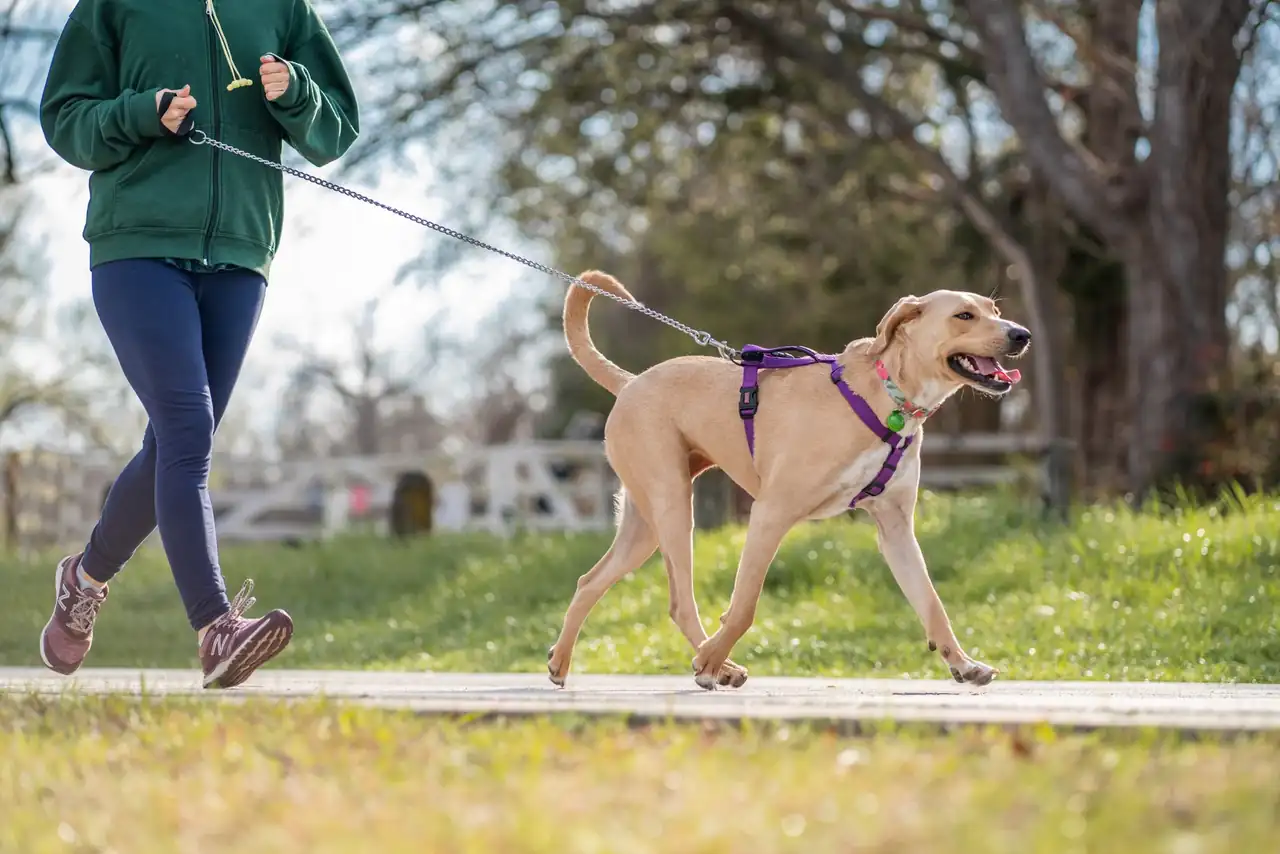
Running with a dog completely changes the experience: it stops being a quick walk and becomes a shared workout where traction, fit, and stability matter. A poorly chosen harness is noticeable right away, like a seam rubbing on every stride or a leash pulling from an awkward angle. That is why the right harness is not a secondary accessory, but the piece that distributes force, protects the neck, and lets the animal move naturally.
The market is dominated by padded, reflective, adjustable models with well-thought-out attachment points. That combination appears again and again because it addresses what matters most: comfort for the dog, control for the person, and less risk of sudden jerks. In running, jogging, or recreational canicross, the system works best when the harness adapts to the dog’s body without restricting breathing or the shoulder, and when the leash follows the movement instead of fighting it.
The centerpiece of the gear and why not just any one will do
A harness designed for running does not serve the same purpose as one for city walks. On a calm outing, the dog can stop, sniff, and change pace without much trouble. By contrast, when jogging for several kilometers, the force is repeated hundreds of times and any rubbing ends up multiplying. That is where the difference appears between a vest that merely holds and a model that distributes the load across the chest and torso, leaving the neck free and allowing a fluid stride.
Catalogs from specialized brands insist on that approach because sports use demands a different architecture. Running-oriented models usually include padded straps, multiple adjustments, breathable materials, and reflective elements. Some add a handle for occasional control, others combine front and rear rings, and the more technical versions prioritize a cleaner pull line. The idea is the same: less pressure on delicate areas and more stability during effort.
Size matters more than it seems, too. A harness that is too loose twists on the body and ends up creating friction points; one that is too tight blocks shoulder blade movement and makes the dog work less efficiently. The right fit shows up in a simple detail: the gear follows, it does not force correction. It stays in place when the animal accelerates and does not dig in when it slows down. In a sport where the body is constantly in suspension, that precision is worth its weight in gold.
What features make the difference in a good choice
The first clue is padding. The goal is not simply to look for a soft harness, but to find a balance between softness, support, and durability. A material that is too thin may feel comfortable at first and then give way or mark the skin. A very stiff one, on the other hand, limits movement and increases the feeling of load. The best-rated models tend to use breathable fabrics, reinforced in the support zones, with interiors designed for long sessions.
The second key is the adjustment system. The more serious references include quick-release buckles, adjustable chest and neck straps, and several sizes to cover everything from small dogs to large breeds. That range is not a marketing move; it responds to the need to adapt the harness to bodies with deep chests, short backs, or narrower torsos. Fine-tuning prevents the weight from falling on the wrong area and allows the harness to stay stable without squeezing too much.
Visibility also matters. Reflective stitching and luminous bands do not turn the dog into a beacon, but they do add a very useful layer at dawn, dusk, or on paths shared with bicycles. On urban or suburban outings, that detail has immediate practical value. The same is true of the top handle, which is not meant to stop forward motion continuously, but rather to correct a movement, help over a step, or keep the animal close to the body in a tricky spot.
Harness, leash, and belt: one system, not three loose pieces
The search for the right harness often leads to another common mistake: choosing only one part of the set. In reality, the harness, elastic leash, and waist belt work as a single mechanism. If one fails, the experience suffers. The shock-absorbing leash softens changes in tension; the belt spreads the load across the hip or abdominal area; the harness transfers that effort to the dog’s body without concentrating it on the neck.
That is why specific running-with-dog gear usually includes bungee lines, padded belts, and attachments that allow some freedom of movement. That small amount of elasticity makes a huge difference when the dog suddenly speeds up or gets distracted by a stimulus. The pull does not disappear, but it is cushioned. And that gesture, mechanical as it may seem, changes the biomechanics of the outing and reduces the feeling of a jolt for both.
Hands-free systems have also become standard in this setting because they free the hands and leave the torso less restricted. For runners on trails or shared paths, that freedom is especially useful. Even so, the real value is not human comfort, but that the leash remains more stable and the dog receives a clear, less erratic signal throughout the route.
Correct fit is measured in motion, not on the hanger
A harness may seem perfect in your hand and fail on the first stride. The real test comes when the dog walks, trots, and changes pace. That is when you can see whether the piece rides up toward the neck, whether the chest bridge shifts, or whether the underarm area rubs with every step. Shoulder mobility is the best thermometer. If it looks free, the gear is following; if not, the harness is imposing its shape on the dog.
Brands specialized in canine sports usually point out something sensible: every dog has its own build and the best model depends on the type of activity. A dog running beside a person at an easy pace is not the same as one taking part in canicross, bikejoring, or recreational mushing. In the first case, a short, stable harness may be enough; in the second, the geometry changes because the pull is more constant and force transmission requires a different distribution.
It is also worth looking at the dog’s behavior. Very nervous animals appreciate clear adjustment points and easy placement; those that pull hard need a design that does not shift; short-haired dogs, for example, may feel any hard edging sooner. By contrast, dogs with more body mass often benefit from firmer structures, as long as they do not sacrifice ventilation. The best harness is the one that disappears while the dog runs.
Materials, durability, and details that really matter
Product sheets repeatedly use words like durable, breathable, reflective, or padded. They are not empty embellishments: they describe qualities that make a difference after several weeks of use. A breathable fabric prevents the feeling of trapped heat on mild days, especially on long routes. Reinforced seams withstand repeated tension better. And reflective bands provide a simple, almost silent advantage, but one that is very valuable when daylight starts to fade.
Durability does not always mean heaviness. In fact, some of the best-rated models combine lightness and support so the dog does not feel a rigid block on its back. That balance is similar to a runner’s technical clothing: the less it gets in the way, the easier it is to forget it is there. In active dogs, that feeling of lightness helps maintain cadence and avoid extra fatigue from too much material.
Systems with multiple rings also deserve attention. A front ring can help redirect pulling in certain situations; the rear ring, by contrast, is the most common for most running or jogging outings. There is no need to overcomplicate things: what matters is that the configuration matches the intended use. A highly sophisticated setup is not worth it if it ends up being too big, shifting around, or requiring adjustment every two minutes.
How much it costs to gear up well and what is available on the market
The price range is wide and says a lot about the diversity of the segment. On general marketplaces, sports harnesses start at a little over 15 euros and go up to technical models that hover around 97 euros. Hands-free leashes and running belts often range between 10 and 30 euros, while the more specialized lines, geared toward pulling sports or intensive use, easily rise above 60 euros. It is not a matter of prestige, but of materials, design, and intended use.
The range helps explain a basic fact: not all dogs or runners need the same level of equipment. For occasional outings on pavement or in parks, a balanced set may be enough. However, if the route includes dirt sections, pace changes, and frequent sessions, it is worth looking at more robust materials and belts with better load distribution. The real investment is not paying more, but getting the function right.
Specialized catalogs also offer useful clues about where each product sits. There are everyday harnesses, running models, trekking options, versions for dogs that pull more strongly, and lines designed for sports such as canicross or bikejoring. That segmentation is not a commercial whim; it responds to different needs for support, control, and movement. It is worth reading it as what it is: a technical clue about how the gear will work on the street, in the mountains, or on a dirt path.
Common mistakes that turn an active walk into a bad experience
One of the most common mistakes is confusing a walking harness with a sports harness. A city model may be comfortable for strolling around, but it does not always tolerate the sustained pace of a trotting outing well. The result usually appears in the form of chafing, vest twisting, or unbalanced pulling. The dog starts protecting itself from the gear before enjoying the exercise, and at that point the activity loses its purpose.
Another mistake is ignoring size in order to squeeze the dog into an approximate category. Each brand has its own sizing and some even offer more than a dozen measurements. The variation depends not only on weight, but also on chest circumference, back length, and chest shape. A very muscular dog and another dog of the same weight may need different solutions. Measuring properly avoids returns, yes, but above all it avoids repeated discomfort.
It is also common to use a rigid or too-short leash. When running, that forces you to move while constantly managing the arm and worsens coordination. Moderate elasticity absorbs part of the impact and lets the whole system breathe better. The dog is not running tied to a wall, but connected to a system that moves with it. That difference, which seems subtle on paper, is felt immediately on the trail.
Why canicross has raised the bar for this type of harness
The rise of canicross has pushed manufacturers and specialty stores to refine the design much more. A durable harness is no longer enough; now they seek shapes that respect the dog’s mechanics while pulling effectively. That pressure has led to specific lines with better fit, adapted pull lines, and more technical materials. The discipline has turned comfort into a requirement, not an extra.
In that context, models developed for pulling sports make a clear difference. Some are designed for very active dogs, others for mixed use between running and hiking, and others include safety or assistance features. The important thing is to understand that the market is no longer generic. Someone looking for a harness to run with their dog is no longer faced with a single object, but with a small map of solutions.
That map has also sharpened the language of purchase. People no longer value only whether the harness is pretty or durable, but whether it distributes the load well, whether it breathes, whether it has reflectors, and whether it allows smooth control when needed. The maturity of the category is evident in that shift. The user is not buying a simple chest harness; they are buying a specific way to share the effort with their dog without turning the outing into a struggle.
A well-made choice is noticeable on the first lap around the park
When the set fits properly, everything becomes cleaner. The dog starts off with less neck tension, the runner does not have to correct every three meters, and the leash stops behaving like a taut rope and becomes a support line. The outing gains rhythm, stability, and confidence. Even on short stretches, that feeling is noticeable right away.
The key is to look at the gear as a small piece of home engineering: simple, yes, but very specific. The right harness distributes the load, the leash follows, the belt unloads pressure, and the reflective elements add a margin of safety. If one of those pieces is out of place, the rest feels it. That is why the choice matters so much even though the product, at first glance, may seem like just one more among dozens of options.
The final picture is clear: a dog that runs without friction and a person who keeps pace without fighting the leash. That image sums up the purpose of a good setup for running together. It is not about spectacle, but continuity. And in shared running, continuity is almost always the best sign that the harness was the right choice.



How to prevent thigh chafing: causes and real solutions

Women’s running windbreakers: seven jackets and how to choose

Do more workouts get rid of soreness? A guide for runners

Jaén Half Marathon 2026: Record 3,800 Runners Registered

Men’s short running tights: how to choose the right pair

World Triathlon confirms data breach involving medical data

Izan Edo targets podium at Miyazaki World Cup

María Pérez ranks ninth in World Athletics’ 2026 top ten

Dos Santos, Duplantis and Sawe: World Athlete of the Year finalists

San Silvestre Vallecana 2026: 42,000 places, prices and start times

 Races3 months ago
Valencia Half Marathon 2027: date and registration

 Races3 months ago
Valencia Marathon 2026: entry, ballot and course

 Reviews and Comparisons4 months ago
Asics Gel-Roadmiles 3 for men: review and current price

 Reviews and Comparisons4 months ago
Asics Gel Sonoma 8 Gore-Tex: complete analysis for trail and rain

 Sneakers3 months ago
Saucony Endorphin Pro 4: full review and verdict

 News5 months ago
Strava API 2026: what changes for clubs, challenges and runner apps?

 Reviews and Comparisons5 months ago
Nike Alphafly 3: opinions, sensations, and real key points

 Reviews and Comparisons4 months ago
Under Armour running shoes review 2025-2026: models and key features

 Sports Equipment4 months ago
Shoe sizes in cm: a clear guide to getting the right fit for your footwear

 Sneakers3 months ago
Skechers GO RUN Consistent 2.0 analysis: comfort and limits

 News5 months ago
Valencia Marathon 2026 route: key tips to train and run better

 Sneakers4 months ago
Adidas Adizero Boston 13 for men: review and verdict