Reviews and Comparisons
Forerunner 245 or 55: which one is more worth it
Real differences in battery, metrics, and daily use to choose the Garmin watch that best fits your way of running.

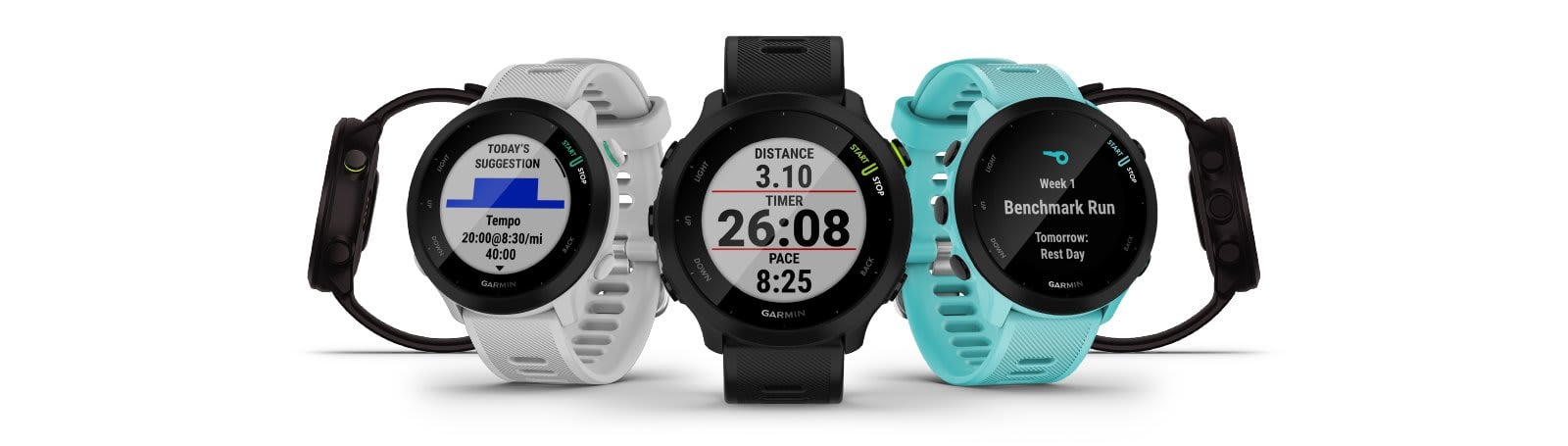
Forerunner 55
The Garmin Forerunner 245 and the Forerunner 55 share the same underlying idea: to measure running well without making the watch complicated. Both are sports-focused watches, with GPS, an optical heart rate sensor, and the Garmin Connect platform as the core of analysis. The difference between them is not in the fact that they record workouts, but in the depth with which each one turns that data into useful information.
The choice, then, is not about which one is better in the abstract, but about what kind of runner you are. The Forerunner 55 goes for simplicity, lightness, and generous battery life in everyday use. The 245 adds more metrics, a larger screen, and a more ambitious approach for anyone who wants to read their sessions better and get more out of each training week.
Two running watches with different philosophies
The Forerunner 55 behaves like a direct, almost austere tool, one that wants to be ready without asking too much in return. It is designed for those who go out running regularly, follow simple plans, and value a watch that doesn’t turn into a small office on the wrist. Its proposition is clear: record pace, distance, heart rate, and recovery with a very low learning curve.
The Forerunner 245, on the other hand, is closer to the runner who wants to read patterns. Its 1.2-inch screen and 240 x 240-pixel resolution offer a sharper display than the 55, which stays at 1.04 inches and 208 x 208 pixels. That difference doesn’t change the essence of training, but it does improve comfort when checking data fields during intervals or looking at a summary after a long run.
There is also a time difference that helps explain them. The Forerunner 245 came out in 2019 and the 55 arrived in 2021, and that gap is noticeable in the overall approach. The 55 is newer in spirit, simpler and more efficient; the 245 keeps a broader range of functions and a direction that is closer to the runner who already wants something more than a basic watch to start running.
Screen, design, and comfort on the wrist
On the wrist, both follow a recognizable Garmin aesthetic: round case, five buttons, and no touchscreen. That means button-based control, something many runners appreciate in the rain, with sweat, or when wearing gloves. There are no gestures that fail or menus that resist because of a poorly timed press; the control is mechanical, firm, and predictable.
The Forerunner 245 weighs 38.5 grams, while the 55 comes in at 37 grams. The difference is minimal, but it exists. The 55 gives a slightly lighter feel in continuous use, and that can matter in long sessions or for people who wear the watch all day. The 245 makes up for it with a larger screen and higher resolution, a combination that improves data readability when effort ramps up and your eyes don’t want to waste time.
Both are discreet watches, sporty in profile, and easy to wear for many hours at a time. In addition, the strap can be replaced on both models, which extends the aesthetic and practical lifespan of the device. In terms of resistance, they share a 5 ATM rating, enough for rain, sweat, and pool swimming, although they are not designed for high-pressure water sports.
Battery and autonomy: the point where the 55 gains ground
Battery life is one of the areas where the Forerunner 55 stands out more clearly. It offers up to 14 days in watch mode and around 20 hours with GPS enabled. For someone who runs several times a week and doesn’t want to think too much about the charger, that margin is very valuable. Charging becomes an occasional task, not a constant routine.
The Forerunner 245, for its part, reaches up to 7 days in watch mode and about 24 hours with GPS. In pure running tracking, the 245 lasts a bit longer with positioning active, but its daily battery life is lower. If the watch is going to live alongside notifications, sensors, and constant use, the 55 comes out ahead for endurance and for that sense of freedom that comes from forgetting the charger for longer.
There is an important nuance: the 245 Music version significantly reduces battery life with GPS when music is played directly from the watch. In that scenario, autonomy can drop to around 6 hours. That is enough for normal workouts, but much less convenient if you’re thinking about long runs, extended races, or more demanding days of use.
GPS, pace, and accuracy in real-world use
Both models use satellite positioning systems that work well in cities and open environments. Garmin combines GPS with other networks such as GLONASS and Galileo, a useful setup when the route passes between buildings, trees, or areas with less clean signal. In running, that translates into fewer strange jumps and a more stable pace reading.
The Forerunner 245 offers a bit more margin in pure GPS mode, with up to 24 hours compared with the 55’s 20. For most everyday workouts that difference won’t be decisive, but it can matter on long outings or for those who regularly run far from home. The 55, still, is more than enough for easy runs, intervals, and training for 5K, 10K, and popular half marathons.
Accuracy also depends on how the watch is used. Adjusting the strap properly, waiting a few seconds for the signal to lock, and choosing the right environment helps more than it seems. A watch can be technically solid and still deliver worse results if the activity is started in a hurry or the positioning mode is used incorrectly.
Training metrics: where the 245 opens the gap
The Forerunner 245’s big advantage is the amount of data it interprets. In addition to heart rate, VO2 max, and sleep, it includes functions such as heart rate variability tracking, training load, training effect, compass, altitude, and cadence sensor. That combination brings it closer to a more analytical use, more attentive to how the body responds after several back-to-back sessions.
The Forerunner 55 also measures what matters for an average runner, but it does so in a simpler language. It records heart rate, steps, sleep, stress, VO2 max, and offers daily training suggestions. For many users that is more than enough, because the watch doesn’t overwhelm with too many indicators. Its value lies in guiding without overwhelming.
The real difference appears when the runner starts looking beyond the day’s workout. The 245 allows you to dig deeper into fitness trends and load progression with more judgment. If the goal is to understand why a week felt heavy or what happened after a quality block, that extra layer of reading can be useful. The 55, by contrast, stays on a more practical and accessible level.
Smart features and the Garmin ecosystem
Both watches connect with iPhone and Android and sync with Garmin Connect, a central piece for reviewing activity, sleep, steps, and overall progress. That app is free and works as a sports diary, training archive, and control panel. It doesn’t do magic, but it organizes information well and makes it easy to see the runner’s behavior over time.
In connectivity, the Forerunner 55 provides the essentials, while the 245 adds Wi-Fi in some versions and Bluetooth 4.2 versus the 55’s Bluetooth 5. In practice, the most visible difference is not in pairing the watch with the phone, but in the extra functions. The 245 has a richer proposition for those who review data often and want a slightly more complete device in everyday use.
They also share common features such as notifications, heart rate alerts, stopwatch, inactivity alerts, and compatibility with external sensors via ANT+. These are elements that help integrate the watch into the routine, not just into training. The result is a device that works for running, but also for keeping a certain discipline outside the shoes.
What each one offers in health and recovery
In wellness, both watches measure sleep, resting heart rate, calories, stress, and other basic indicators that help place effort in context. That matters because training is not just about pushing harder; it also involves interpreting the body’s response. Seeing how the runner sleeps, how they recover, and how resting heart rate evolves gives a fuller picture than a simple stopwatch.
The Forerunner 245 adds sensors and metrics that broaden that picture, such as the pulse oximeter for blood oxygen levels and heart rate variability tracking. These are not data points that change your life on their own, but they do add an extra layer of context. For runners who train with more volume or want to monitor recovery more closely, that detail can help distinguish normal fatigue from a spell of overload.
The Forerunner 55, for its part, offers enough insight for anyone who needs to control effort without turning sport into a spreadsheet. That sobriety works in its favor. There are runners who train better when the information is clear and not excessive. For them, fewer screens can mean more focus.
Sport, profiles, and use beyond the road
Both watches go beyond pure running and allow you to record cycling, pool swimming, and gym or mobility sessions. The Forerunner 245, though, opens the door to more varied profiles and broader activity tracking, something that becomes noticeable when the user mixes sports during the week. Its functional catalog is closer to the runner who also wants a useful watch off the road.
The 245 also includes TrackBack, a compass, and altitude measurement, a more interesting combination for routes, light trail, or sessions on uneven terrain. It doesn’t turn it into an advanced mountain watch, but it does add resources to orient yourself better and follow routes with more confidence. The 55, with fewer sensors and less detail, stays with a cleaner experience and one more focused on simple workouts.
If the main use is running through the city, parks, or tracks, both perform well. If you alternate road, hills, trails, and a bit of cycling, the 245 gains ground through variety and data reading. That versatility is one of the reasons it still appears in comparisons against newer models.
Price and real buying value
Price is usually the argument that tips the scale toward the Forerunner 55. In the current market, it can be found around 149 euros, while the Forerunner 245 often appears closer to 237 euros or even above that, depending on the finish and whether it is the Music version. The price difference is notable and not always justified if the use is going to be basic.
The 55 is easier to justify for anyone who wants Garmin quality without paying for the jump to a more ambitious range. It has longer battery life in daily use, good running readability, reliable GPS, and the functions most people need to train in an organized way. The 245, on the other hand, better justifies its cost when its metrics, screen, and analytical depth are truly used.
The purchase makes more sense if you look several months ahead and not just at the starting price. A watch you use four or five days a week ends up mattering more for comfort, battery life, and clarity than for the initial difference in euros. That is where the 55 stands out for cost-effective simplicity, while the 245 only pays off when its extra features really come into play.
Which profile fits each watch better
The Forerunner 55 fits better with someone who wants to start, get back into it, or maintain a running routine without too much complexity. It also makes a lot of sense for runners preparing for 5K, 10K, or half marathons with a standard plan and who don’t need a wide catalog of metrics. Its light weight, long battery life, and clean interface make everyday use very comfortable.
The Forerunner 245 is aimed at a slightly more demanding user, someone who looks at more data, compares sessions, and values seeing fitness and recovery trends. If training already has some structure, if there are intervals, pace changes, or load blocks, that extra information starts to make sense. The Music version, moreover, adds the appeal of listening to audio without carrying the phone.
At its core, the difference is a matter of relationship with data. Someone who wants to go out running, record it, and move on is usually better off with the 55. Someone who enjoys reviewing every detail of effort, recovery, and progression will find more room in the 245. It’s not a question of absolute level, but of habits.
The most sensible decision based on what you will actually use
If the goal is to choose wisely, the Forerunner 55 offers the most reasonable balance between price, battery life, and ease of use. It has enough technology for most recreational runners and doesn’t force you to learn half a manual to get the most out of its functions. It’s a watch that keeps you company without asking too much.
The Forerunner 245 is worth it when the user knows they are going to take advantage of its extras. A larger screen, more metrics, deeper analysis, and a music-enabled version keep it appealing even against newer models. It is a purchase with more technical ambition and less simplicity, but also with more room to grow if used regularly.
In a comparison this close, the key is not which one impresses more, but which one fits better with the real act of running. The 55 measures the essentials comfortably. The 245 interprets training better and offers more room to grow. Between the two, the best choice does not depend on the isolated spec sheet, but on how each outing, each week, and each goal is lived.
You may also like: Garmin Venu 2S vs. Vivoactive 4S: which one is more worth it.
Este artículo contiene enlaces de afiliado: si compras a través de ellos, se genera una pequeña comisión sin coste adicional para ti. Más información.



How to prevent thigh chafing: causes and real solutions

Women’s running windbreakers: seven jackets and how to choose

Do more workouts get rid of soreness? A guide for runners

Jaén Half Marathon 2026: Record 3,800 Runners Registered

Men’s short running tights: how to choose the right pair

World Triathlon confirms data breach involving medical data

Izan Edo targets podium at Miyazaki World Cup

María Pérez ranks ninth in World Athletics’ 2026 top ten

Dos Santos, Duplantis and Sawe: World Athlete of the Year finalists

San Silvestre Vallecana 2026: 42,000 places, prices and start times

 Races4 months ago
Valencia Half Marathon 2027: date and registration

 Races4 months ago
Valencia Marathon 2026: entry, ballot and course

 Reviews and Comparisons4 months ago
Asics Gel-Roadmiles 3 for men: review and current price

 Reviews and Comparisons4 months ago
Asics Gel Sonoma 8 Gore-Tex: complete analysis for trail and rain

 Sneakers3 months ago
Saucony Endorphin Pro 4: full review and verdict

 News5 months ago
Strava API 2026: what changes for clubs, challenges and runner apps?

 Reviews and Comparisons5 months ago
Nike Alphafly 3: opinions, sensations, and real key points

 Reviews and Comparisons4 months ago
Under Armour running shoes review 2025-2026: models and key features

 Sports Equipment4 months ago
Shoe sizes in cm: a clear guide to getting the right fit for your footwear

 Sneakers3 months ago
Skechers GO RUN Consistent 2.0 analysis: comfort and limits

 News5 months ago
Valencia Marathon 2026 route: key tips to train and run better

 Sneakers4 months ago
Adidas Adizero Boston 13 for men: review and verdict