Races
Angkor Empire Marathon: complete guide to the Angkor marathon
A race in Cambodia among ancient temples, with a flat course, humid heat, and a strong charitable dimension.

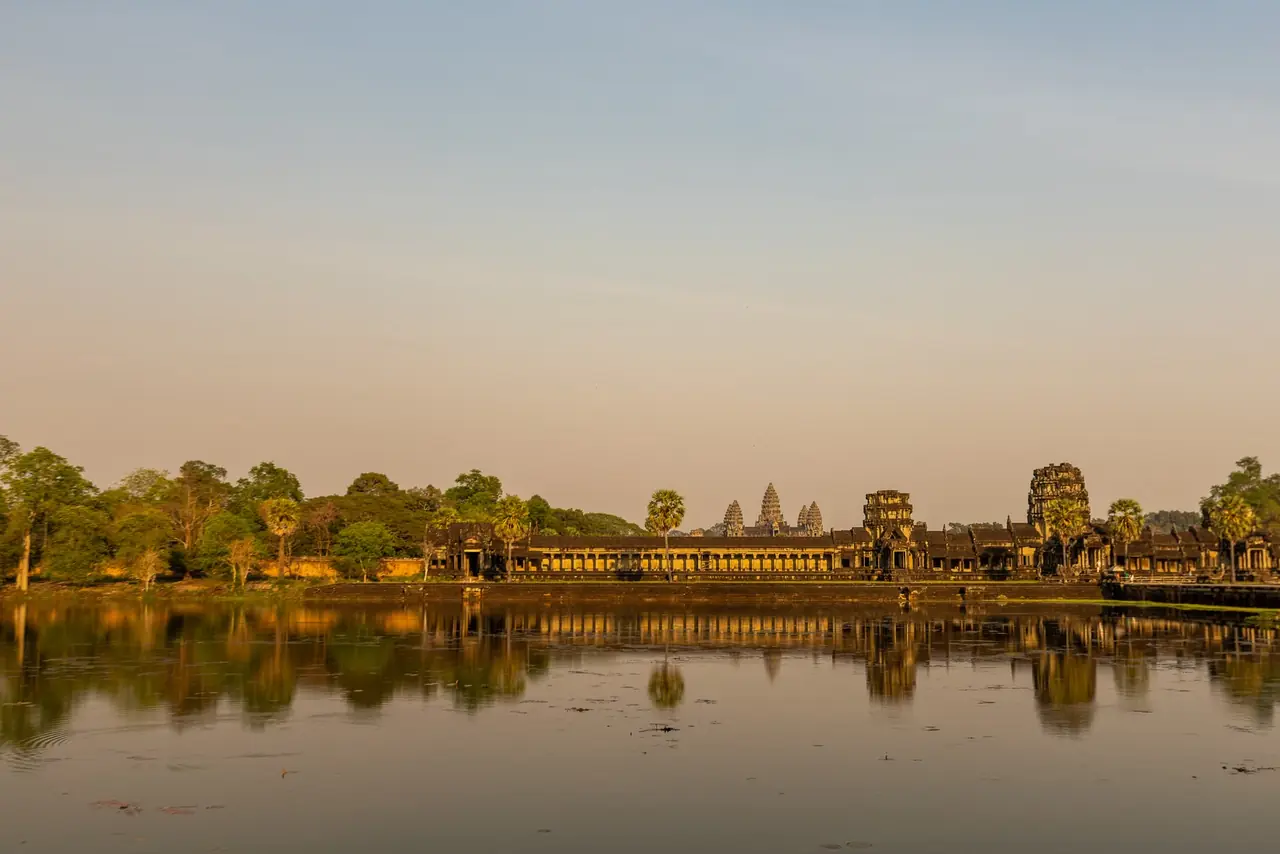
The Angkor Empire Marathon is much more than a 42.195-kilometer race: it is a run mapped out among the temples of Angkor, in Cambodia, where dawn falls on stone, jungle, and red dust with a theatrical quality that is hard to replicate anywhere else on the international calendar.
Since its debut in 2014, it has established itself as Cambodia’s first full marathon and as an event that blends sports tourism, world heritage, and logistics designed for runners looking for something different from the great urban avenues. The start and finish are located in the Angkor Wat complex, and that detail alone explains much of its magnetism.
A marathon born among living ruins and with a charitable vocation
The race belongs to the Angkor races universe, a group organized around the Siem Reap archaeological park, with the support of the National Olympic Committee of Cambodia and local entities linked to athletics and event organization. Its history is tied to a very specific idea: running as a way to attract attention, resources, and visitors to a place that does not need an introduction, but does need protection.
The charitable dimension is not decorative. The available information about the event indicates that the funds and partnerships have benefited children’s hospitals, organizations linked to disability, and humanitarian entities in the country. At the origin of the project also appears the fight against landmines, a historical wound in Cambodia that continues to shape civilian life decades after the conflict.
This combination of sport and social cause explains why the race has never been understood solely as an elite competition. Although it has timing, rankings, and winners, the focus is also on the symbolic value of running through a territory that preserves memory, landscape, and devotion in a single scene.
The course: asphalt, dust, and temples under the first light
The route is known for being technically fast and environmentally demanding. It has no major elevation changes and runs over a mix of asphalt and compact dirt sections, passing through areas of the archaeological park and around iconic temples. That apparent simplicity is deceptive: heat, humidity, and the start time affect the effort from the very first kilometer.
The marathon starts and finishes in front of Angkor Wat temple, a setting that works both as a postcard and as a logistical challenge. The circuit passes through areas such as Angkor Thom, Bayon, and Ta Prohm, and moves into spaces of shade, stone, and tropical vegetation where the race becomes almost a cinematic sequence. The runner advances between carved facades and paths where the silence of the place weighs as much as fatigue.
In sporting terms, the route favors steady paces because of its fairly flat profile, but the environmental conditions demand caution. In a race of this kind, hydration is not a detail: it is a central part of the race strategy, just like managing the heat in a start that is usually held before dawn to avoid the hottest hours of the day.
What sets Angkor apart from other destination marathons
The Angkor marathon does not compete only with other Asian marathons. It competes with a broader idea of sporting experience. Those who travel to Siem Reap for this event are not looking only for a personal best; they are looking for a race that seems to cross a sheet of history. The appeal is not pure speed, but the rarity of running in an environment with archaeological, spiritual, and scenic value.
That uniqueness also explains its growth. Data observed across different editions show increasingly international participation, with runners arriving from dozens of countries and a very strong local base. In the 2024 edition, for example, the event brought together more than 3,000 participants, and in 2025 it surpassed 4,000 registrations, confirming steady growth in the post-pandemic period.
The race has been gaining ground within Cambodia’s sports tourism sector, an increasingly visible segment. Hotels, restaurants, transfers, and excursions benefit from the pull of an event that concentrates visitors in Siem Reap and extends the season beyond the simple tourist temple circuit. Its economic impact is indirect, but tangible, especially in a destination where local life depends largely on the flow of travelers.
Distances, formats, and the marathon’s place in the full day
The Angkor Empire Marathon is part of a broader program that usually includes other distances. The main reference remains the full marathon, although the event shares the day with half marathon, 10-kilometer, and, in some years, shorter popular runs. That structure multiplies participation and makes the event function as an athletic festival of several speeds.
For recreational runners, that breadth has a clear consequence: the day is not limited to the challenge of 42.195 kilometers. The atmosphere becomes a mosaic of paces, from those seeking to cover the distance calmly to those chasing a podium place. In organizational terms, this requires carefully separating flows, paces, and aid stations, something especially delicate in a heritage setting.
The marathon, as the flagship event, retains an image of classic effort, but in Angkor it is wrapped in an additional layer of context. The race does not gain epic quality because of altitude or alpine toughness; it gains it through the contrast between bodily fatigue and a landscape that seems suspended in time.
Winners, times, and a list that reflects the race’s character
The race’s winners’ list confirms that this is not a circuit designed for track records. The winning times are solid, but the environment, climate, and type of course place the competition in a different register. The first men’s winner was Neko Hiroshi, with a time of 2:45:28 in 2014, while the initial women’s winner was Veronique Messina, from France, with 3:36:04.
Subsequent editions feature names from Japan, Australia, the United Kingdom, Ireland, Vietnam, and Cambodia, revealing the event’s international weight. In 2024, Van Pheara clocked 2:40:51 in the men’s victory and Caitriona Jennings won the women’s race in 3:05:41. These are times that show a serious, competitive race with a notable level, but always conditioned by a geography that shows no mercy.
The reading of these results reveals another important idea: Angkor rewards adaptation to context. It is not enough to arrive in good shape; you have to know how to run in humidity, manage your pulse, and accept that the course demands respect. The beauty of the place does not eliminate the difficulty; it only disguises it for a few meters.
The heritage value and the tensions generated by so much visibility
The presence of thousands of runners in the archaeological park raises an unavoidable question: how to reconcile the event’s international profile with the conservation of a fragile site. Angkor is a UNESCO site and one of the world’s great archaeological jewels, but it is also a place subject to enormous tourist pressure throughout the year.
Authorities and organizers have emphasized control measures, marked routes, and logistical care to reduce the impact. Even so, the debate exists because every mass event adds traffic, noise, waste, and another layer of use on a space already strained by conventional tourism. The race lives off the beauty of the place, but it also inherits its vulnerabilities.
That balance is delicate. In an urban marathon, the main issue is usually street closures. In Angkor, the question is deeper: how to turn a heritage space into a sports stage without trivializing or wearing it down. The answer is never simple, and that is why the event arouses both interest and caution.
Climate, timing, and real demands on the runner
The early start is not an aesthetic whim. In Siem Reap, heat and humidity can make an effort that, on paper, seems easy because of the flat course, feel scorching. Running before sunrise helps lower the temperature, but it does not eliminate the strain. The body sweats more than expected, the heart rate rises quickly, and the thermal sensation changes rapidly as the sun gains height.
That is why the race demands preparation different from what a mild autumn marathon in Europe would require. The pace must be calibrated carefully, because managing fluids and salts weighs almost as much as aerobic fitness. Those who ignore the climate often discover too late that a flat course can become a battle of endurance simply because of the environment.
This contrast between apparent ease and real difficulty is one of the marathon’s keys. The profile is not intimidating, but the environment is. And in races like this, the environment is not a backdrop: it is a main actor.
An event that has gained weight within the Asian calendar
The growth of the Angkor Empire Marathon reflects a broader trend: the expansion of destination marathons in Asia, where heritage, tourism, and sport have combined with notable effectiveness. Cambodia has found in Angkor a natural showcase, and the race has served as a gateway for runners seeking experiences outside the European or North American circuit.
The pandemic interrupted that momentum, as it did with so many races around the world, but the recovery afterward has been clear. In recent years, the event has once again brought together local and international runners, with an increasingly stable participation base and a profile that no longer depends solely on initial curiosity.
Its place in the calendar matters because it reinforces a specific image of Cambodia: that of a country using sport to tell another story about itself, one less immediate than the tourist postcard and more closely tied to resilience, memory, and shared movement.
Why the Angkor marathon continues to attract runners from many countries
The answer lies in the combination of factors. The setting is incomparable, the organization has grown over the years, the charitable component adds meaning, and the course offers an experience that is difficult to replicate anywhere else. It is not a race to chase a fast time and stop there; it is an event that blends stopwatch and landscape as if they were part of the same story.
Moreover, the race has something many major marathons have lost through excessive homogeneity: its own character. It does not resemble a traffic-closed avenue or a skyscraper circuit. It has stone, temples, humidity, history, and a light that changes the perception of every kilometer. That mix creates loyalty among those who run it once and decide to return.
In a calendar saturated with very similar events, Angkor stands out because it forces the runner to think differently. There, performance is measured not only in minutes, but also in the ability to coexist with an exceptional place without damaging its fragility. That tension, between effort and respect, is probably the underlying reason why the Angkor Empire Marathon has gone from an exotic novelty to a stable reference point for destination marathons in Asia.
A race that matters as much for its story as for its finish
The Angkor Empire Marathon retains the rarity of events that still seem to tell a story larger than themselves. Its value lies not only in the standings or the number of finishers, but in the image it leaves behind: runners entering and leaving a landscape where jungle, stone, and dawn seem to breathe at the same time.
That is its great merit. It turns running into a way of seeing. And in times of uniform calendars, that quality is worth almost as much as a good finishing time. Angkor does not promise ease; it promises a scene that lingers, as if each stride left one more line on the sand of an ancient place that is still alive.



How to prevent thigh chafing: causes and real solutions

Women’s running windbreakers: seven jackets and how to choose

Do more workouts get rid of soreness? A guide for runners

Jaén Half Marathon 2026: Record 3,800 Runners Registered

Men’s short running tights: how to choose the right pair

World Triathlon confirms data breach involving medical data

Izan Edo targets podium at Miyazaki World Cup

María Pérez ranks ninth in World Athletics’ 2026 top ten

Dos Santos, Duplantis and Sawe: World Athlete of the Year finalists

San Silvestre Vallecana 2026: 42,000 places, prices and start times

 Races3 months ago
Valencia Half Marathon 2027: date and registration

 Races3 months ago
Valencia Marathon 2026: entry, ballot and course

 Reviews and Comparisons4 months ago
Asics Gel-Roadmiles 3 for men: review and current price

 Reviews and Comparisons4 months ago
Asics Gel Sonoma 8 Gore-Tex: complete analysis for trail and rain

 Sneakers3 months ago
Saucony Endorphin Pro 4: full review and verdict

 News5 months ago
Strava API 2026: what changes for clubs, challenges and runner apps?

 Reviews and Comparisons5 months ago
Nike Alphafly 3: opinions, sensations, and real key points

 Reviews and Comparisons4 months ago
Under Armour running shoes review 2025-2026: models and key features

 Sports Equipment4 months ago
Shoe sizes in cm: a clear guide to getting the right fit for your footwear

 Sneakers3 months ago
Skechers GO RUN Consistent 2.0 analysis: comfort and limits

 News5 months ago
Valencia Marathon 2026 route: key tips to train and run better

 Sneakers4 months ago
Adidas Adizero Boston 13 for men: review and verdict