Races
Backyard Aranjuez O1R 2027: route, date and prices
An endurance race by the Tagus, with a four-loop option and practical details worth checking.


The O1R Backyard in Aranjuez returns on Friday, June 11, 2027, using an ultradistance format in which participants set off on a new loop whenever the hour begins. The announced circuit is 6.706 kilometres long, and the event also offers a Challenge capped at four laps, or around 27 kilometres in total.
The event is based at Estadio El Deleite in Aranjuez. The organisers run three formats on the same loop: the classic Backyard and the 3×8 relay start on June 11 at 7:30 p.m., and the four-lap Challenge starts on June 12 at 7:30 a.m.
A race that changes the logic of ultradistance
A conventional race is measured by distance and time: runners reach the finish after completing the course. In the Backyard format, the loop and the clock set the terms. Runners must cover approximately 6.706 kilometres within each one-hour interval; at the start of the next hour, those still competing set off again. The event continues until one participant remains able to complete the final lap alone.
This structure changes the strategy. Stamina matters, but runners also need to finish each lap with time to spare, eat and drink without wasting time, and be ready to run again. Speed alone does not decide the result. A sustainable pace and making good use of the available recovery minutes can matter more than gaining a few seconds in the opening kilometres.
The 2027 edition is the event’s third. For first-timers, its appeal lies in the balance between repetition and endurance: the same distance starts over, but fatigue, temperature and decisions in the rest area are never quite the same.
Date, venue and start times to distinguish
The date for the main event is June 11, 2027, in Aranjuez, in the province of Madrid. Every lap starts and finishes at Estadio El Deleite.
The Backyard starts at 7:30 p.m. Runners begin in the evening, and those who keep going run through the night and into the next day.
The four-lap Challenge starts the next morning, June 12 at 7:30 a.m. The organisers aim it at runners who want to try the format. The 3×8 relay is for teams of three: each runner has to complete eight hours, and they can hand over whenever they like. It starts with the Backyard and is meant for intermediate runners or those who find the Challenge too short. All three formats share the loop, so newcomers run alongside the event’s veterans.
Course & elevation Edition 2027
Per-kilometre table
| Km | Elevation | Grade |
|---|---|---|
| 1 | 518 m | 0.2 % |
| 2 | 566 m | 4.8 % |
| 3 | 535 m | -3.1 % |
| 4 | 542 m | 0.8 % |
| 5 | 537 m | -0.6 % |
| 6 | 511 m | -2.6 % |
| 7 | 518 m | 0.9 % |
The 6.706 km loop and its terrain
The route combines natural trails, dirt tracks and sections of asphalt. Available descriptions call it relatively nontechnical compared with steeper mountain courses, although switching surfaces requires runners to adapt their stride. A firm section may invite a faster pace; on uneven dirt, that same long stride can feel less stable and waste energy.
The official GPX of the loop gives about 166 metres of climbing per lap. Even moderate climbing adds up over many laps.
Estadio El Deleite is described as the start, finish and support area. The route is linked to the natural surroundings of Aranjuez, with references to paths by the Tagus and shaded areas. These details may change with the final course, so the organiser’s map and instructions should take priority over general third-party descriptions.
How the Backyard format works
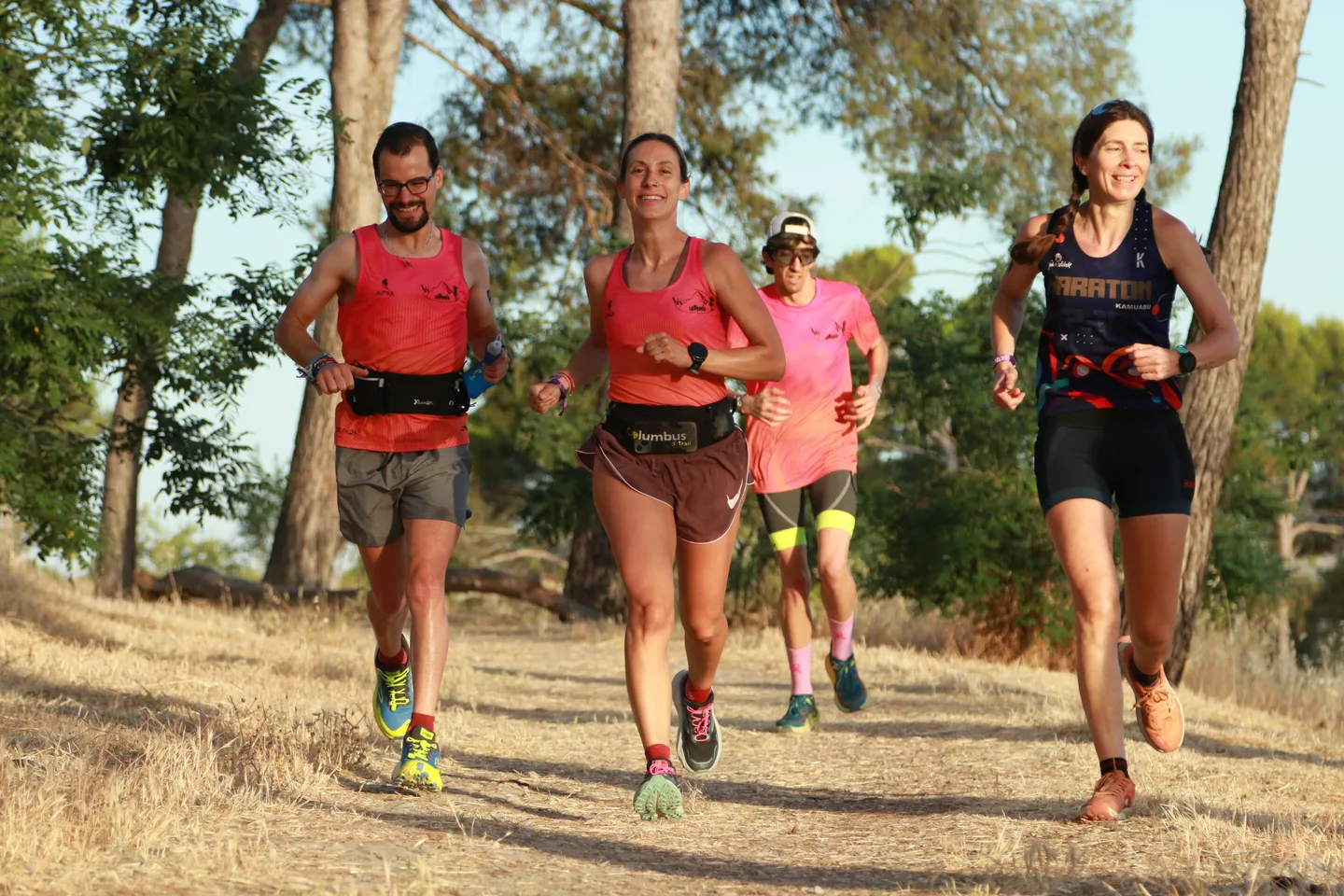
In a classic Backyard, each runner has an hour to complete the loop. Those who finish early do not win for doing so: the remaining time is available for drinking, eating, changing clothes or recovering before the next start. Anyone who fails to finish on time, misses the start or does not complete the lap under the rules is out. The race continues until one person completes a lap without another participant finishing alongside them.
The pause between laps may seem generous when legs are fresh, but it becomes a delicate resource as the hours pass. Sitting for too long can make it harder to start moving again; setting off without drinking or eating may have consequences later. A simple, repeatable routine in the life base, the support area at the stadium, can help avoid improvising every time.
The event also asks runners to accept that the pace of one lap cannot predict what will happen several hours later. Temperatures may fall after sunset and rise again in the morning; sleep, digestion and blisters can change too. Endurance builds lap by lap, with room to adjust effort and pay attention to the body.
The four-lap Challenge, a different distance
The Challenge allows runners to complete up to four laps, making it more limited than the open-ended Backyard format. Four loops of 6.706 kilometres add up to approximately 26.8 kilometres. It is not a conventional 27-kilometre race on one continuous course: the effort is divided into laps and organised around the format’s starts and breaks.
This option offers a defined challenge for those who do not want to remain in competition for hours or until only one runner is left. Even so, four laps mean enough time on the move for hydration, comfortable footwear and nutrition to matter. The transition at the stadium is not a decorative detail; it is part of managing effort from one section to the next.
The Challenge costs 35 euros and starts the morning after the main event, so check the date and time of your format when registering and planning travel.
Entry fees and registration: the listed price bands
The Backyard entry fee has three bands: 65 euros until July 12, 2026, 75 euros from July 13 to October 19, and 85 euros from October 20 until registration closes on May 31, 2027. The Challenge costs 35 euros.
Each format has its own registration page on YouEvent: Backyard, 3×8 relay and Challenge.
Items mentioned as included are a race bag, food and drink from the first lap, a finisher gift and medical assistance during the event. The precise services and conditions for each format may change; the current regulations and registration confirmation are the practical references for what the entry actually includes.
Fuel, rest and equipment
Descriptions say food and drink will be available at the stadium from the first lap, but not at supported stations along the course. In practice, this separates the support available at the life base from what participants need to carry during a loop. This matters especially in hot weather or during the later hours, when thirst and fatigue can make decisions harder.
Comfortable, stable footwear matters more than an extreme outsole on a route described as mixed and relatively nontechnical. Shoes should work reasonably well on trails, dirt and asphalt without creating pressure points that can turn into blisters over repeated laps. A cap, sunscreen, spare socks and a dry layer may be useful, but the final choice depends on the forecast close to race day.
The support area allows runners to organise familiar foods, drinks and spare clothes, in line with the rules. Keeping each item in a recognisable place prevents a short break turning into a search through bags. Race day is not the time to try new products: familiar food and drink mean fewer unknowns when the stomach begins to feel the hours.
June in Aranjuez: heat and managing effort
June usually brings high temperatures and long hours of sunshine to central Spain. A guide based on historical averages estimates temperatures between 17 and 29 degrees on the date, but this is a climate reference, not a forecast for race day. Actual conditions can vary, and an event continuing into the following morning may pass through different weather within a few hours.
The 7:30 p.m. start puts the opening laps in the heat stored during the day. Shade brings relief but does not eliminate fluid loss or the risk of overheating.
Effort should stay at an intensity that allows runners to continue without turning every lap into a race against the clock. Regular drinking and familiar foods are general guidelines, not a fixed prescription: needs change with temperature, sweat and duration. Dizziness, confusion, sudden weakness or severe discomfort are reasons to stop and seek help, not tests of character.
Records and the context of the event
Results listings name Emilio Pérez as the author of a mark of 27 laps in the 2025 edition, equivalent to around 181 kilometres using a 6.706-kilometre loop. Another report gives 183.6 kilometres, a figure that appears to use a different lap distance. The discrepancy shows why it is useful to read kilometre totals alongside lap counts and the course used in each year.
For 2026, one guide credits Guzmán Calderón with the men’s win after 20 laps and says Sandra Armas completed 17 to set the best women’s mark of that edition. Results in this kind of event reflect more than fitness: experience, tolerance for repeating the course and the ability to maintain a routine through the night all play a part.
Those results help illustrate the endurance level the event can reach, but they are not a reasonable benchmark for every participant. The Challenge has its own limit, while the open Backyard has no predetermined final distance. Conditions vary from one edition to another, and the most striking result does not tell the whole story of the field.
Travel and details still to confirm
Aranjuez is connected to Madrid by the C-3 Cercanías commuter rail line; one guide estimates the journey from Atocha at around 50 minutes. It also says the station is about a 15-minute walk from Estadio El Deleite. These are useful references for planning a car-free journey, though actual travel times depend on rail service and the final location of the start.
Those travelling with a chair, clothing, food and other support items may find a car more convenient, but the available information does not make one essential. Staying in Aranjuez or nearby towns may be an option if the event runs into the evening and night or if the Challenge requires an early start. Parking, access and specific services should not be assumed without checking the organiser’s instructions.
For last-minute updates, the organisers post on the Only One Race website and on Instagram.
Free training runs and course videos
Ahead of the race, the organisers run a training community with free monthly social runs: November 28, 2026, and January 17, February 20, March 14, April 18 and May 22, 2027.
You can see the loop in this course video, and the 2026 start filmed by drone on YouTube (more in their video playlist).
A race decided between one lap and the next
The distinctive feature of the Aranjuez Backyard is not only running trails and tracks around the stadium. It is returning to a familiar point, stopping for a few minutes and deciding whether the body can handle another hour. For some, the goal will be to complete four laps; for others, it will be to keep going while competitors remain in the race.
Aranjuez provides natural paths and a contrast between the life base and a course that starts over again and again. But the experience depends on practical details: a clear start time, a route that matches the edition and an understanding of what each format includes. In an event built on repetition, accurate information is part of endurance too.
Where to stay in Aranjuez
Hotels available 9–12 June 2027.
Affiliate links: if you book through this map we earn a commission, at no extra cost to you.



How to prevent thigh chafing: causes and real solutions

Women’s running windbreakers: seven jackets and how to choose

Do more workouts get rid of soreness? A guide for runners

Jaén Half Marathon 2026: Record 3,800 Runners Registered

Men’s short running tights: how to choose the right pair

World Triathlon confirms data breach involving medical data

Izan Edo targets podium at Miyazaki World Cup

María Pérez ranks ninth in World Athletics’ 2026 top ten

Dos Santos, Duplantis and Sawe: World Athlete of the Year finalists

San Silvestre Vallecana 2026: 42,000 places, prices and start times

 Races3 months ago
Valencia Half Marathon 2027: date and registration

 Races3 months ago
Valencia Marathon 2026: entry, ballot and course

 Reviews and Comparisons4 months ago
Asics Gel-Roadmiles 3 for men: review and current price

 Reviews and Comparisons4 months ago
Asics Gel Sonoma 8 Gore-Tex: complete analysis for trail and rain

 Sneakers3 months ago
Saucony Endorphin Pro 4: full review and verdict

 News5 months ago
Strava API 2026: what changes for clubs, challenges and runner apps?

 Reviews and Comparisons5 months ago
Nike Alphafly 3: opinions, sensations, and real key points

 Reviews and Comparisons4 months ago
Under Armour running shoes review 2025-2026: models and key features

 Sports Equipment4 months ago
Shoe sizes in cm: a clear guide to getting the right fit for your footwear

 Sneakers3 months ago
Skechers GO RUN Consistent 2.0 analysis: comfort and limits

 News5 months ago
Valencia Marathon 2026 route: key tips to train and run better

 Sneakers4 months ago
Adidas Adizero Boston 13 for men: review and verdict