Races
Bidasoa Half Marathon 2027: route and schedules
Irun and Hondarribia once again host a fast, approved race with services designed for runners.

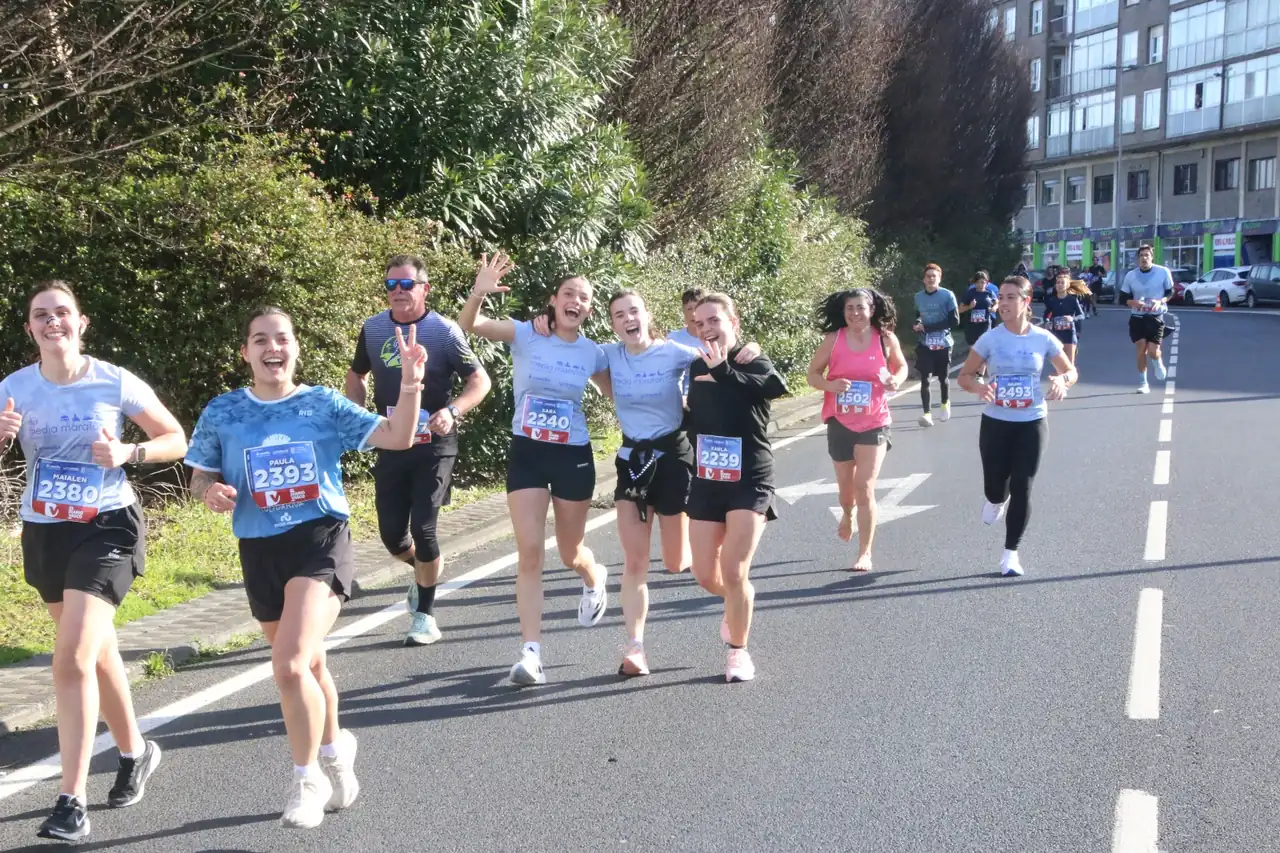
Photo: Super Amara Bidasoa Atletiko Taldea (2026 edition), courtesy of the organisers.
The Bidasoa Half Marathon has established itself as one of the fastest races in the northern part of the Iberian Peninsula: a flat, officially certified course starting in Irun that also crosses Hondarribia before returning to the urban heart of the finish. The 2027 edition is set for February 28, with the 10K starting at 09:50 and the half marathon at 10:00, a schedule that favors those looking for a fast pace and a steady performance.
The event combines what rarely comes together on the same Sunday: a fast course, organization highly focused on the runner, and a coastal setting that gives the event its character. It is not just a race for those chasing a time; it is also for those who value clear logistics, finish-area services, and a well-put-together competition experience, with bib collection, bag drop, changing rooms, and refreshments planned at several points along the course.
A course designed for real running
The main appeal of this race lies in the shape of the route. The start is located on Paseo de Colón, in Irun, and from there the course heads toward Hondarribia following an almost uninterrupted line. The organizers themselves describe it as a fully certified and flat course, two words that carry enormous weight in the road-racing calendar: certified means the route is validated so times are officially recognized, and flat means less muscular punishment and fewer pace variations.
In practice, that makes the race a very rewarding setting for those seeking consistency. There is no mountainous profile to disrupt stride mechanics or a succession of turns to upset rhythm. The 2026 edition already included a change in the final stretch to create a straighter, faster finish with no turns, and the certification was renewed. That kind of adjustment may seem minor from the outside, but in a road race every curve avoided is a small victory against the clock.
The finish is at Plaza de Urdanibia, in Irun, closing an urban route with an Atlantic feel and open views of the border area. The race name is not decorative: the Bidasoa River serves as the guiding thread, and its presence shapes much of the event’s identity, with a route through city, coast, and border landscape that sets it apart from more mundane half marathons.
Schedules, distances, and start times
The event offers two official distances, 10 kilometers and a half marathon, a format that is increasingly common in races that want to attract different runner profiles without losing sporting coherence. The 10K starts at 09:50 and the half at 10:00, with separate start corrals according to participants’ levels. That detail is not incidental: it helps organize the field from the first meter and reduces start-line congestion in a race where pace matters almost as much as endurance.
The half marathon also includes split-time references that help explain its real level of difficulty. The total time limit is 2 hours and 30 minutes, with intermediate checkpoints at kilometers 5, 10, 15, and 20. In the 10K, the maximum time is set at 1 hour and 10 minutes. These are reasonable limits for a popular race, but clear enough to rule out improvisation: here, it pays to start with a race plan, however simple.
The organizers have also detailed the aid-station layout: five aid stations planned in the half marathon and two in the 10K, plus the finish refreshments. In a fast race, these stations do more than provide water; they also help regulate body temperature, break up monotony, and maintain focus when the pace starts to weigh on the legs. In a road race by the sea, where weather can change quickly, that logistical support becomes even more valuable.
Courses & elevation
Edition 2026
Per-kilometre table
| Km | Elevation | Grade |
|---|---|---|
| 1 | 14 m | -1.1 % |
| 2 | 5 m | -0.9 % |
| 3 | 5 m | 0.0 % |
| 4 | 4 m | -0.1 % |
| 5 | 5 m | 0.1 % |
| 6 | 6 m | 0.0 % |
| 7 | 4 m | -0.1 % |
| 8 | 6 m | 0.2 % |
| 9 | 7 m | 0.1 % |
| 10 | 7 m | 0.1 % |
| 11 | 6 m | -0.1 % |
| 12 | 7 m | 0.1 % |
| 13 | 4 m | -0.3 % |
| 14 | 6 m | 0.2 % |
| 15 | 24 m | 1.8 % |
| 16 | 7 m | -1.7 % |
| 17 | 9 m | 0.3 % |
| 18 | 8 m | -0.2 % |
| 19 | 8 m | 0.0 % |
| 20 | 8 m | 0.0 % |
| 21 | 6 m | -0.1 % |
| 22 | 7 m | 0.8 % |
Edition 2026
Per-kilometre table
| Km | Elevation | Grade |
|---|---|---|
| 1 | 11 m | -1.1 % |
| 2 | 5 m | -0.6 % |
| 3 | 12 m | 0.7 % |
| 4 | 22 m | 1.0 % |
| 5 | 6 m | -1.6 % |
| 6 | 7 m | 0.0 % |
| 7 | 6 m | -0.1 % |
| 8 | 6 m | 0.0 % |
| 9 | 3 m | -0.2 % |
| 10 | 6 m | 0.2 % |
Entries and places
According to the organisers, bibs are still available. There is a limit of 3,200 bibs across the two distances, the half marathon and the 10K, and entries are on the official race website.
- Charity: the association chosen for the next edition is Mi Dulce Guerrero, which fights type 1 diabetes.
- Smarktec company race: companies enter teams of 4 runners; each runs individually and their times are added up for the company ranking. There are men’s, women’s and mixed categories in both the half marathon and the 10K.
- Course: it runs through Irun and Hondarribia. It is right by the border but does not cross into France.
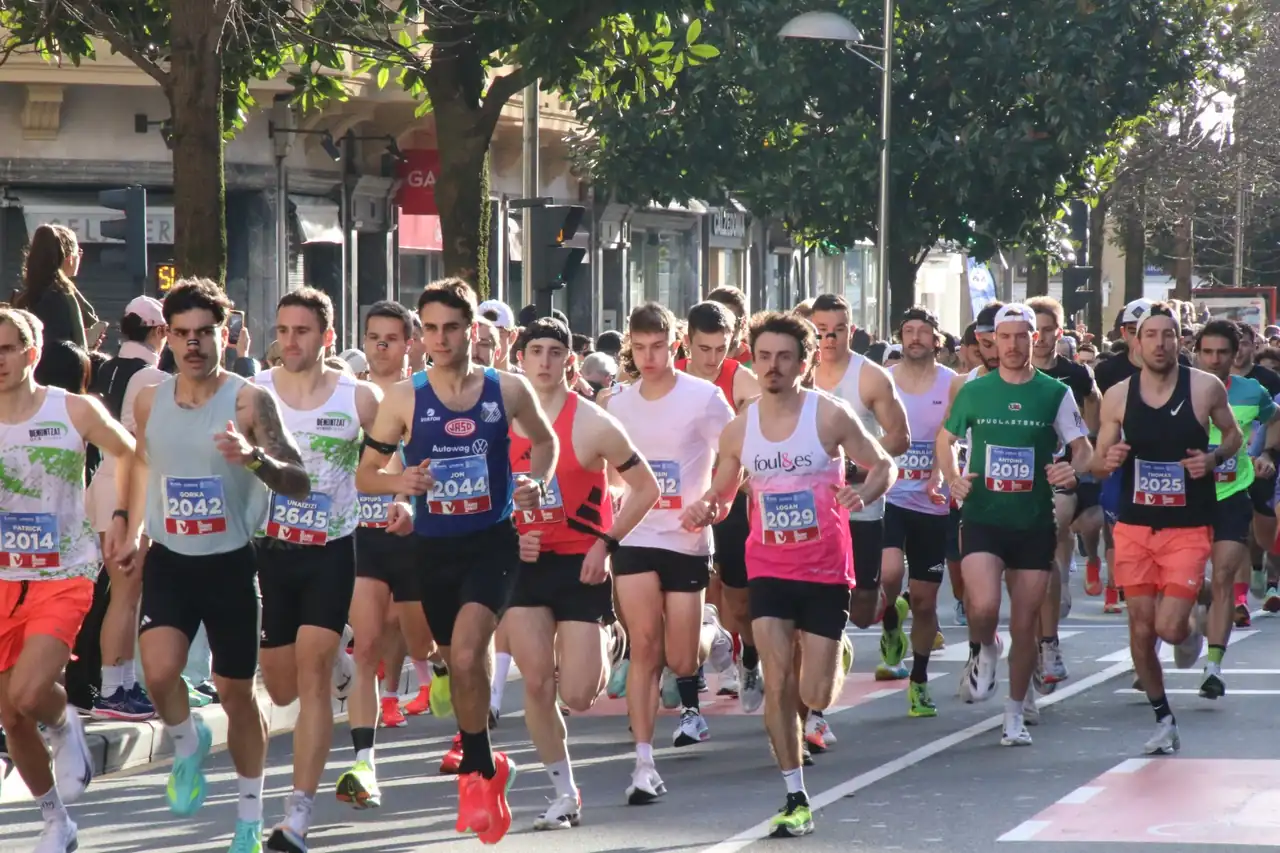
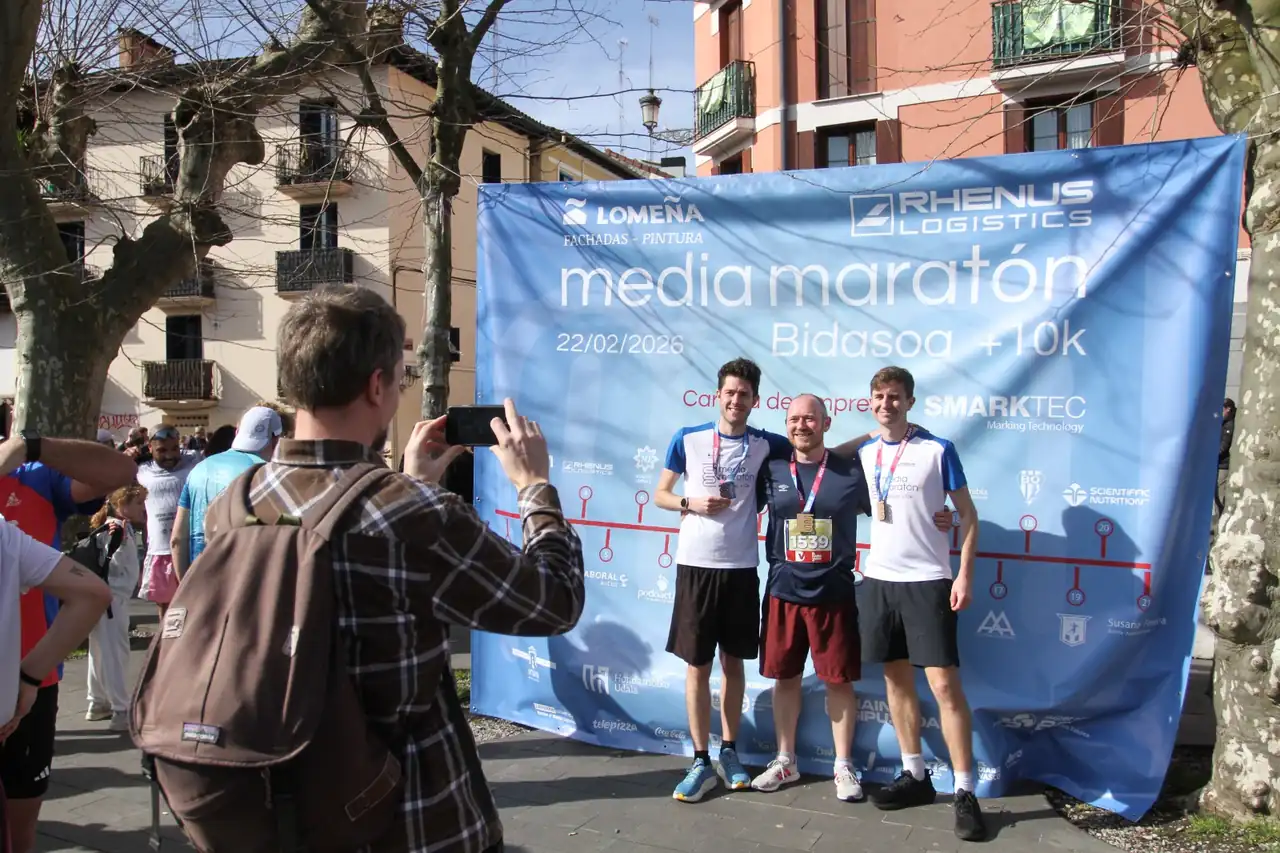
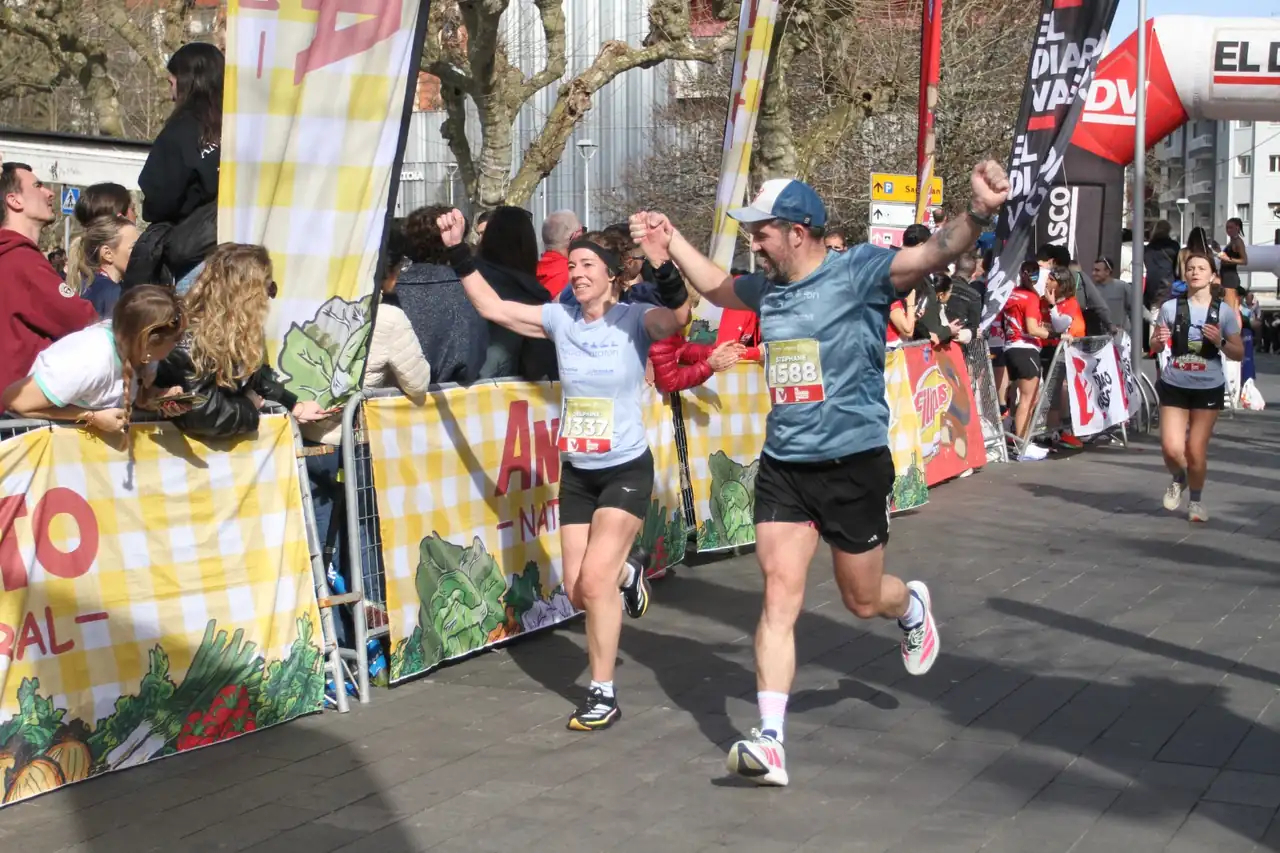
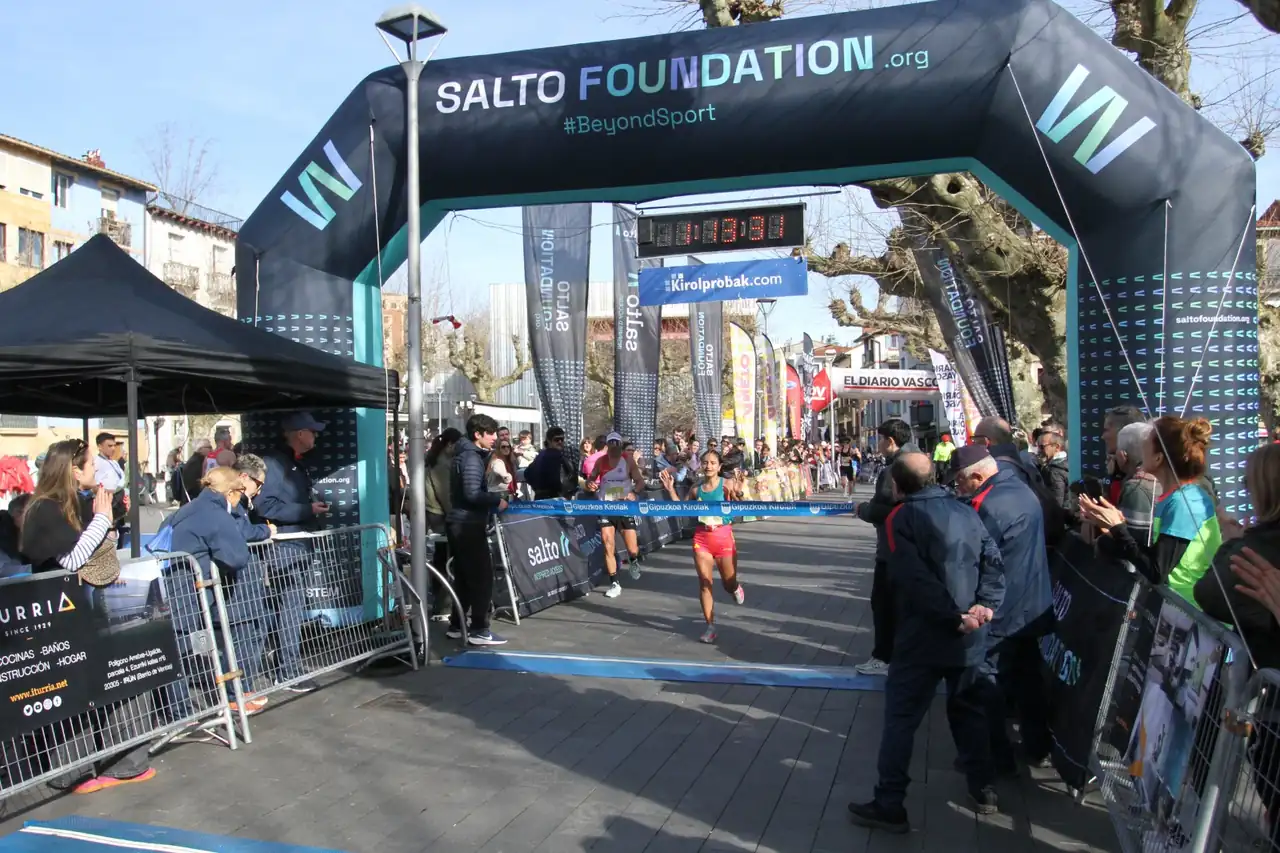
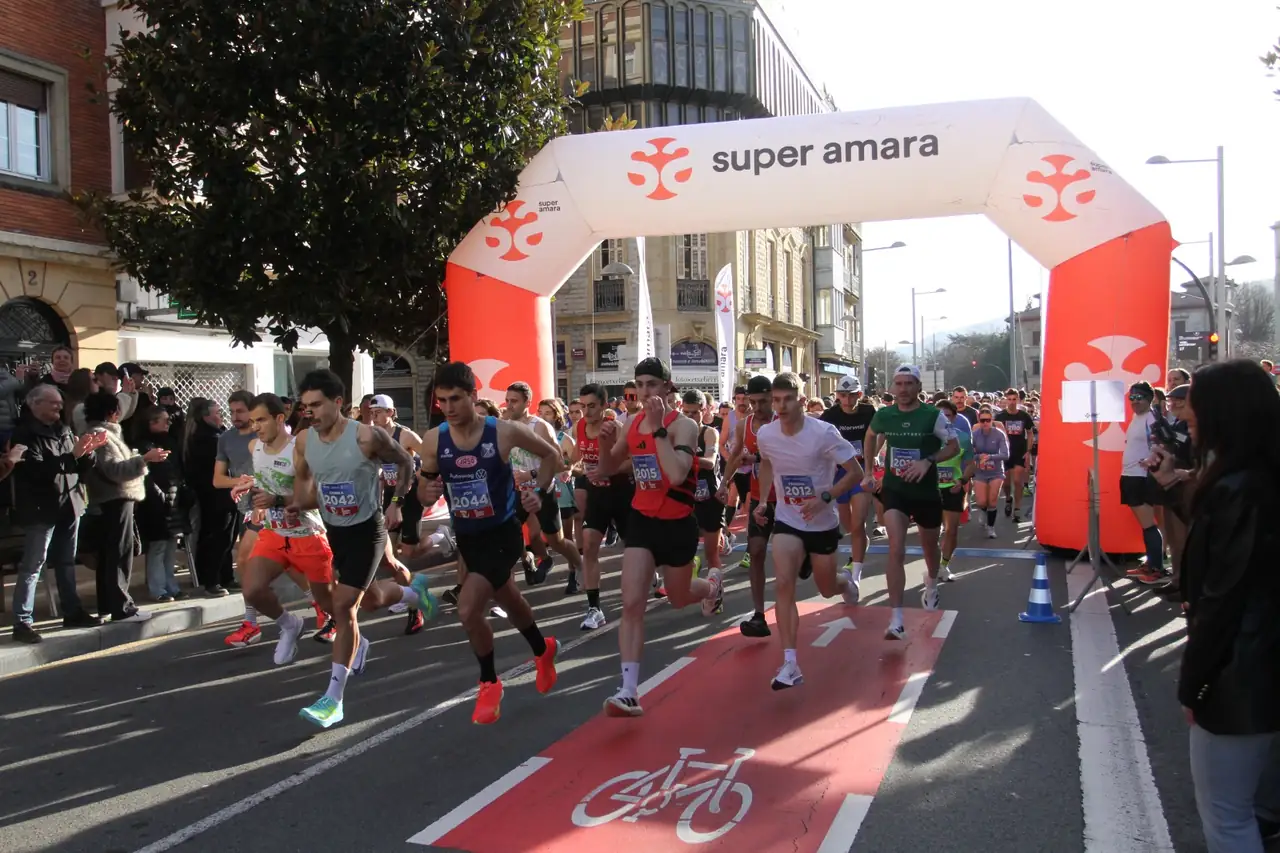
Photos from the 2026 edition. Photos: Super Amara Bidasoa Atletiko Taldea.
Bib, collection, and participant services
One of the best-handled aspects of this race is bib collection. The runner expo is held at Plaza Ensanche in Irun and is complemented by advance pickup at a local sports store and same-day pickup on race day at the Frontón Uranzu. This multi-day, multi-location setup reduces queues and keeps logistics from becoming a parallel race, which is especially useful when the number of entries grows sharply.
The runner bag and associated materials also play an important role in the experience. In the most recent information, the organizers mentioned the delivery of an official T-shirt, safety pins, discount vouchers, and, after crossing the finish line, a main bag with food and refreshments. These are seemingly small details, but in a mass-participation race they make the difference between a decent event and a well-finished one. In addition, the organizers provide bag drop, showers, and changing rooms in nearby facilities, a basic trio that makes life easier for those arriving from outside or who want to leave the finish area without complications.
Physiotherapy service has also been added in the finish area, a new feature that responds to a very tangible reality: after a half marathon, things do not end when you cross the arch. Having professional support to relieve overload or address post-race discomfort adds an extra layer of care to the event, without turning it into a clinical service or an exaggerated promise. It is simply a practical improvement that fits the profile of an increasingly large race.
The runner profile and the strength of foreign participation
The race has grown strongly in part because of its ability to attract runners from outside the area. In the latest major edition with detailed figures, 41% of entrants came from France, mostly from Iparralde, while the Bidasoa area contributed 22% and Donostia another 9%. That distribution clearly explains the event’s border character: it is not just a local race, but an event that brings together geographic references, sporting habits, and different audiences on the same February morning.
Female participation also stands out, at around 35% overall, with 30% in the half marathon and 44% in the 10K. These figures reflect a broader trend in Spanish popular running: women’s participation continues to grow, especially in younger and middle age groups. In this race, that shift is clearly visible and contributes to a more diverse image, more representative of how endurance running has evolved in recent years.
The organizers have also planned separate corrals and pacers in the half marathon, a valuable aid for those chasing specific paces. In a fast race, that detail is not anecdotal: it helps avoid unnecessary bottlenecks and organizes the front of the popular field. The half marathon, therefore, is not designed only for the brave; it is built for runners who want to measure, adjust, and squeeze every kilometer with some precision.
Solidarity, companies, and race weekend atmosphere
Beyond the stopwatch, the race maintains a charitable side that has accompanied it across different editions. Recent information has highlighted support for Tadamun and the Oporrak Bakean program, an initiative linked to supporting Sahrawi children during the summer. In 2026, an initial fundraising total of €2,500 was announced, showing that the social component is not just a campaign embellishment, but a recognizable part of the event.
The Smarktec Corporate Race has also gained importance, a format that combines the times of three runners to create men’s, women’s, and mixed classifications. This offshoot broadens the audience without breaking the identity of the main event. It offers a different interpretation of the same setting: less pure individualism and more shared competition, with the added value that team atmosphere usually boosts the buzz at both the start and finish.
The runner expo, local businesses, and visitor influx help turn the weekend into more than just a morning of bibs and shoes. Full hotels, busy bars, and streets closed for the race create a small sports ecosystem that repeats every year. In a city like Irun, with its natural connection to Hondarribia and the border area, that effect is almost immediate: the race blends into the urban landscape and changes it for a few hours with striking precision.
The 10K course and why it also matters
The 10-kilometer distance deserves its own reading because it is not just a side event to the half marathon. Its start at 09:50 and shorter route make it an attractive option for those who want an intense effort without entering half-marathon territory. The route shares the central Irun start and also uses the corridor along the Bidasoa, preserving the event’s fast essence without requiring the same late-race strain.
Its maximum time of 1 hour and 10 minutes requires some discipline, but it remains accessible for many profiles. That mix of demand and logistical friendliness is part of its success. The shorter race lets runners take part in the atmosphere of a major event without the physiological commitment imposed by the half marathon, which is why it tends to attract both developing runners and veterans who want a fast, controlled morning without too much muscular cost.
In editorial terms, the 10K and the half marathon tell the same story: a race where the landscape helps, the course supports performance, and the setting of Irun and Hondarribia provides a recognizable backdrop. There is no artifice in its appeal. What this race sells is what it delivers: a clean course, an organization that has refined the details, and a calendar date that, for many runners, is beginning to carry the same weight as other major winter half marathons.
A northern benchmark that has learned to grow without losing its character
The Bidasoa Half Marathon has found a very rare formula: growing without becoming diluted. It has added participants, strengthened services, expanded runner support, and at the same time preserved its identity as a fast, certified race on the border. That balance is not improvised. It is built over years of fine-tuning, with a careful understanding of what popular runners need and a refusal to turn the event into a mere bib-and-medal package.
Its place in the calendar also works in its favor. February is usually a month for chasing times, for returning to serious competition after the winter break, and for sensible choices for those who want to test the work they have accumulated. In that context, the Bidasoa race emerges as a reliable tool: it does not promise mountain drama or overflowing mass spectacle, but it does offer objective conditions for fast running, well-managed services, and an environment with its own identity.
That is why its name carries more and more weight in the popular racing calendar. Not because of noise, but because of consistency. And in running, where so many events look alike like two lanes of a highway, that consistency is worth gold: a course where you can run, an organization that cares about timing, and a city that understands the event as part of its landscape. The rest is up to each runner, minute by minute, until the final stretch in Urdanibia.
Where to stay in Irun
Hotels available 26 February – 1 March 2027.
Affiliate links: if you book through this map we earn a commission, at no extra cost to you.



How to prevent thigh chafing: causes and real solutions

Women’s running windbreakers: seven jackets and how to choose

Do more workouts get rid of soreness? A guide for runners

Jaén Half Marathon 2026: Record 3,800 Runners Registered

Men’s short running tights: how to choose the right pair

World Triathlon confirms data breach involving medical data

Izan Edo targets podium at Miyazaki World Cup

María Pérez ranks ninth in World Athletics’ 2026 top ten

Dos Santos, Duplantis and Sawe: World Athlete of the Year finalists

San Silvestre Vallecana 2026: 42,000 places, prices and start times

 Races3 months ago
Valencia Half Marathon 2027: date and registration

 Races3 months ago
Valencia Marathon 2026: entry, ballot and course

 Reviews and Comparisons4 months ago
Asics Gel-Roadmiles 3 for men: review and current price

 Reviews and Comparisons4 months ago
Asics Gel Sonoma 8 Gore-Tex: complete analysis for trail and rain

 Sneakers3 months ago
Saucony Endorphin Pro 4: full review and verdict

 News5 months ago
Strava API 2026: what changes for clubs, challenges and runner apps?

 Reviews and Comparisons5 months ago
Nike Alphafly 3: opinions, sensations, and real key points

 Reviews and Comparisons4 months ago
Under Armour running shoes review 2025-2026: models and key features

 Sports Equipment4 months ago
Shoe sizes in cm: a clear guide to getting the right fit for your footwear

 Sneakers3 months ago
Skechers GO RUN Consistent 2.0 analysis: comfort and limits

 News5 months ago
Valencia Marathon 2026 route: key tips to train and run better

 Sneakers4 months ago
Adidas Adizero Boston 13 for men: review and verdict