Races
Donostia Triathlon: history, events, and key features of a unique competition
The San Sebastián race combines tradition, challenge, and a unique setting beside La Concha.

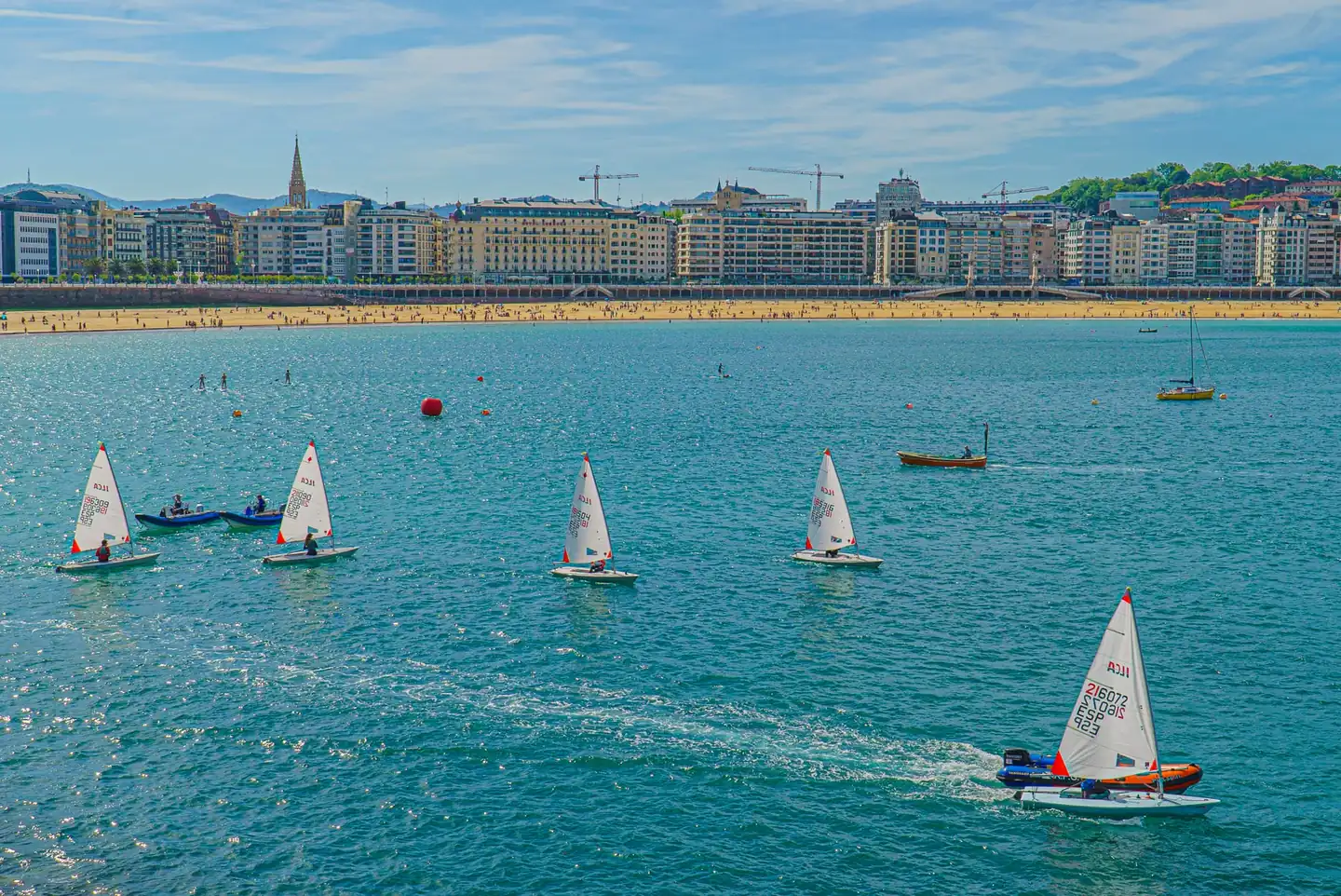
Triathlon in Donostia has its own significance within the Basque calendar: it is not just a competition, but an event shaped by the bay, the coastal wind, and an audience that understands sport as part of the urban landscape. Over the years, the race has earned a reputation for its demanding course and for the symbolic value of competing in a city where the sea enters sporting conversation with the same naturalness as the rain or a walk along La Concha.
The race has had different names and editions, but in the local triathlon imagination it has become associated with a tough, technical format full of personality. The available references speak of historic editions, including the 24th held in 2009 and the 31st edition linked to the Memorial Onditz in 2016, with more than 1,000 participants and victories by Sara Pérez Sala and Francesc Godoy. That track record of more than three decades helps explain why Donostia appears not only as a venue: it appears as a setting with memory.
A race with its own identity in La Concha Bay
Donostia offers a triathlon that is recognizable from the very first meter in the water. La Concha Bay, with its open profile and direct connection to the city center, turns the swim segment into an intense postcard, but also into a start affected by weather, water temperature, and the reading of currents and waves. This is not an expanded outdoor pool; here the environment sets the rules and every stroke must adapt to a sea that is never identical to the day before.
The visual side weighs as much as the technical one. In other venues the race is almost unnoticed by those watching from the sidewalk, but in Donostia the triathlon blends into the city and gains a very public dimension. The coast, the promenade, the cycling bends, and the final run turn the event into an experience that is immediately recognizable even to those who do not closely follow the official calendar.
That urban and maritime character explains part of its prestige. Some triathlons are measured by elevation gain, others by participation, and others by history. Donostia combines all three and adds one more, less quantifiable: the feeling of competing in a place where sport is in dialogue with a very specific geography. That brings it closer to those events that leave a mark, not just to those that fill a results sheet.
From swimming to asphalt: a course that gives nothing away
The known editions of the Donostia triathlon have shown a clear pattern: toughness and consistency. In 2009, the 24th edition included 1,500 meters of swimming in La Concha, a cycling segment of nearly 40 kilometers passing through Orio and Igeldo, and a final 10-kilometer run also along the bay, split into three laps. That layout clearly shows the kind of effort the race demands: first control, then endurance, and finally the ability to hold pace when the body is already running on empty.
The combination is especially demanding because there is no breathing space between segments. Swimming requires positioning and composure; cycling, power and judgment; running, fatigue management and a touch of pride. On a course like Donostia’s, the cyclist cannot simply push hard: they must know how to read the terrain, the competitive traffic, and the small variations in the route, which can completely change the way the race is approached.
The final stretch on foot is usually the great revealer. That is where the differences appear between those who have managed their effort well and those who have emptied themselves too soon. Running along the shore of La Concha, with the crowd very close and the sea as a constant backdrop, does not ease the pain; it makes it more visible. It is a finish that feels like an honest conversation between body and will, without embellishment.
A memorial with its own name and a history tied to women’s triathlon
The Memorial Onditz name adds an emotional layer to the event. In 2016, the race was presented as the 31st Donostia Triathlon – Memorial Onditz, a name that already speaks of continuity, remembrance, and roots. Not every event can rely on an identity like this; here memory is part of the sporting story and helps the competition feel like more than just a date on the calendar.
The reference to the 7th edition of the Women’s Triathlon also suggests another important dimension: the visibility of women’s participation in a sport where balance in representation has gained ground over the years. Although the available information does not allow us to reconstruct every organizational detail of each edition, it does make clear that Donostia has been a space for women’s competition and for the event’s gradual growth as an open and diverse gathering.
That historical component is not decorative. In endurance sport, continuity matters as much as the clock. A race that is repeated, adapted, and remains attractive in a demanding city must sustain complex logistics, solid organization, and an environment that does not lose interest as the seasons pass. Donostia has done so with a mix of tradition and local prestige that explains its permanence.
What makes competing in San Sebastián different
The city does not act as a mere backdrop. San Sebastián imposes its own way of competing because of its climate, its relationship with the sea, and the tactical reading of the course. In triathlon, context matters as much as physical preparation, and here that context is felt in every segment. A calm morning can turn into a day of strong currents; an apparently friendly cycling sector can become a sequence of pace changes; and the run, with accumulated fatigue, forces athletes to squeeze even the smallest gestures.
The quality of the urban environment also plays a role. It is not the same to cross an industrial area as to turn through a city where the public naturally spreads between the promenade, the sidewalk, and highly recognizable landmarks. Donostia offers the triathlete a landscape that helps them understand where they are and how much is left ahead. That visual clarity may seem minor, but in long races it helps sustain concentration.
The beauty of the setting does not eliminate the difficulty; it sharpens it. Some courses soften suffering, while others frame it with almost cinematic precision. The Donostia triathlon belongs to the latter. Cold or rough water, stretches along coastal roads, and the finish in the city create a sequence in which effort is visible, audible, and easy to remember.
Results, participation, and the value of a consolidated race
References from older editions show broad and competitive participation. In 2016, there were said to be more than 1,000 participants across men’s and women’s categories, a figure that places the event on a notable scale within the national scene. That volume speaks not only of popularity, but also of organizational capacity and sporting appeal. A race does not reach those numbers by inertia; it needs prestige, stability, and a story that connects with athletes of different profiles.
The podiums also help measure its competitive stature. In that 2016 edition, Sara Pérez Sala won the women’s category with 2:16:55 and Francesc Godoy won the men’s with 1:57:36. Beyond the specific names, the times reflect a high-level race, where the gap between the front-runners and the rest is often shaped by the swim, the bike, and the ability to finish strongly in the run without falling apart in the closing stretch.
In an event like this, the result is only the most visible part of the matter. Behind it lies a combination of logistics, generational continuity, club loyalty, and a sporting fabric that understands triathlon as something broader than an isolated competition. Donostia has managed to preserve that mix of elite and grassroots, participation and performance, spectacle and quiet work.
Triathlon in the Basque Country as sporting culture
Basque triathlon has a personality defined by effort and consistency. It is no coincidence that Donostia appears repeatedly in the historical records of regional sport. The tradition of road and mountain races, clubs, and events has made the area especially receptive to endurance disciplines. In that context, the Donostia race does not stand out as an oddity, but as a natural piece of a very lively ecosystem.
That ecosystem also explains athletes’ loyalty. Events are sustained not only by one brilliant edition, but by the trust they build year after year. When a competition maintains its identity, its challenge, and an organization that delivers, it becomes a reference event for clubs, fans, and athletes who want more than a medal: they want a measurable and memorable experience.
In Donostia, the experience usually comes with a strong symbolic weight. Running by the sea, cycling along such a recognizable coastline, and finishing the effort in an elegant, open urban setting creates a feeling that is hard to replicate. Here triathlon is not limited to adding kilometers; it adds context, history, and a very direct relationship with the city.
How Donostia’s triathlon appeal is understood today
Its current appeal rests on three pillars: history, setting, and challenge. History provides legitimacy; the setting, a powerful visual identity; and the challenge, sporting credibility. In an increasingly crowded calendar, only those events that know how to stand out without artifice remain strong. Donostia does this naturally, relying on a recognizable course and a reputation built over years of continuity.
Its ability to attract diverse profiles also matters. For some, it is a race to test legs and lungs over a serious distance; for others, a challenge experienced for the first time with respect and the desire to finish; for the most experienced, a race with a special atmosphere, the kind that gets marked in red because of where it is held. That variety of profiles helps keep the event from aging like a relic, instead remaining a living occasion.
Cities with emblematic events usually have something in common: they turn competition into a collective story. Donostia achieves this because triathlon is not separate from urban life, but integrated into it, like a scene the city recognizes as its own. And once that relationship is established, it is hard to break.
What a race like this leaves on the calendar and in memory
A triathlon like Donostia leaves more than classifications. It leaves very specific images: the start in the water, the passage along the coast, the sound of the bicycles, the heavy breathing in the final run, and the feeling, upon crossing the finish line, of having traversed an entire city through sheer effort. It is the kind of memory that lasts because it blends toughness with beauty, and because it needs no exaggeration to feel intense.
On the map of Spanish running and triathlon, few venues offer such a recognizable combination of landscape and tradition. The Donostia triathlon has been able to endure for decades precisely because it does not copy outside formulas. Its identity comes from the sea, the city, and a sporting culture that values both result and perseverance. That equation explains its relevance.
Donostia’s importance does not depend only on the city’s name, but on the way the race has turned that name into a synonym for well-placed effort. Those who look at the palmarès see times, positions, and editions; those who look at the whole perceive something broader: a competition with memory, character, and a scene that, once seen, is hard to forget.



How to prevent thigh chafing: causes and real solutions

Women’s running windbreakers: seven jackets and how to choose

Do more workouts get rid of soreness? A guide for runners

Jaén Half Marathon 2026: Record 3,800 Runners Registered

Men’s short running tights: how to choose the right pair

World Triathlon confirms data breach involving medical data

Izan Edo targets podium at Miyazaki World Cup

María Pérez ranks ninth in World Athletics’ 2026 top ten

Dos Santos, Duplantis and Sawe: World Athlete of the Year finalists

San Silvestre Vallecana 2026: 42,000 places, prices and start times

 Races4 months ago
Valencia Half Marathon 2027: date and registration

 Reviews and Comparisons4 months ago
Asics Gel-Roadmiles 3 for men: review and current price

 Races4 months ago
Valencia Marathon 2026: entry, ballot and course

 Reviews and Comparisons4 months ago
Asics Gel Sonoma 8 Gore-Tex: complete analysis for trail and rain

 Sneakers3 months ago
Saucony Endorphin Pro 4: full review and verdict

 News5 months ago
Strava API 2026: what changes for clubs, challenges and runner apps?

 Reviews and Comparisons5 months ago
Nike Alphafly 3: opinions, sensations, and real key points

 Reviews and Comparisons4 months ago
Under Armour running shoes review 2025-2026: models and key features

 Sports Equipment4 months ago
Shoe sizes in cm: a clear guide to getting the right fit for your footwear

 Sneakers3 months ago
Skechers GO RUN Consistent 2.0 analysis: comfort and limits

 News5 months ago
Valencia Marathon 2026 route: key tips to train and run better

 Sneakers4 months ago
Adidas Adizero Boston 13 for men: review and verdict