Races
Jungfrau Marathon: route, difficulty, and key points of the Swiss race
A unique alpine marathon, with significant elevation gain, postcard-perfect scenery, and a demanding finish right in the heart of the Swiss massif.

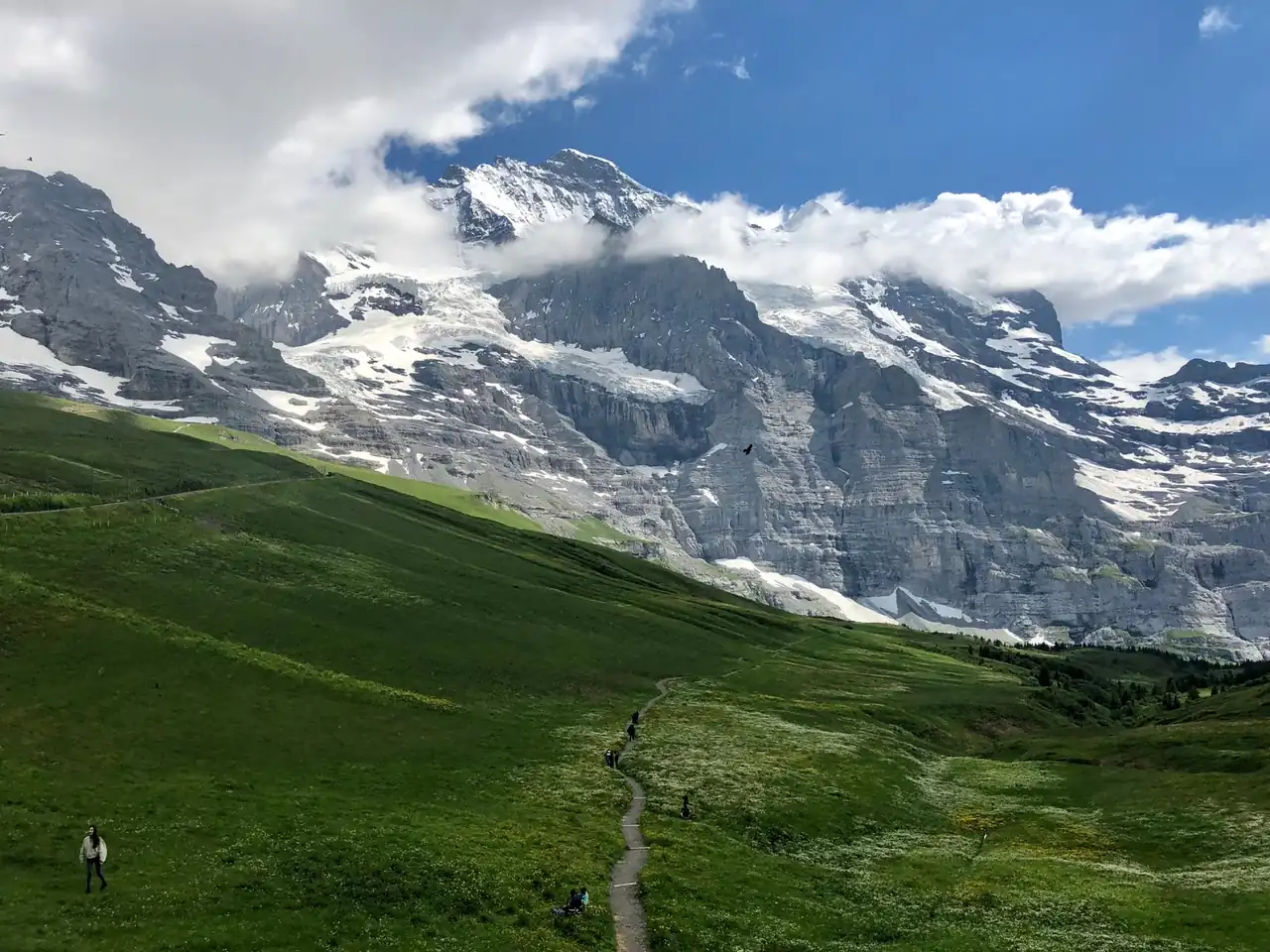
The Jungfrau Marathon is not just a mountain marathon: it is a challenge that turns every kilometer into a change of scenery, temperature, and pace. It was born in 1993 and since then has earned a unique reputation for its combination of Alpine beauty and sustained toughness, with a start in Interlaken and a finish at the Eigergletscher, at 2,320 meters above sea level.
The race covers 42.195 kilometers and has a total elevation gain of 1,953 meters, a figure that by itself explains why this event has become part of the international running imagination. The route starts gently, almost deceptively, before becoming tougher in the Lauterbrunnen valley and ending with an unrelenting climb toward the foot of the Eiger, with the Mönch and the Jungfrau as a backdrop.
A marathon measured in scenery and elevation gain
In the calendar of Alpine races, the Jungfrau Marathon occupies a place of its own. It does not compete with the great city marathons in speed or perfect asphalt; its prestige comes from something else, from an experience that blends endurance, altitude, and setting. The numbers help make it clear: around 4,000 bibs, a pure mountain course, and a finish more than two thousand meters up that forces runners to manage their effort with a cool head.
The start in Interlaken sets the contrast from the very first minute. The runner leaves the postcard of two lakes and enters a sequence of valleys, villages, and slopes where the terrain quickly changes character. The cool air, the murmur of the crowd, and the mountain silhouettes give the race a highly recognizable, almost cinematic identity that has made it famous far beyond Switzerland.
Its reputation as one of the most beautiful mountain marathons in the world is no empty slogan. For much of the course, the race runs alongside Lake Brienz, passes through traditional communities, and enters an environment where every bend reveals a different view. The toughness is not an accident; it is the price of running in a setting that seems carved to impress.
The course: from Interlaken to the glacier
The first 10 kilometers offer a false truce. The opening stretch is relatively flat, passing through the center of Interlaken and the Bönigen area before heading toward Wilderswil. That start, more rhythmic and orderly, helps establish sensations but also conserve energy. In a race like this, going out too fast often becomes too costly a bill once the real climbing begins.
The middle section fully enters the postcard landscape of the Bernese Oberland. From Zweilütschinen to Lauterbrunnen, the route steadily gains height between narrow valleys, meadows, and rock walls. Lauterbrunnen, with its waterfalls and enclosed valley, works as a kind of threshold: from there the race stops feeling like a conventional marathon and becomes a prolonged ascent, with the body working against the slope and against thinner air.
The hardest section comes on the climb toward Wengen. These are about 5 kilometers in which around 450 meters are gained, with switchbacks that force runners to ration every stride. There is no room there for a heroic gesture that lasts only a moment; consistency rules. After that, the climb continues past Wengernalp, heads toward the Eiger, and ends at the Eigergletscher, at 2,320 meters, in a finish that is impressive even for those who already know the mountain.
The most notable recent course change was the move of the finish from Kleine Scheidegg to the Eigergletscher, a decision that pushed the event’s Alpine character even further. The new finish reinforces the sense of culmination in a glacial setting, with the mountain closing the horizon and the effort written into the breathing of every runner who crosses the line. In a race like this, the last meter feels like several hundred.
Course & elevation Edition 2026
Per-kilometre table
| Km | Elevation | Grade |
|---|---|---|
| 1 | 570 m | 0.2 % |
| 2 | 569 m | -0.1 % |
| 3 | 573 m | 0.4 % |
| 4 | 568 m | -0.5 % |
| 5 | 567 m | -0.1 % |
| 6 | 570 m | 0.3 % |
| 7 | 571 m | 0.1 % |
| 8 | 574 m | 0.3 % |
| 9 | 581 m | 0.7 % |
| 10 | 584 m | 0.3 % |
| 11 | 644 m | 6.0 % |
| 12 | 653 m | 0.9 % |
| 13 | 654 m | 0.1 % |
| 14 | 669 m | 1.5 % |
| 15 | 658 m | -1.1 % |
| 16 | 688 m | 3.1 % |
| 17 | 750 m | 6.2 % |
| 18 | 753 m | 0.3 % |
| 19 | 787 m | 3.4 % |
| 20 | 813 m | 2.6 % |
| 21 | 792 m | -2.1 % |
| 22 | 798 m | 0.6 % |
| 23 | 806 m | 0.8 % |
| 24 | 804 m | -0.2 % |
| 25 | 790 m | -1.4 % |
| 26 | 890 m | 10.0 % |
| 27 | 1,067 m | 17.8 % |
| 28 | 1,173 m | 10.5 % |
| 29 | 1,205 m | 3.2 % |
| 30 | 1,287 m | 8.2 % |
| 31 | 1,305 m | 1.8 % |
| 32 | 1,346 m | 4.1 % |
| 33 | 1,474 m | 12.9 % |
| 34 | 1,569 m | 9.5 % |
| 35 | 1,672 m | 10.3 % |
| 36 | 1,706 m | 3.4 % |
| 37 | 1,774 m | 6.8 % |
| 38 | 1,855 m | 8.1 % |
| 39 | 1,893 m | 3.8 % |
| 40 | 2,077 m | 18.5 % |
| 41 | 2,189 m | 11.2 % |
| 42 | 2,107 m | -8.2 % |
| 43 | 2,087 m | -10.4 % |
Plan your pace on this course →
Route source: OpenRunner
The real challenge of running at altitude
The challenge of the Jungfrau Marathon is not limited to the elevation gain. Altitude changes the rules. Running above 2,000 meters reduces oxygen availability, increases the sensation of fatigue, and forces effort to be managed far more strictly than in a city marathon. For anyone arriving with the ambition of running by asphalt sensations, the wall can appear much sooner than expected.
The mountain also adds uncertainty that is hard to tame. Weather can change quickly, visibility can drop, and the ground can become more uncomfortable if rain or fog appears. That instability not only complicates performance, it also reshapes the mental management of the race. It is not about holding an exact pace, but about understanding that the terrain dictates the terms and that the body responds differently when the gradient bites for so many kilometers in a row.
The race includes strict time checkpoints. Wengen, at kilometer 30.7, has a cutoff set at 4 hours and 25 minutes of race time, while Wengernalp, at kilometer 38.5, sets the limit at 5 hours and 50 minutes. These cutoffs are not an organizational whim, but a safety measure on a mountain route where the margin for continuing alone and out of control is limited. In that sense, the race makes no attempt to be anything else: it demands, filters, and protects.
An organization designed for the mountain, not the asphalt
The Jungfrau Marathon operates with logistics typical of major Alpine events. There are refreshment stations approximately every 5 kilometers, medical support on the course, baggage transport, and a tracking system that allows organizers to monitor participants’ progress. All of that is part of the infrastructure that supports a race very different from a major city marathon, where the foundation is usually wide avenues rather than a segmented mountain route.
Also notable is the role of the so-called pace bike, a bicycle that marks the closing pace at key points. If a runner passes it and does not reach the next checkpoints on time, they lose the option to continue normally. The sweeper bike, meanwhile, signals the operational end of the race. It is a way to maintain order on an open route, with sections of public use that must be reopened as soon as the race clears out.
The finish includes details that are very Swiss, almost like an Alpine ceremony. Runners are often greeted with traditional music, the presence of bell-carpet soundscapes, and, in the final stretch, the image of a piper or mountain bagpipe player adding character to the finish. It is not folkloric decoration: it is part of the race’s cultural narrative, which combines sport, place, and a very precise way of understanding the landscape.
The return to Interlaken is also built into the experience. The bib usually gives access to the return transport, a practical solution in an environment where mobility is a key part of the event. In high-participation mountain races, these logistical decisions are not minor; they help maintain an orderly flow of participants and reduce tensions in sensitive high-mountain areas.
Beyond the marathon: a weekend with several races
The event program is not limited to the main race distance. The previous Friday features several parallel events that broaden the weekend’s reach and attract very different participant profiles. There is a Minirun with distances between 200 and 1,600 meters, a Minimarathon of 4.2 kilometers, an inclusive Pararace, and the Harder Run Race, a 4.4-kilometer climb with 755 meters of elevation gain to Harder Kulm.
These complementary races serve an important purpose. They ensure that the event is not reduced to an elite group of highly trained marathoners, but opens up to families, young runners, and athletes with disabilities. In journalistic terms, this matters because it explains why the event has grown so much without entirely losing its mountain character: a small ecosystem of participation has been built around the main marathon.
Added to this is the Lauberhorn Run, a 4.48-kilometer winter race with 1,028 meters of ascent along the famous ski downhill course. Although held on another date, it expands the region’s sports brand and connects running with Alpine imagery in a very recognizable way. The mountain is not a backdrop here; it is the core of the entire proposition.
From the first edition to international prestige
The race was founded in 1993 and from the start attracted runners from different countries. That debut, with Jörg Hägler and Birgit Lennartz as the winners, helped establish an identity that was later consolidated over the years. The evolution was gradual but steady: more finishers, more international attention, and an increasingly solid reputation among mountain running specialists.
The big leap in visibility came in 2007, when the event hosted the World Long Distance Mountain Running Challenge. That edition strengthened the Jungfrau Marathon’s international profile and placed it even more clearly on the mountain-running map. Since then, the event has maintained a very effective mix of tradition, physical challenge, and scenic appeal, three ingredients that are rarely combined with such coherence.
Over time, the field has stabilized at around 4,000 runners, and entries usually sell out quickly. That limit is no accident: the organizers prioritize logistical quality, safety, and environmental preservation. In an area declared a UNESCO World Heritage site, any large-scale race must coexist with a delicate balance between tourism, sport, and landscape protection.
The names that have shaped the race
The Jungfrau Marathon’s list of winners is full of mountain-running specialists. In the men’s category, New Zealander Jonathan Wyatt set the course record with 2:49:01 in 2003, a mark that still stands. Other major dominators include Swiss runner Marco Kaminski, Ethiopian Tesfaye Eticha, and British athlete Robbie Simpson, all capable of repeated victories on a course that punishes anyone who misreads the gradient.
In the women’s race, the current benchmark is Maude Mathys, who set the record at 3:12:56 in 2017. The Swiss runner established a time that perfectly symbolizes the mix of strength and control required by this marathon. Before and after her, names such as Emebet Ambossa, Simona Staicu, Aline Camboulives, and Martina Strähl have left their mark on a race whose history speaks of remarkable diversity among winners and constant competitive progression.
That winners’ list also reveals a geographic shift in the race’s dominance. In the early years, Swiss runners weighed more heavily; then came victories by African athletes, and later the spotlight was shared among Europeans, Oceanians, and emerging names from different continents. The Jungfrau Marathon, therefore, is not a local race with international fame; it is an event where the mountain elite has measured itself regularly and under real pressure.
What makes a marathon like this special for everyday runners
The appeal of this race for everyday runners does not come from the chance of setting a personal best. In fact, almost everything here pushes in the opposite direction. The attraction lies in finishing, in completing a route where every climb leaves a different mark and where the landscape transforms the perception of effort. For many participants, crossing the finish line at the glacier is worth more than any stopwatch.
There is also the sense of order and care that usually surrounds major Alpine events. Signage, checkpoints, on-course support, and transport logistics reduce uncertainty and allow runners to focus on the basic act of moving forward. In a race this long and demanding, that safety is part of the experience, just like the elevation gain or the cold at altitude.
The Jungfrau Marathon is, in essence, an exercise in controlling effort in an extraordinary setting. The mountain does not forgive improvisation, but it does reward the runner who knows how to read it. That is why it continues to generate interest year after year: it offers not an easy victory, but a complete story, one that leaves in the memory the smell of cold air, the strain of the climbs, and the final image of the glacier beneath the peaks of the Bernese Oberland.
A race that continues to define the idea of an Alpine marathon
Some races endure through tradition and others through spectacle. The Jungfrau Marathon has both, but it adds something harder to manufacture: coherence. The name, the landscape, the course, the toughness, and the event culture fit together with unusual precision. Nothing feels incidental, and that explains why it remains a reference in mountain running.
Its relevance also rests on a very simple and very powerful idea: running can be a way of reading the territory. In this race, the runner does not cross a neutral space; they pass through valleys, villages, slopes, and glaciers that tell a story of Switzerland as clear as it is austere. In the end, the marathon becomes a lived map, a line of effort that climbs from the lake to the snow.
The Jungfrau Marathon means precisely that: the blend of beauty and limit, of postcard and endurance. In an era when many races try to stand out with gimmicks, this marathon preserves a very simple truth. The mountain rules, the body responds, and the landscape, when it is all over, remains as the final great reward.
You may also like: Gornergrat Zermatt Marathon: key points of the Swiss alpine race.



How to prevent thigh chafing: causes and real solutions

Women’s running windbreakers: seven jackets and how to choose

Do more workouts get rid of soreness? A guide for runners

Jaén Half Marathon 2026: Record 3,800 Runners Registered

Men’s short running tights: how to choose the right pair

World Triathlon confirms data breach involving medical data

Izan Edo targets podium at Miyazaki World Cup

María Pérez ranks ninth in World Athletics’ 2026 top ten

Dos Santos, Duplantis and Sawe: World Athlete of the Year finalists

San Silvestre Vallecana 2026: 42,000 places, prices and start times

 Races3 months ago
Valencia Half Marathon 2027: date and registration

 Races3 months ago
Valencia Marathon 2026: entry, ballot and course

 Reviews and Comparisons4 months ago
Asics Gel-Roadmiles 3 for men: review and current price

 Reviews and Comparisons4 months ago
Asics Gel Sonoma 8 Gore-Tex: complete analysis for trail and rain

 Sneakers3 months ago
Saucony Endorphin Pro 4: full review and verdict

 News5 months ago
Strava API 2026: what changes for clubs, challenges and runner apps?

 Reviews and Comparisons5 months ago
Nike Alphafly 3: opinions, sensations, and real key points

 Reviews and Comparisons4 months ago
Under Armour running shoes review 2025-2026: models and key features

 Sports Equipment4 months ago
Shoe sizes in cm: a clear guide to getting the right fit for your footwear

 Sneakers3 months ago
Skechers GO RUN Consistent 2.0 analysis: comfort and limits

 News5 months ago
Valencia Marathon 2026 route: key tips to train and run better

 Sneakers4 months ago
Adidas Adizero Boston 13 for men: review and verdict