Sneakers
Puma Fast-R Nitro Elite 2: review of a radical racing shoe
More foam, an extended plate, and outstanding grip in a racing flat that’s very different from the rest of the market.

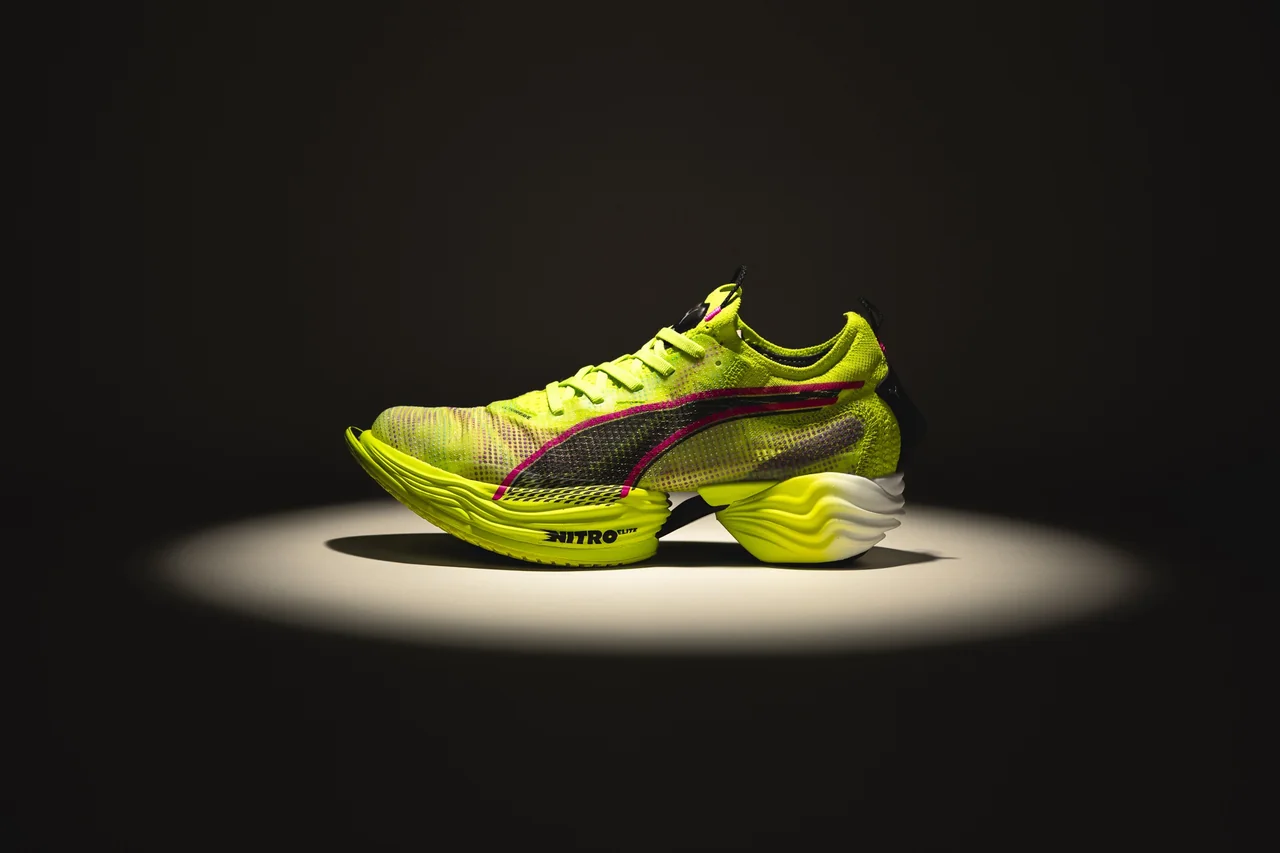
Image: PUMA
The Puma carbon-plated racer that has generated the most buzz in recent months does not play in the league of gentle shoes. Its design breaks with the sector’s usual silhouette, with an aggressive geometry, a wide forefoot base, and a plate that shows through as if the midsole were open in the middle. On the racing-shoe track, that is already a statement of intent.
The result is a model designed to run fast on asphalt, with a combination of premium foam, grippy outsole, and an ultra-light upper. It is also a shoe that divides opinion for a very specific reason: it offers a lot of protection and a very particular ride, but it is not trying to please everyone. That is precisely its journalistic value. It is not just another super shoe; it is a proposal with its own personality.
Puma’s bid to change the script
Puma has been pushing hard in the racing-shoe arena for years, and this model represents one of its most ambitious bets. The brand has taken to the extreme the idea of combining high-level cushioning with a rigid carbon-fiber plate and a very refined outsole. The goal is clear: improve the feeling of propulsion at high paces without giving up a more generous support base than in previous generations.
The technical specs already place the product in serious territory: 40 mm at the heel and 32 mm at the forefoot, with an 8 mm drop. These measurements are right at the limit allowed for road racing under World Athletics rules for this type of footwear. Added to that is a weight hovering around 260 grams in a standard men’s size, an important figure because it explains much of the in-race feel and also its limits versus lighter rivals.
The most useful reading, therefore, is not to see it as a universal solution, but as a specific tool. Its reason for being lies in sustained pace, running economy, and the work of runners moving in and out of the marathon or half marathon with fairly stable form. It is a performance shoe, yes, but also a nuanced one.
Foam, plate, and geometry: the recipe that makes the difference
The heart of the model is NITROFOAM ELITE, a TPU-based nitrogen-infused foam designed to deliver a lively, consistent response. Compared with the market’s most celebrated blends, the feel here is less explosive and a bit firmer, but also more stable and predictable. That technical choice has direct consequences in running: the foot does not sink as much, the platform feels more controlled, and the transition is less unpredictable.
The other key piece is the carbon-fiber PWRPLATE, extended toward the front and visible in the midfoot thanks to the midsole’s open design. Puma presents it as an element that guides the stride and improves propulsion, increasing stride length with each contact. In practice, that translates into a rigid and very pronounced feel, especially when running at high speeds and the runner loads the forefoot more.
Geometry matters too. The model adopts a more aggressive silhouette than a conventional fast-training shoe, with a more rolling transition and a broad forefoot under the outsole, even though the upper fit is quite snug. That contrast, between a wide platform and a narrow upper, explains why stability depends not only on shape, but on how you land. It is a shoe that rewards decisive footstrike and punishes hesitation.
What it feels like to run in it
The first impression is that of a shoe that is very rigid and very protective. At lively paces, especially below threshold or near race pace, the whole package responds with a kind of dry push—less springy than other super shoes, but very consistent. The rocker engages early and drives the body forward with a sense of continuity, like a ramp gently tilting the runner toward the next stride.
That behavior changes when the pace drops. On easy runs or during warm-up paces, the shoe can feel heavier than expected and somewhat awkward in transition. It is not a matter of pure comfort, but of mechanical language: it is built to speak fast, not to converse slowly. In racing, that means it works best once the runner is in the thick of it and the technique is dialed in.
There is also an important detail for the user profile. Those who strike midfoot or forefoot generally get more out of the design, while pure heel strikers may notice a less fluid transition. It is not an hostile shoe, but it is demanding. And in this kind of product, demanding is not a flaw; it is part of its identity.
More protection, less lightness: the big trade-off
The main criticism this model receives is well known and well founded: it weighs more than most of its direct rivals. In a category where every gram counts, the difference becomes noticeable as the pace rises and fatigue starts to bite. That is no small matter, because in a marathon the feeling of agility can greatly change the runner’s experience in the final kilometers.
In return, Puma has gained cushioning and presence underfoot. That extra foam reserve may be useful for medium- to heavier-weight runners, or for those who prefer a more generous platform in longer events. The shoe performs with a certain authority over 21 kilometers and also in the marathon, provided the runner matches its technical language. It can also perform over shorter distances, but that is not where it feels most natural.
The real debate is not whether it cushions or not, but how much it sacrifices to achieve that. And that is where the model’s main dilemma appears: its behavior is closer to that of a long-haul tool than to a pure, lightweight racer. That does not invalidate it; it simply places it in a very specific niche within the racing showcase.
Upper, fit, and locked-in feel
The upper uses ULTRAWEAVE, a very thin, breathable material with an almost dry touch, minimal reinforcements, and little padding. The result is a low-volume fit, very close to the foot, which conveys a high level of security without needing to build a heavy structure. In a racing shoe, that is usually good news.
However, that lightness has a downside. The forefoot feels relatively narrow in the overall sensation, though not so much in the internal measurements, and the heel has a fairly flexible rear area. The tongue is extremely thin and the whole package aims to save grams in every possible corner. All of this reinforces the model’s competitive character, but it does require prior adaptation from the runner, something not to be underestimated.
There is also a sensitive point that several independent reviews have noted: the rear edge can rub against the Achilles tendon or feel somewhat bothersome depending on foot shape and sock type. It is not a universal issue, but it is a useful warning. Racing shoes sometimes win the weight battle only to lose some structural comfort, and that trade-off is clearly visible here.
Grip and outsole: where Puma shines
If there is one area in which this model tends to impress almost unanimously, it is the outsole. The PUMAGRIP compound delivers outstanding traction on both dry and wet asphalt, with a security that is much appreciated on city courses, tight turns, and rainy days. In a market where some super shoes prioritize weight over ground contact, Puma has chosen not to cut too much here.
The rubber distribution is well thought out too. It does not cover everything indiscriminately, but it protects the essentials in the forefoot and heel, where wear and the need for grip matter most. That coverage helps improve outsole durability, something uncommon in a category where lifespan often takes a back seat to one-off racing performance.
This balance between grip and durability adds real value. It is not only about running fast; it is about doing so with confidence when the road is wet, a turn appears without warning, or the pace becomes slightly messy due to fatigue. In those moments, the outsole acts like a silent net underfoot, making no noise and asking for no spotlight.
Who it suits best
The Fast-R Elite 2 is not meant for everyone, and that makes it more interesting. It suits midfoot or forefoot runners best, with good ankle and calf strength, who want a very rigid platform to race a half marathon or marathon. It may also appeal to those who prefer a firmer feel and a pronounced support sensation, far from the softer, mushier super foams on the market.
On the other hand, it does not seem like the ideal choice for anyone prioritizing extreme lightness, a very soft feel, or very smooth heel-to-toe transitions. Nor is it the best recommendation for someone wanting a fast shoe for everything, from short intervals to long runs at controlled pace. Its specialization is a virtue and, at the same time, its boundary.
That is why it is best read as a race tool with personality, not as Puma’s universal answer to the category. There are runners who will value its planted character, its very reliable outsole, and its feeling of controlled stiffness. Others will find it too forceful, too heavy, or simply too odd. And that duality, far from diminishing its interest, makes it one of the segment’s most distinctive products.
Against its rivals, a less docile proposition
Compared with other benchmark super shoes, Puma’s model does not try to impress with extreme softness or an immediate rebound response. Its message is different: more control, more structure, and a way of pushing that depends heavily on the runner’s mechanics. That difference matters because it explains why some users find it solid and others simply uncomfortable.
Against well-known rivals from Nike, adidas, Hoka, ASICS, or Saucony, this model appears as a more particular alternative, less complete and more experimental. In a marathon, that experimentation can be a blessing for someone who fits the concept, but a burden for someone who does not. Today’s competition rewards not just specs; it rewards the match between shoe and biomechanics.
In that context, Puma has gained something valuable: an identity. Not everyone wants a super shoe that behaves just like the rest. Some runners appreciate a different stride, a solid base, impeccable grip, and a platform feel that invites you to push without losing the foot. The Fast-R Elite 2 lives there, in that middle ground between innovation and character.
A super shoe that makes more sense over long distances
The model’s final value lies in its real-world use, not in the label. In long events, when the runner has already accepted that the race is won not by sweet sensations but by accumulated efficiency, the shoe reveals part of its case. The combination of generous foam, a rigid plate, and a secure outsole offers a serious foundation for racing with ambition.
The problem is that that same ambition comes packaged with noticeable weight and a less spontaneous dynamic than other options on the market. That is why the Fast-R Elite 2 cannot simply be sold as the fastest shoe. It is more accurate to see it as a specialized tool, designed for a very specific runner profile and a very specific type of race.
The final picture is of a model that takes more risks than usual. And in a category where many brands converge on similar solutions, that risk is worthy of merit. Puma has not made a friendly shoe to please everyone; it has made a shoe with its own voice, capable of leaving a mark on the asphalt and on the conversation about where racing footwear is heading.
A model that forces a choice between character and consensus
The Fast-R Elite 2 neatly sums up the current tension in elite running: every improvement comes with a concession. Here it gains in protection, grip, and structure, but loses some of the lightness and flying sensation many associate with a modern super shoe. That decision is not accidental; it is a technical choice that defines its personality from start to finish.
In a market saturated with acronyms, foams, and plates, that personality may be more valuable than a perfect spec sheet. The shoe is not the friendliest or the most universal, but it is one of the most recognizable for what it offers and what it demands. And that, in high-level competition, matters too. Not all good answers are comfortable. Some are simply honest with the runner who chooses them.
You may also like: Puma Fast-RB Nitro Elite: price, design, and running feel.



How to prevent thigh chafing: causes and real solutions

Women’s running windbreakers: seven jackets and how to choose

Do more workouts get rid of soreness? A guide for runners

Jaén Half Marathon 2026: Record 3,800 Runners Registered

Men’s short running tights: how to choose the right pair

World Triathlon confirms data breach involving medical data

Izan Edo targets podium at Miyazaki World Cup

María Pérez ranks ninth in World Athletics’ 2026 top ten

Dos Santos, Duplantis and Sawe: World Athlete of the Year finalists

San Silvestre Vallecana 2026: 42,000 places, prices and start times

 Races3 months ago
Valencia Half Marathon 2027: date and registration

 Races3 months ago
Valencia Marathon 2026: entry, ballot and course

 Reviews and Comparisons4 months ago
Asics Gel-Roadmiles 3 for men: review and current price

 Reviews and Comparisons4 months ago
Asics Gel Sonoma 8 Gore-Tex: complete analysis for trail and rain

 Sneakers3 months ago
Saucony Endorphin Pro 4: full review and verdict

 News5 months ago
Strava API 2026: what changes for clubs, challenges and runner apps?

 Reviews and Comparisons5 months ago
Nike Alphafly 3: opinions, sensations, and real key points

 Reviews and Comparisons4 months ago
Under Armour running shoes review 2025-2026: models and key features

 Sports Equipment4 months ago
Shoe sizes in cm: a clear guide to getting the right fit for your footwear

 Sneakers3 months ago
Skechers GO RUN Consistent 2.0 analysis: comfort and limits

 News5 months ago
Valencia Marathon 2026 route: key tips to train and run better

 Sneakers4 months ago
Adidas Adizero Boston 13 for men: review and verdict