Races
Frómista Triathlon: history, routes, and key points of the race
The Canal de Castilla, middle distance, and a high-level palmarès have made Frómista a unique event on the calendar.

Frómista has gone from being a classic stop on the Way of Saint James to also becoming a benchmark for national triathlon. Its race, born in 2015, quickly grew thanks to a clean course, a highly recognizable organization, and a setting that blends heritage, plateau winds, and canal water. In just a few years, the race gained prestige among high-level athletes and ended up established on the map of Spain’s most talked-about middle-distance events.
The appeal lies not only in the name of the town or the postcard view of the church of San Martín. The combination of swimming in the Canal de Castilla, fast cycling, and urban running shaped a different competition, with very competitive times and an atmosphere that, during several editions, filled the streets of the Palencia town with spectators. That balance between toughness and fluidity explains much of its success.
A triathlon that turned a small town into a major event
The story began in 2015 with a first edition that brought together 98 entrants. The project took shape thanks to Borja Mayordomo and the Triatlón Frómista sports team, a small but ambitious structure that quickly understood that the value of the event lay in doing simple things well: a safe circuit, clear logistics, and close treatment of the athlete. Kevin Tarek Viñuela and Elena Díez de la Fuente topped the first honors list in that inaugural edition.
In a short time, the race stopped being a local novelty and became an event with big names. Demand rose, spots sold out quickly, and the Frómista triathlon gained prestige for one very specific reason: it didn’t feel like an inflated race, but rather a serious, precise, and demanding competition. In 2019, the 200 available spots were filled in 48 hours, a clear sign that Frómista had already entered the agenda of many triathletes as a red-letter target.
What’s more, the growth was neither linear nor cosmetic. The event changed distance, improved its competitive profile, and endured a forced pause in 2020 due to the pandemic. When it returned to the calendar, it did so with more momentum and with an identity that was already firmly established. That continuity, in such a crowded calendar, is what sets apart events that move from being a good idea to becoming sporting tradition.
From sprint to middle distance: the leap that changed the race’s profile
The most important evolution came in 2018, when the race left behind its initial format and switched to an Olympic configuration, before making another leap in 2022 toward middle distance. That change completely redefined the event’s tactical reading. Moving to 1.9 kilometers of swimming, 90 kilometers of cycling, and 21.1 kilometers of running increased the physical toll and forced participants to manage their effort better from the start.
The new format didn’t erase the spirit of the race; on the contrary, it reinforced it. The absence of drafting in the cycling segment, the wide nature of the circuit, and the demands of the final half marathon made Frómista earn a reputation as a fast race, yes, but not an easy one. There are no miracles there. There are legs, patience, and a very fine sense of pacing. The margin for error is small, and that is precisely what attracts many experienced triathletes.
2022 marked the debut of that middle distance with immediate success. Pello Osoro dominated the men’s category with a very solid bike performance, while Gurutze Frades once again imposed her authority in the women’s race. From then on, the event cemented its image as a fast and selective race, capable of attracting both national specialists and athletes with international ambitions.
The course: water, flat terrain, and a relentless run
Swimming takes place in the Canal de Castilla, one of the event’s most recognizable features. It is not open sea or a capricious lake; it is a straight course, with favorable current in some stretches and a layout that encourages high speeds from the very first meter. That feeling of getting out of the water with your pulse still in your throat and seeing the bank rush by is part of Frómista’s hallmark.
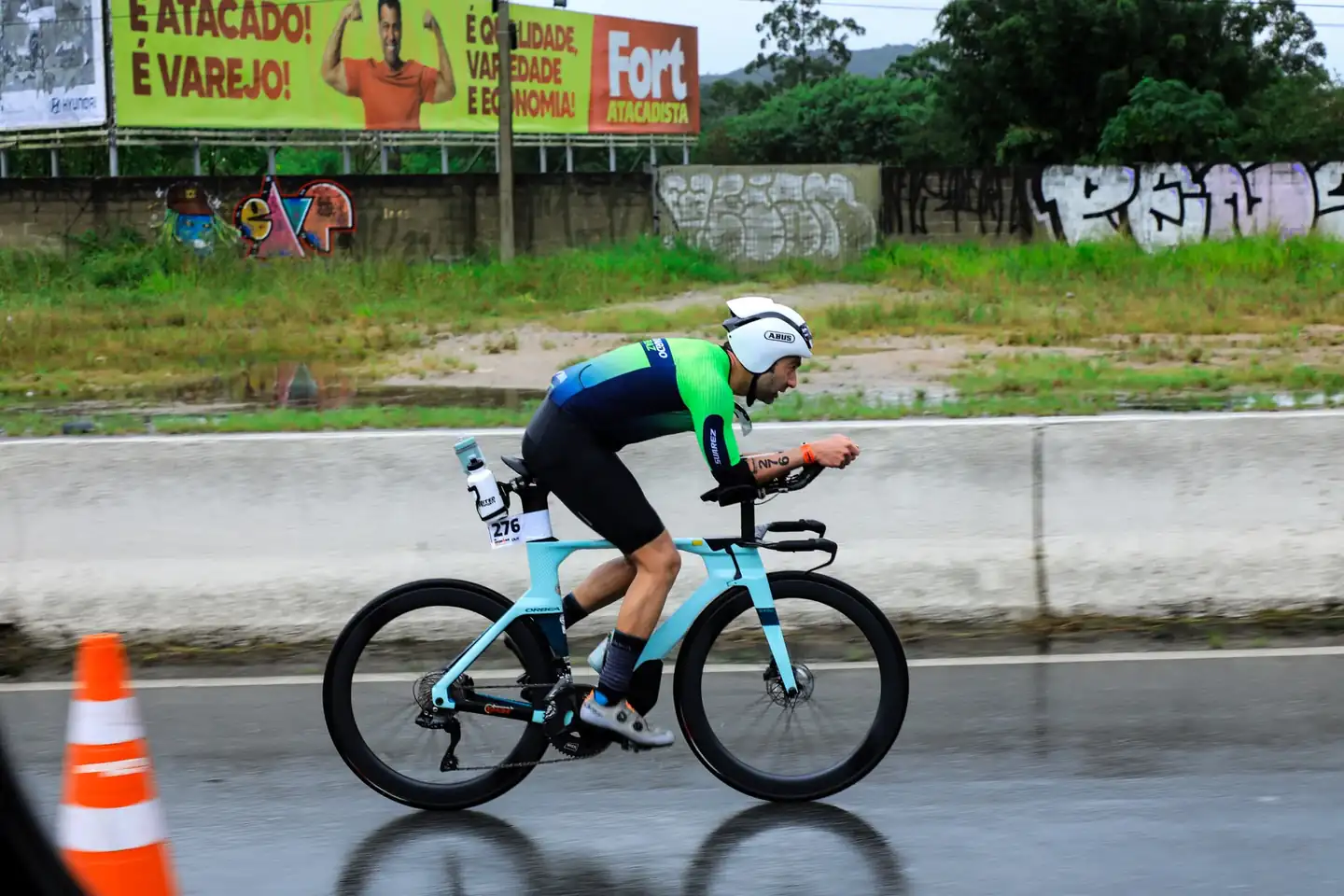
Cycling has also been one of the race’s strongest selling points. With 90 kilometers and three laps on practically flat terrain, the segment demands constant power and good bike position. Drafting is not allowed, so the race truly requires competition, not hiding in a large group. That rule, as simple as it is decisive, explains why the triathlon has attracted athletes looking for a clean and transparent contest.
The run completes the picture with 21.1 kilometers on asphalt, on a six-lap urban circuit that punishes more than it seems. The historic center, the town streets, and the pace changes each lap create a very recognizable atmosphere, almost like a Swiss watch. The race doesn’t climb a mountain or rely on the epic drama of elevation gain: its toughness comes from accumulated fatigue, the August heat, and the need to hold the same level for hours.
That design has a clear consequence: whoever arrives in Frómista in good shape usually runs very fast, but whoever gets too ambitious on the bike pays the price in the final stretch. It is a race of precision more than of bravery. And perhaps that is why it has produced so many memorable records and so few comfortable wins.
Recent editions and the weight of international stature
The 2023 edition marked another step forward. The organizers announced that the race had become part of the PTO international ranking in the Bronze category, a label that confirmed its rise in level and its ability to attract foreign participation. In a small town, that visibility had special value, because it placed Frómista on a circuit of attention much broader than the regional or national one.
That same year, Pello Osoro achieved his third victory in the race, while Marta Sánchez won on her debut. Both also set the race records at the time, a sign that the course had already found a very high competitive standard. Records are not a decorative extra in Frómista; they are part of its identity. Each season there seems to demand a little more.
In 2024, the competition maintained that international profile and had to adapt the course because of the high-speed rail works between Palencia and Santander, without altering the total distance. The prize money then reached 21,000 euros, the highest amount to date in the event, and the podium once again reflected that blend of national talent and foreign presence that had begun to consolidate a year earlier.
The men’s winner was Jonas Schomburg, with Pello Osoro second and Mikel Múgica third. In the women’s category, Chloe Nicolás took the victory, followed by Diana Castillo and Helene Alberdi. The list of names confirms a reality that is now established: Frómista not only rewards great middle-distance specialists, it also attracts athletes from different triathlon schools and different racing paces.
Roll of honor and the names that explain the race’s reputation
The men’s roll of honor reflects the event’s transformation very well. In the early stage, names such as Kevin Viñuela, Ciro Tobar de Urbina, Pello Osoro, Luis Miguel Sánchez, Miguel Ángel Fidalgo, and Emilio Aguayo appeared, a lineup that was already enough to show the race was entering the radar of the domestic elite. Later, with the arrival of the middle distance, the level rose even further and the times became much more demanding.
In the women’s event, the evolution was similar. Elena Díez de la Fuente, Silvia González, Aintzane Argaiz, and later Gurutze Frades, Sara Pérez, Marta Sánchez, and Chloe Nicolás have built a list of winners that speaks not only of quality, but also of competitive continuity. Frómista has had the rare privilege of seeing repeated victories from athletes very well established in middle and long distance racing.
Beyond the individual names, there is a fact that helps explain the accumulated prestige: the terrain. The event has produced very serious performances because it combines a favorable canal, very fast cycling, and a half marathon that rewards the ability to suffer without breaking. In other words, it gives nothing away, but it also doesn’t hide each athlete’s true level. The podium usually sorts out the race well.
The role of the town, the crowd, and the racing experience
Frómista does not function as an isolated venue. The race runs through streets, livens up the square, and turns a summer morning into a small sporting celebration. For years, the impact on the town was part of the event’s charm. There was atmosphere in the transition areas, noise on the corners, and a nearly close-to-home race feeling, even though the lineup level was extremely high. That unusual mix between town and elite is one of its great achievements.
The organizers paid attention to details that participants remember easily: frequent aid stations, live tracking, athlete bags with local products, recovery services, and a finish with food and a social atmosphere. These are elements that, together, do not win a race, but they do build memories. A triathlon also leaves its mark in the way it treats the athlete once the intensity drops.
In that sense, Frómista was always more than just a fast race. It was an event that understood the value of the complete experience: competing, yes, but also being comfortable, feeling cared for, and recognizing the place. That is why many triathletes associated it not only with times or splits, but with an entire weekend that brought together sport, heritage, and community.
The 2025 suspension and what remains of a sports brand
The news that there would be no 2025 edition opened a delicate pause in a very well-built story. After nine editions, the organizers announced a break following a period of personal exhaustion, insufficient structure to sustain such a demanding event, and a change in institutional priorities that left the race without a subsidy. The burden of organizing a competition like this fell on very few hands, and that eventually became unsustainable.
The suspension does not erase what came before. Frómista had already left a clear legacy: showing that an event born in a small municipality can achieve enormous prestige if it combines technical quality, its own identity, and impeccable execution. The Palencia triathlon showed that excellence does not depend on the size of the stage, but on the coherence of the project and the ability to grow it without stripping away its essence.
It also left behind a less visible but equally important lesson: popular triathlon and elite triathlon share fragility. They require volunteers, institutional support, financial continuity, and a human team able to withstand the pressure. When one of those legs fails, even an admired event can stop. And that, in a discipline as demanding as triathlon, is especially revealing.
What remains is a benchmark that is hard to match. Canal de Castilla, middle distance, no drafting, fast records, and a town fully involved are already part of the recent sporting memory of Castile and León. Frómista did not just organize a race: it built a standard. And in the Spanish triathlon calendar, that is no small thing.
A small name for an ambition that left its mark
Some races survive out of habit and others are remembered for their character. Frómista belongs to the second family. Its story shows that identity, when well defined, is worth as much as budget. The straight swim, the bike free of peloton suffocation, and the run through town streets shaped a triathlon that was easy to explain and hard to master.
That is why its absence weighs more than a date on the calendar. A race that earned respect without fuss is missing, with a blend of Castilian hospitality and sporting demands that was not common. In Spanish triathlon, Frómista stopped being just a point on the map and became a way of understanding competition: clear, fast, clean, and with its own personality.
The memory of a race like this is not measured only in winners, times, or prizes. It is also measured by how other events take note of what worked: less noise, more judgment; less artifice, more racing. In that sense, Frómista remains present even though the calendar is on hold. Like bells that stop ringing for a while, but whose vibration can still be felt in the square.
You may also like: 2026 Villa de Fuente Álamo International Triathlon: key points and results.



How to prevent thigh chafing: causes and real solutions

Women’s running windbreakers: seven jackets and how to choose

Do more workouts get rid of soreness? A guide for runners

Jaén Half Marathon 2026: Record 3,800 Runners Registered

Men’s short running tights: how to choose the right pair

World Triathlon confirms data breach involving medical data

Izan Edo targets podium at Miyazaki World Cup

María Pérez ranks ninth in World Athletics’ 2026 top ten

Dos Santos, Duplantis and Sawe: World Athlete of the Year finalists

San Silvestre Vallecana 2026: 42,000 places, prices and start times

 Races3 months ago
Valencia Half Marathon 2027: date and registration

 Races3 months ago
Valencia Marathon 2026: entry, ballot and course

 Reviews and Comparisons4 months ago
Asics Gel-Roadmiles 3 for men: review and current price

 Reviews and Comparisons4 months ago
Asics Gel Sonoma 8 Gore-Tex: complete analysis for trail and rain

 Sneakers3 months ago
Saucony Endorphin Pro 4: full review and verdict

 News5 months ago
Strava API 2026: what changes for clubs, challenges and runner apps?

 Reviews and Comparisons5 months ago
Nike Alphafly 3: opinions, sensations, and real key points

 Reviews and Comparisons4 months ago
Under Armour running shoes review 2025-2026: models and key features

 Sports Equipment4 months ago
Shoe sizes in cm: a clear guide to getting the right fit for your footwear

 Sneakers3 months ago
Skechers GO RUN Consistent 2.0 analysis: comfort and limits

 News5 months ago
Valencia Marathon 2026 route: key tips to train and run better

 Sneakers4 months ago
Adidas Adizero Boston 13 for men: review and verdict