Races
Run With The Horses Marathon in Green River: complete guide
Date, route, elevation gain, distances, and fees for a tough and unique event in Green River, Wyoming.

Run With The Horses Marathon has earned a very clear reputation: it is a short field event, but one that is big in physical demands and scenery. Every August, Green River, Wyoming, turns a road and trail race into a high-altitude journey, starting at around 6,100 feet and taking runners up above 7,500. The result is a marathon, half marathon, 10K, and 5K that combines pavement, compacted dirt trail, and an open, dry environment with almost no shade.
The 2026 edition is set for Saturday, August 15, with the start at 7:00 at Expedition Island in Green River. The race takes place alongside the River Festival, so the weekend is not only about the bib: there is also music, craft stalls, food, fireworks, and a local fair atmosphere that provides context for one of the most distinctive races on the U.S. late-summer calendar.
A high-altitude race, dry heat, and changing terrain
The first reason this event draws attention is the course profile. It is not a route for chasing an easy PR or a course designed to hide pacing mistakes. The altitude is felt from the start, and the first kilometers already punish your breathing before the course heads into the hardest section, with an approximate two-mile climb into the White Mountain area. From there, the terrain undulates between elevations around 7,300 and 7,500 feet, with the constant feeling of running through a wide, bare, exposed landscape.
The heat also matters. Although the start is usually set early, in August Green River sits in a climate range that can begin cool and end much warmer. Reference readings place the average around 64 °F, about 17 °C, with average highs around 79 °F, about 26 °C. That difference between an early morning with cold air and a finish under a high sun forces runners to read the race well from the outset. The effort is not only in the legs; it is in how energy is managed in a place where the scenery invites you to look around, but the body demands caution.
The comparison with other races is easy to understand: there are no sheltered boulevards or an urban course packed with crowds. There is a high-plains desert, long panoramas, dust, gravel, and a sense of freedom that, for some, more than makes up for the toughness. For others, precisely that exposure is the reason to arrive with more conservative preparation and a realistic pacing strategy.
Start, distances, and event format
The race is run in an out and back format, with a turnaround at the midpoint of each distance and a return to the start/finish area at Expedition Island. That means runners face the same scenery twice, but not with the same feeling: the outbound leg usually preserves the surprise, while the return requires negotiating fatigue after hours on dirt, gravel, and small rises. In the marathon, the profile is also made tougher by the combination of distance, altitude, and false-flat sections.
The official distances are marathon, half marathon, 10K, and 5K. All share a 7:00 a.m. start, and the organizers state that online registration closes at midnight on the Monday before race day, while in-person or phone registration may remain open until the previous Wednesday at 5:00 p.m. In practice, that makes the final week a short and clearly defined administrative stretch, with simple but early logistics.
The registration package includes a T-shirt and finisher medal, though there are nuances: in 2026, the marathon and half marathon include the shirt in the entry fee, while for the 10K and 5K the shirt costs extra if you want to add it. That pricing difference reflects the design of a well-tiered local event, where each distance serves a different audience but shares the same identity: a tough, scenic race deeply tied to the region.
Course: two miles of pavement, then dirt, climb, and horizon
The course begins at Expedition Island and covers the first two miles through city streets and the Greenbelt Trail, a paved section along the Green River. That opening feels almost cinematic in transition: first a more forgiving setting, with urban references and the river pacing the stride, and then a turn toward a different world, drier and rougher. The runner moves from town to countryside without artifice, as if a door suddenly opens.
Then comes Wild Horse Canyon Road, a county-maintained dirt road, and with it the real change in texture. The body stops relying on smooth asphalt and begins dealing with a surface that demands constant small corrections. The climb through 1st Springs Canyon takes approximately two miles and leads into a higher, more open, visually expansive landscape. From there, the road winds over White Mountain on a rolling profile, gentle enough on paper, but sufficient to break rhythm if run with too much confidence.
The technical character of the course is moderate, but its physiological demands are high. This is not an alpine mountain race or an extreme trail, but rather a race that combines elements of both: pavement at the start, compact dirt in the middle, and total exposure to the weather. The base altitude, combined with the lack of shade, leads many runners to describe the experience as challenging and, at the same time, memorable. It is the kind of event where the postcard and the effort blend until they are almost the same thing.
Wild horses, desert, and a finish with history
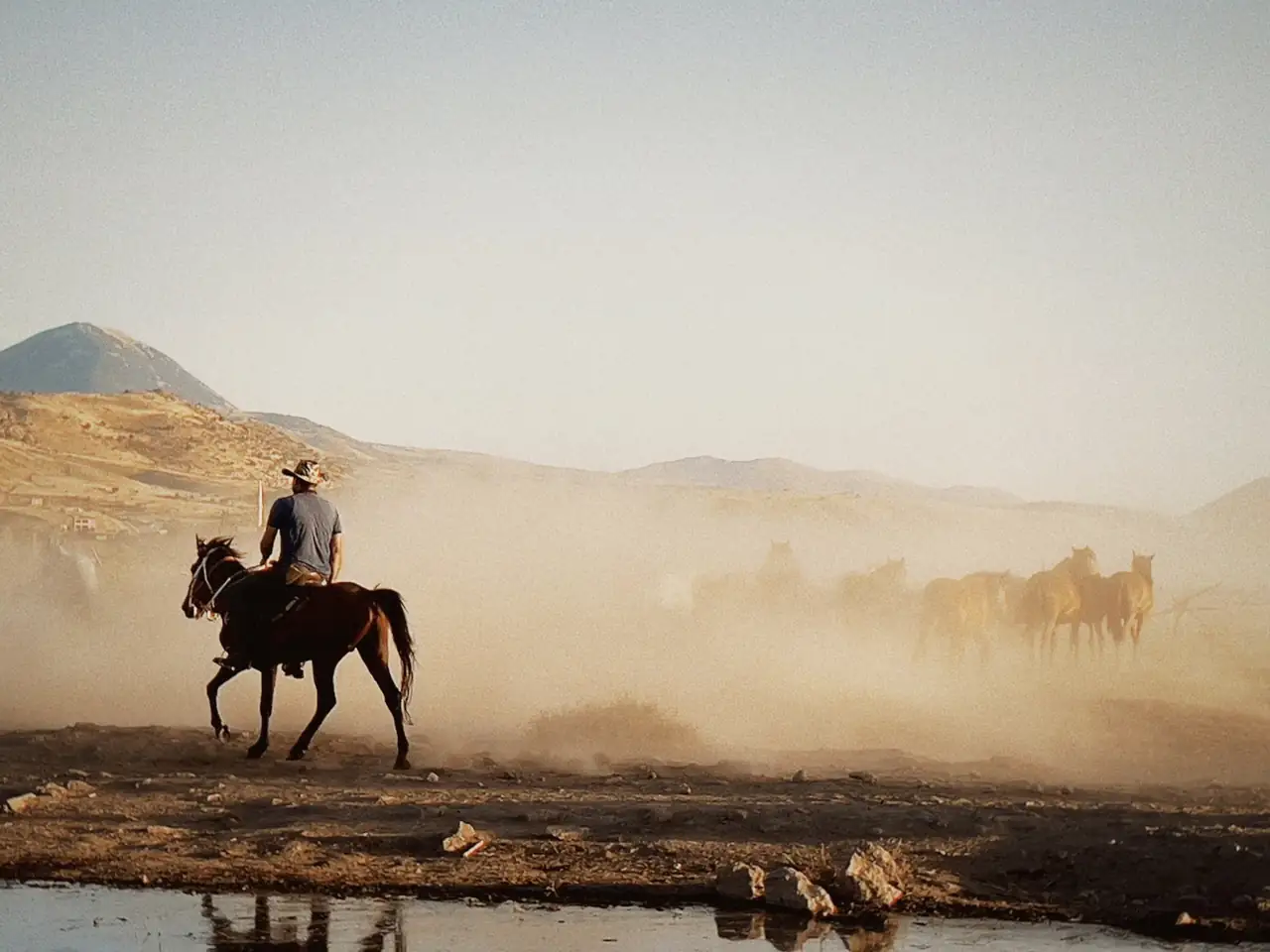
One of this race’s hallmarks is the possibility of seeing wild horses and other Western wildlife on the course or nearby. This is not a promotional flourish; it is a real part of the landscape of Sweetwater County and of the imagery surrounding the event. In a dry, open, treeless stretch, any animal sighting—a group in the distance, a silhouette on the slope, a mane moved by the wind—changes the runner’s perception. The race becomes not just a clock to beat, but also an observation of the land.
The finish at Expedition Island also carries a very specific historical weight. It was there that John Wesley Powell began his 19th-century exploration of the Colorado River, and that detail adds another layer to a race that already aims to stand apart. Running there means not just completing a distance; it means crossing a place with memory, in an area that still retains the pulse of the open frontier, of expedition, and of a landscape not yet fully tamed.
The finish line therefore works as a kind of narrative anchor. The runner returns to the same point where they started after crossing a geography that, in the marathon, requires a mix of aerobic endurance, tolerance for altitude, and mental patience. What ends up being rewarded is not only speed, but the ability to sustain a steady effort when the surroundings invite you to look far, very far, and the clock demands that you stay focused.
Aid stations, time limits, and details that change the experience
The organizers place aid stations every two miles starting from around mile two, with water and Gatorade as the base. Fruit, potato chips, granola bars, M&M’s, and other typical race foods are also offered at several support points. This is important, because on such an exposed course aid stations are not only about nutrition: they also provide a small refuge, a brief pause between the sun, the wind, and the monotony of effort.
As for services, there are portable toilets at the start and at several points on the course, including intermediate markers and the marathon turnaround. The most consistent organizational reference speaks of a seven-hour time limit for all distances, a generous cutoff that suggests an accessible shorter-distance event, but also makes clear that this race is not designed for rushing. Those who come here usually do so with the idea of finishing, enjoying the scenery, and surviving the altitude with dignity.
The shirt and special medal are also part of the race’s identity. In 2026, the marathon costs 95 dollars, rising to 105 dollars after August 1; the half marathon costs 65 dollars, or 75 dollars after that date; the 10K is 30 dollars, or 40 dollars after August 1; and the 5K is 20 dollars, or 30 dollars after that date. These are reasonable fees for a well-run local race, with clear added value in logistics, course, and festival atmosphere.
What the elevation profile says about the real effort
The elevation profile helps put numbers where the story can sometimes fall short. Different references place the low point at around 6,097 feet and the high point near 7,572 feet. Translated into the body, that means less dense air than at sea level, more expensive breathing, and slightly slower recovery when intensity changes. This is not an extreme race in terms of cumulative ascent, but it is one in physiological context.
In the marathon, that changes how performance is read. A time that might seem conservative in a flat race has a different meaning here. Elevation and terrain alter the perception of pace: dirt sections absorb part of the stride, climbs take more out of you than the visual profile suggests, and the return, when faced with the same environment but accumulated fatigue, often feels longer than the outbound leg. That is one of the reasons experienced runners speak of this event with respect.
There is also a strategic element that makes it especially appealing for anyone looking for distinctive races on the calendar. This is not a mass event or a showcase for major brands, but a race with a very defined regional identity. That personality reduces the noise and increases the value of the details: dawn among canyons, fine dust underfoot, the sound of footsteps on gravel, and the feeling of crossing a natural corridor where every kilometer seems to have its own texture.
Green River during River Festival weekend
The festive setting matters because it turns the race into more than a morning of running. The River Festival begins on Friday with Cajun food, live music, craft stalls, food tents, beer, and fireworks. For a runner coming from out of town, that changes the sense of the destination: it is not just a start and finish point, but a town opening its streets and public spaces to a full weekend of activity.
This overlap between sport and celebration has a very American logic, but here it appears in a particularly local tone. Green River relies on its chamber of commerce and a community network that makes the race an excuse to showcase scenery, attract visitors, and strengthen town life during an August weekend. In that sense, the race serves both a sporting and civic purpose. That is no small thing.
The practical consequence is that the event gains atmosphere, but also logistical complexity. Bib pickup at Expedition Island, waiver requirements, fixed times, and the overlap with parallel activities require some advance organization. Far from diminishing the charm, that discipline helps reinforce the feeling that everything is designed so the runner enters and exits the same ecosystem: the race, the festival, the river, and the desert.
Which runner profile fits best here
The Green River marathon does not favor anyone looking for a flat, predictable course. It suits runners who accept terrain variation, altitude, and heat as part of the experience, not as an annoying exception. Patience matters more than aggression. Going out too fast can be costly on the initial climb and on the exposed sections of White Mountain, where wind, sun exposure, and lack of shade become their own challenge.
It is also a good race for anyone who values events with character. There are faster races, technically speaking, but few combine so well the feeling of frontier, wild fauna, high-plains scenery, and the simple structure of a well-understood small-town race. In shorter distances, the setting lets you enjoy the place without the difficulty becoming such a marked barrier; in the marathon, by contrast, the same setting requires a blend of endurance and acceptance that few courses offer so clearly.
That is why the event has steadily built a small reputation among those chasing different kinds of races. It does not need to be massive to leave a mark. Sometimes all it takes is a stretch of white dirt, a climb at dawn, a horse in the distance, and the feeling of moving through a space where the American West is still breathing. In Green River, that is the race’s real promise: not just to run, but to run within a landscape that asserts itself.
A race that is better understood when seen, not just measured
The data help, but they do not fully explain why this race leaves such a strong impression on those who run it. The start at 6,100 feet, the climb to above 7,300, the out-and-back route, and the high desert setting combine into an experience that works like a moving photograph. Every kilometer adds a different layer: town, riverbank, dirt, canyon, plateau, open horizon.
In a calendar increasingly full of homogeneous races, Run With The Horses Marathon keeps a clear personality. It has dates, fees, distances, and rules that are easy to understand; but it also has silence, dust, altitude, and the real possibility of seeing wild horses just a few meters from human effort. That combination makes it a race that is easy to remember and hard to compare with others. And that is precisely where its strength lies: in offering a marathon that does not try to resemble the rest, but rather its own territory.
Year after year, the Green River event remains a very specific way to measure the body against the landscape. Its value lies in visible toughness and unvarnished beauty. Those who cross the finish line take home not only a medal, but also the impression of having traversed a stretch of the American West that still retains something wild, something open, and something unsettlingly alive.
You may also like: Nitty Gritty Marathon: date, route, prices, and key details.



How to prevent thigh chafing: causes and real solutions

Women’s running windbreakers: seven jackets and how to choose

Do more workouts get rid of soreness? A guide for runners

Jaén Half Marathon 2026: Record 3,800 Runners Registered

Men’s short running tights: how to choose the right pair

World Triathlon confirms data breach involving medical data

Izan Edo targets podium at Miyazaki World Cup

María Pérez ranks ninth in World Athletics’ 2026 top ten

Dos Santos, Duplantis and Sawe: World Athlete of the Year finalists

San Silvestre Vallecana 2026: 42,000 places, prices and start times

 Races3 months ago
Valencia Half Marathon 2027: date and registration

 Reviews and Comparisons4 months ago
Asics Gel-Roadmiles 3 for men: review and current price

 Races3 months ago
Valencia Marathon 2026: entry, ballot and course

 Reviews and Comparisons4 months ago
Asics Gel Sonoma 8 Gore-Tex: complete analysis for trail and rain

 Sneakers3 months ago
Saucony Endorphin Pro 4: full review and verdict

 News5 months ago
Strava API 2026: what changes for clubs, challenges and runner apps?

 Reviews and Comparisons5 months ago
Nike Alphafly 3: opinions, sensations, and real key points

 Reviews and Comparisons4 months ago
Under Armour running shoes review 2025-2026: models and key features

 Sports Equipment4 months ago
Shoe sizes in cm: a clear guide to getting the right fit for your footwear

 Sneakers3 months ago
Skechers GO RUN Consistent 2.0 analysis: comfort and limits

 News5 months ago
Valencia Marathon 2026 route: key tips to train and run better

 Sneakers4 months ago
Adidas Adizero Boston 13 for men: review and verdict