Sneakers
ASICS introduces the GEL-Kayano 33 for long-distance running with more comfort
The ASICS GEL-Kayano 33 softens its stability with more cushioning and adaptive support for long runs on asphalt with steady miles.

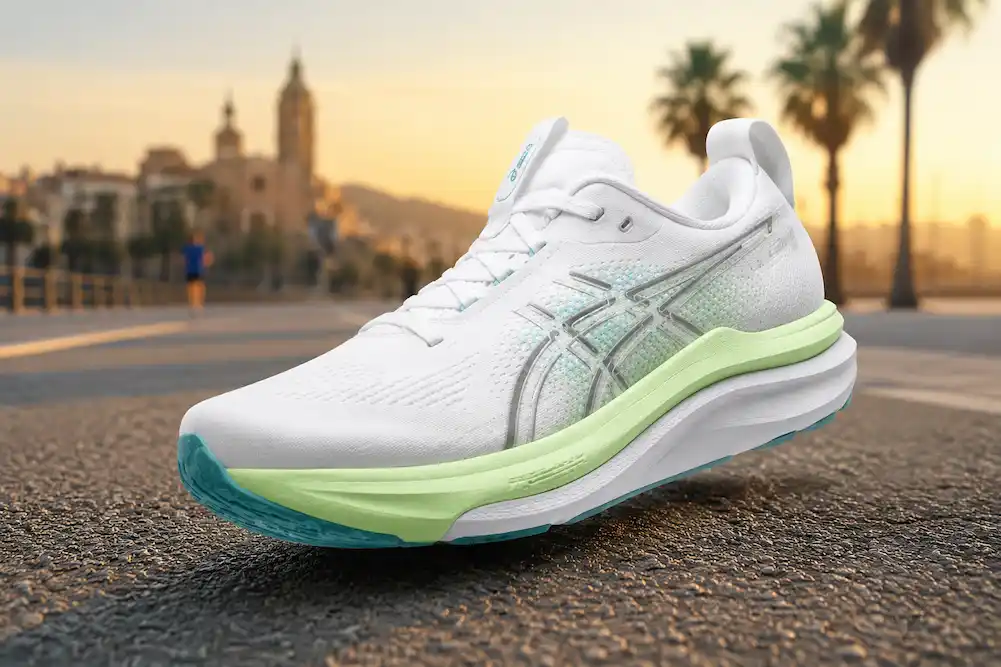
ASICS GEL-Kayano 33
The ASICS GEL-Kayano 33 arrives in Spain with a very specific idea: to keep the reputation of a stable shoe, almost a refuge for runners who need control, while shedding part of that stiffness that for years has accompanied many antipronation shoes. The news is not just that there is a new model in a historic saga. It’s in the shift: more softness, more adaptation to movement, and a less bulky, less orthopedic stability, less of “I’m holding you because you don’t know how to run.” The GEL-Kayano 33 went on global sale on June 1, 2026 and in the official Spanish store it appears with a price of 200 euros, 8 mm drop and 298 grams declared in the reference men’s version.
The word ASICS places at the center of the launch is FLUIDSUPPORT, a new support system designed to adapt to the runner’s biomechanical needs during the stride, instead of imposing a hard correction from the midsole. Translated to the asphalt: the Kayano wants to keep being a Kayano, but without feeling like a shoe with a corrective insole complex. The brand talks about a smoother and more stable run, supported by a combination of FF BLAST PLUS and FF BLAST MAX foams, plus the well-known PureGEL technology for impact absorption.
The Kayano changes skin without giving up its surname
The GEL-Kayano is not just any shoe in ASICS’ catalog. It is one of those families that have accompanied several generations of popular runners, the ones who head out at dawn with the watch still half asleep and the ones preparing for a marathon while paying more attention to their heart rate than to the posing. For decades, Kayano has meant one fairly clear thing: stability. Control. Security. That feeling that the foot isn’t dancing around inside the shoe when the kilometers start to weigh on you and your form begins to unravel.
The 33 version keeps that territory, but the technical language changes. It’s no longer sold so much as a correction as as supporting. And that’s an important nuance. Many traditional stability shoes have used firmer pieces, different densities or fairly obvious structures to limit pronation. They worked for certain runners, yes, but sometimes they left a rough feeling, as if the foot were inside a rail. Useful, though not very exciting. Effective, though a bit gray. The new Kayano is looking for something else: for support to appear when needed, not as a wall, but like a hand on your back.
That move doesn’t come out of nowhere. The running shoe market has been softening categories for years. Neutral shoes have become more stable through geometry, stability shoes have learned to be kinder, racing shoes are no longer impossible planks, and daily trainers seem to get plusher all the time. In that landscape, a rigid Kayano would have sounded old-fashioned. Like carrying a GPS with an antenna in the smartphone era. ASICS has read the moment: the runner who needs stability also wants comfort. And the one who runs long doesn’t want the shoe reminding them every 500 meters that they supposedly have a problematic stride.
The brand defines the ASICS GEL-Kayano 33 as a shoe for long-distance runners who need stability or show excessive pronation, a concept that’s worth handling carefully. Pronation is not an illness or a sentence; it’s a natural movement of the foot. The problem appears when that movement is excessive, poorly tolerated, or combined with fatigue, weakness, a history of discomfort, or a technique that falls apart as the kilometers go by. That’s where a stable shoe can bring order. Not magic. Order.
FLUIDSUPPORT, the new word for an old obsession
The big change in the ASICS GEL-Kayano 33 is the FLUIDSUPPORT system. According to the brand’s official information, this technology adapts to changing biomechanical needs during the stride, guiding key phases of the gait cycle while also allowing a more natural foot movement. The phrase sounds like brochure copy, of course. Shoe brands sometimes write as if they were presenting a weather satellite. But behind it there’s a fairly understandable direction: less rigid correction, more dynamic stability.
The difference matters for the popular runner. On long runs, especially when fatigue shows up, the body starts negotiating. The hip drops a little, the ankle rolls in more than it should, the support gets less clean, the pace loses that initial spark. A stable shoe shouldn’t turn all that into a battle against the foot, but rather reduce the noise. Let the runner feel there’s a base, that there’s a platform, that the transition doesn’t break apart. The Kayano 33 tries to sit there: a daily training shoe for piling up kilometers with a softer and less intrusive feel.
That doesn’t mean it’s a shoe for running fast. That doesn’t seem to be its mission. At 298 grams in men’s sizing and a lighter women’s version, the Kayano 33 sits in the territory of consistent shoes, not lightweight weapons for intervals. It’s a shoe for easy runs, long runs, volume training, tired-leg days and runners who prioritize protection. In Valencia, Madrid, Seville or Zaragoza, where the asphalt can feel like a hot plate in summer, that protection is appreciated; another thing is that on extreme heat days you also want excellent, almost miraculous ventilation.
Stability, moreover, is no longer understood only as “antipronation.” Base width, heel geometry, torsional stiffness, rocker, foam distribution, upper fit and the way the shoe lets the foot move forward without spilling inward all matter too. The Kayano 33 enters that modern school: less visible corrective piece and more integrated design. What used to be a firm wedge now tries to be architecture. A stable house, not a corset.
More soft foam, but without turning it into a silly cloud
The midsole combines FF BLAST MAX and FF BLAST PLUS, two compounds ASICS uses to seek a mix of softness, energy return and relative lightness. In the GEL-Kayano 33, that combination points to a softer ride than classic stability generations. The word “soft” here has a catch: a stable shoe can’t sink without control, because then the foot goes with it. Good softness is the kind that cushions without getting mushy. The bad kind is the one that feels comfortable in the store and clumsy at kilometer 18.
ASICS also keeps PureGEL, its impact absorption technology placed in the rear area, aimed at softening the heel strike. This is especially relevant for heel strikers, who are far more numerous than Instagram wants to admit. On a long run not everyone lands like a Kenyan athlete in slow motion. Some runners strike with the heel, others with the midfoot, others change depending on fatigue, elevation or pace. A Kayano should understand that variety, not punish it.
The midsole height places the shoe in a zone of high cushioning, very much in line with what’s sought in training models: more material underfoot, more protection against repeated impact and a generous platform feel. It’s not minimalism. Nor does it need to be. Minimalism had its moment, taught a few useful lessons and also left a few calves crying in silence.
What’s interesting is that ASICS hasn’t wanted to sell the Kayano 33 as a radically fast shoe. Fair enough. There’s already enough saturation of models that promise to do everything: run smoothly, race a marathon, win the sprint to the front door, clean the kitchen and restore democratic hope to the West. The Kayano 33 has a more honest profile: premium stability for road running, with abundant cushioning and a friendlier feel. Its natural place is easy runs, Sunday long runs, base training and the runner who needs structure without feeling trapped.
Which runner it makes sense for, and who it doesn’t make as much sense for
The ASICS GEL-Kayano 33 makes sense for runners looking for a daily training shoe with lots of protection, especially if they notice that on longer runs the foot collapses inward, they lose stability when fatigued, or they’ve used stable models with good results. It can also fit medium- to heavier-weight runners who want a reliable base for logging kilometers on asphalt, though here it’s worth avoiding universal recipes: runner weight matters, but so do technique, injury history, pace, strength and even the usual surface.
For everyday marathoners, the Kayano 33 can be an ally in the less glamorous part of the plan. That is, almost the whole plan. The 50-minute runs with no epic feel, the 24-kilometer long runs, the days you go out because you have to and not because your body is writing poetry. In that context, a stable and comfortable shoe has more value than it seems. It’s not looking for the heroic photo; it’s looking to make sure you can go down stairs on Monday without negotiating with the handrail.
It doesn’t seem, however, like the ideal option for anyone wanting a lightweight shoe for intervals, aggressive pace changes or fast races. For that ASICS has other paths, from more responsive training models to plated racing shoes. The Kayano 33 plays in another league. A less sexy league, but a very real one: the runner who wants to add volume without every landing feeling like a coin toss.
It also needs to be said: not every runner with discomfort needs stability. Buying a Kayano because something hurts is a dangerous simplification. There may be a lack of strength, too much load, poor recovery, worn-out shoes, inefficient technique or simply a horrible week when the body is asking for a break. The shoe helps, but it doesn’t absolve. And no technology, no matter how boldly written, replaces a sensible training progression.
The inevitable comparison with the Kayano 32
The Kayano 32 had already taken steps toward a more modern stability, with 8 mm drop and a structure more fluid than previous models. Its specs also placed it around 298 grams in reference men’s sizing, with a high midsole and a clear stable training focus. The Kayano 33 doesn’t break with that base, but it does change the technical story by introducing FLUIDSUPPORT and a foam combination that seeks a softer ride.
The real question for anyone who owns the Kayano 32 is not whether the 33 is “better” in the abstract. That word works for headlines, but in shoes it’s usually pretty lazy. The question is whether the runner wants a softer, more adaptive feel or is happy with the firmness and fit of the previous model. Anyone coming from a classic Kayano may notice the 33 as a more modern shoe, less blocky. Anyone using the 32 and happy with it may not need to rush out and change it. Sports consumerism has an admirable talent for turning small improvements into spiritual necessity. Let’s breathe.
Where there is clear novelty is in the stability narrative. The 33 wants to move even further away from the old antipronation shoe understood as a corrective device. The idea of soft or plush stability marks an era. Today’s runner wants adaptable support, but doesn’t want to feel diagnosed by their shoes. They want comfort, transition, aesthetics, durability, everyday performance. And, if possible, for the foot not to end up cooked after an hour and a half of Mediterranean summer.
Price in Spain, availability and first cautions
In Spain, the ASICS GEL-Kayano 33 appears in the official store with a price of 200 euros, men’s and women’s versions, plus wide and extra-wide versions in certain men’s models. It also appears at major retailers and price comparison sites, with prices moving around 190-200 euros depending on size, color and store. In other words: premium shoe, premium price. No surprise there. Popular running, that supposedly cheap sport, discovered luxury a long time ago through the midsole door.
The price forces you to be precise. For 200 euros, the Kayano 33 has to offer more than an aesthetic update. Its argument lies in the combination of stability, cushioning and comfort for long distances. Not in grams saved or seconds per kilometer. Anyone buying this shoe should do so because they need that protected, stable platform, not because the novelty shines in the window. An expensive shoe used for the wrong purpose is just a mistake with laces.
Global availability began on June 1, 2026, after the official May presentation. In the Spanish market, the model appears with its own listing and basic data on surface, drop and weight. The indicated surface is asphalt, which is important because, although many road shoes can handle compact paths, the Kayano is not a trail shoe. On easy dirt it can cope; on loose rock, mud or technical descents, better not ask it to be what it isn’t.
Another caution has to do with fit. ASICS has worked the upper with a redesigned technical mesh to improve breathability and hold. In practice, every foot is a small country with its borders, conflicts and quirks. A runner with a wide forefoot may appreciate wide versions. Another may notice too much volume. Another, just the opposite. In stability shoes, fit is even more important: if the foot moves inside, the platform loses part of its purpose.
For a Running Valencia reader, the practical question is not just whether the Kayano 33 brings a new technology. It’s how a shoe like this behaves in the real setting: hot asphalt, humidity stuck to the shirt, runs through the Jardín del Turia, sessions along the Marina, intervals that shouldn’t be done at 30 degrees but are done anyway, because human beings are a brilliant and absurd species.
In that context, a shoe with lots of cushioning and stability can be a blessing on long runs, but it also has to handle heat well. The redesigned mesh promises more breathability, though the prudent runner knows that promising coolness in a Spanish summer is like promising silence at a mascletà. There are improvements, yes. Miracles, few. The Kayano 33 seems more geared toward protection and stability than toward offering an ultra-light, highly ventilated feel. Every model chooses its battles.
For preparing for a marathon, half marathon or simply building aerobic base, it can fit very well as a main training shoe. You don’t need to race in it to get your money’s worth. In fact, many popular runners get more out of a good daily shoe than out of a carbon super shoe used three times a year. The glory of training lies in repetition, not exception. That’s where the Kayano has tradition, and the 33 tries to update it without losing the craft.
Modern stability no longer wants to look like stability
The ASICS GEL-Kayano 33 confirms a broader trend: stability no longer wants to look like stability. For years, a runner could identify an antipronation shoe almost from the other side of the street: hefty midsole, visible reinforcements, firmer feel, tool-like aesthetics. Now brands want support to be more discreet. Geometry does quiet work. Foams are combined. The base is widened. The heel guides without shouting. The shoe stops saying “I correct you” and starts saying “I’m with you.” Much more elegant. Also more marketable, of course. Let’s not be naive.
That change has an advantage: it opens the door to runners who previously rejected stability shoes because they felt too controlled. It also has a risk: the term stability can become blurry and everything seems to work for everyone. No. A Kayano still has a specific profile. It’s a dynamic support shoe for road running, long distance and daily training. It can work for some neutral runners looking for base and security, but its DNA is in those who need extra guidance. The difference is that this guidance tries to feel more natural.
Modern stability is less like an order and more like a conversation. The foot lands, the shoe responds, the body keeps going. When that works, the runner doesn’t think too much about the shoe. And that is perhaps the best sign. The best training shoes don’t always win you over in the first minute; sometimes they convince you at kilometer 14, when everything incidental has disappeared and only the most basic physical question remains: can you keep running comfortably?
At that point, the Kayano 33 has solid arguments. A high platform, generous cushioning, an adaptive support system, an intermediate 8 mm drop, wide versions and a saga with decades of learning behind it. It also has predictable limitations: high price, weight that’s contained but not light, a profile not aggressive for fast paces and a personality that’s more road-trip than explosive. In other words: it’s not a shoe for fireworks. It’s a shoe for streetlights on at seven in the morning.
A less severe Kayano for a more demanding runner
The ASICS GEL-Kayano 33 doesn’t reinvent running, nor does it need to. What it does is more interesting than the usual launch noise: it refines a historic category so stability stops feeling like punishment. It keeps the support, increases the comfort feel, adopts a more adaptive technology and presents itself as a long-distance shoe for runners who want to run with more mechanical calm, not with a hard piece pushing up under their foot.
For anyone who needs real stability, trains many kilometers on asphalt and values protection over lightness, the Kayano 33 appears as one of the important new releases of 2026. For anyone looking for speed, minimalism or a cheap shoe, this is not the place. And that also speaks well of the model: it knows what it wants to be. In a market full of shoes that promise to do everything, the GEL-Kayano 33 allows itself a more adult ambition: to accompany long, soft and stable. Without cardboard epic. With a lot of foam underfoot and a pretty sensible idea of what a runner needs when training stops being pretty and starts being real.
You may also like: ASICS Gel-Kayano 33: release date, price and new features.
Este artículo contiene enlaces de afiliado: si compras a través de ellos, se genera una pequeña comisión sin coste adicional para ti. Más información.



How to prevent thigh chafing: causes and real solutions

Women’s running windbreakers: seven jackets and how to choose

Do more workouts get rid of soreness? A guide for runners

Jaén Half Marathon 2026: Record 3,800 Runners Registered

Men’s short running tights: how to choose the right pair

World Triathlon confirms data breach involving medical data

Izan Edo targets podium at Miyazaki World Cup

María Pérez ranks ninth in World Athletics’ 2026 top ten

Dos Santos, Duplantis and Sawe: World Athlete of the Year finalists

San Silvestre Vallecana 2026: 42,000 places, prices and start times

 Races4 months ago
Valencia Half Marathon 2027: date and registration

 Races4 months ago
Valencia Marathon 2026: entry, ballot and course

 Reviews and Comparisons4 months ago
Asics Gel-Roadmiles 3 for men: review and current price

 Reviews and Comparisons4 months ago
Asics Gel Sonoma 8 Gore-Tex: complete analysis for trail and rain

 Sneakers4 months ago
Saucony Endorphin Pro 4: full review and verdict

 News5 months ago
Strava API 2026: what changes for clubs, challenges and runner apps?

 Reviews and Comparisons5 months ago
Nike Alphafly 3: opinions, sensations, and real key points

 Reviews and Comparisons4 months ago
Under Armour running shoes review 2025-2026: models and key features

 Sports Equipment4 months ago
Shoe sizes in cm: a clear guide to getting the right fit for your footwear

 Sneakers3 months ago
Skechers GO RUN Consistent 2.0 analysis: comfort and limits

 News5 months ago
Valencia Marathon 2026 route: key tips to train and run better

 Sneakers4 months ago
Adidas Adizero Boston 13 for men: review and verdict