Training
Exercises to strengthen feet and ankles in runners
A useful routine to gain stability, improve balance, and reduce the risk of sprains.

Stability starts at the ground. In running, feet and ankles function as the first shock absorber and also as a base for force transmission: each footstrike distributes load, corrects small imbalances, and partly determines how the body reaches the next stride. When that base loses tone, the movement becomes clumsier, lateral control worsens, and discomfort appears that is often attributed to other areas, even though the origin lies lower down.
Strengthening this region does not require machinery or complex routines. What works best is usually a combination of mobility, strength, balance, and some retraining of footstrike. In runners, that mix helps reduce the feeling of a loose ankle, improves the response of the plantar arch, and can slow the cycle of repeated sprains, a problem that often leaves silent aftereffects for months if it is not worked on consistently.
Why feet and ankles matter so much in the stride
The foot is the first point of contact with the ground. From there, everything changes: the ankle adapts the footstrike to the surface, modulates stiffness during push-off, and helps prevent running from becoming a succession of disorganized impacts. If the ankle does not stabilize well, the knee and hip end up compensating, like a chain that passes a small but persistent looseness to higher links.
That detail becomes important in distance runners, where the movement is repeated thousands of times. A strong foot not only withstands load better, it also absorbs and returns energy more efficiently. The sensation is subtle, but real: less wobble on landing, less loss of alignment, and a cleaner response when the pace picks up or the terrain changes.
Weakness does not always hurt at first. In fact, it usually shows up as clumsiness, instability, or odd fatigue in the lower leg. Over time, that lack of control can favor sprains, overload of the plantar fascia, Achilles tendon discomfort, or overuse of the calves and soleus, eventually loading the entire posterior chain.
What is really trained when working this area
It is not all pure strength. Feet and ankles involve several goals at once: frontal and lateral stability, enough mobility so the joint does not become stiff, the ability to react to changes in support, and strength in the intrinsic foot muscles, that small and almost invisible network that helps keep the arch from collapsing with each step.
Proprioception also comes into play, a technical term that is best translated in simple terms: it is the body’s ability to know where a joint is without looking at it. In practical terms, it means noticing a twist earlier, correcting it quickly, and preventing a bad position from turning into injury. That is why the best exercises are not limited to raising the heels; they force the ankle to organize itself while the body maintains balance.
The key is to train several layers at once. Mobility prepares, strength supports, and balance refines. If one of those pieces is missing, the work is incomplete. A mobile but weak ankle does not protect; a strong but stiff one does not solve the problem either. Useful progress comes from the whole, not from an isolated movement.
Mobility before intensity
The first task is to create room to move well. Before seeking strength, it is worth restoring the ankle’s normal range of flexion and extension. When the joint falls short, the body compensates with excessive pronation, unstable support, or a shorter-than-desirable stride. In running, that limitation feels like a heavy footstrike, almost as if it were planted in the ground.
A simple and very useful drill is to bring the knee forward without lifting the heel off the ground, keeping the entire foot supported. That movement, when well controlled, improves dorsiflexion, meaning the ability to bring the tibia closer to the foot. It is also worth working on toe and arch mobility, because the foot is not a board; it is a living structure, with small joints that collaborate in each landing.
Judgment matters more than quantity. If the heel lifts too soon, the knee collapses inward, or the arch collapses, the drill loses quality. In that case, it is better to reduce the range and repeat with more precision. Useful mobility is the kind you can use while running, not the kind you achieve through mechanical motion alone.
Basic exercises that make a difference
Walking on tiptoes and on the heels remains a very valuable reference. It seems simple, but it forces different structures to activate and helps you recognize how the foot distributes weight. When walking on tiptoes, the calf-soleus complex and the ankle are loaded more noticeably; when doing it on the heels, the muscles that lift the forefoot and stabilize the front of the leg are awakened. Switching later to the outer and inner edge of the foot adds shades of control that translate into a more conscious support.
Another highly effective movement is standing heel raises, lifting up with control and lowering even more slowly. The lowering phase is the most instructive, because it forces you to brake the load rather than letting it drop. In runners, that work helps tolerate training repetitions better and improves the ankle’s elastic response, something that is especially noticeable on hills, pace changes, and long sessions.
Toe work also helps. Grabbing a towel with the toes, scrunching it, or moving small objects toward you activates the plantar arch muscles and improves the connection between support and control. It is not a flashy movement, but it is very useful for fighting the sensation of a tired flat foot at the end of a run or a long day on your feet.
Among the most complete drills is inversion and eversion against resistance, which forces the foot to move inward and outward against an elastic band or a light load. That pattern strengthens the lateral ankle stabilizers, precisely the ones that take the worst of many inversion sprains. With this type of work, the ankle learns to react better when the ground tilts or the runner lands unevenly.
Balance is not a decorative part of training
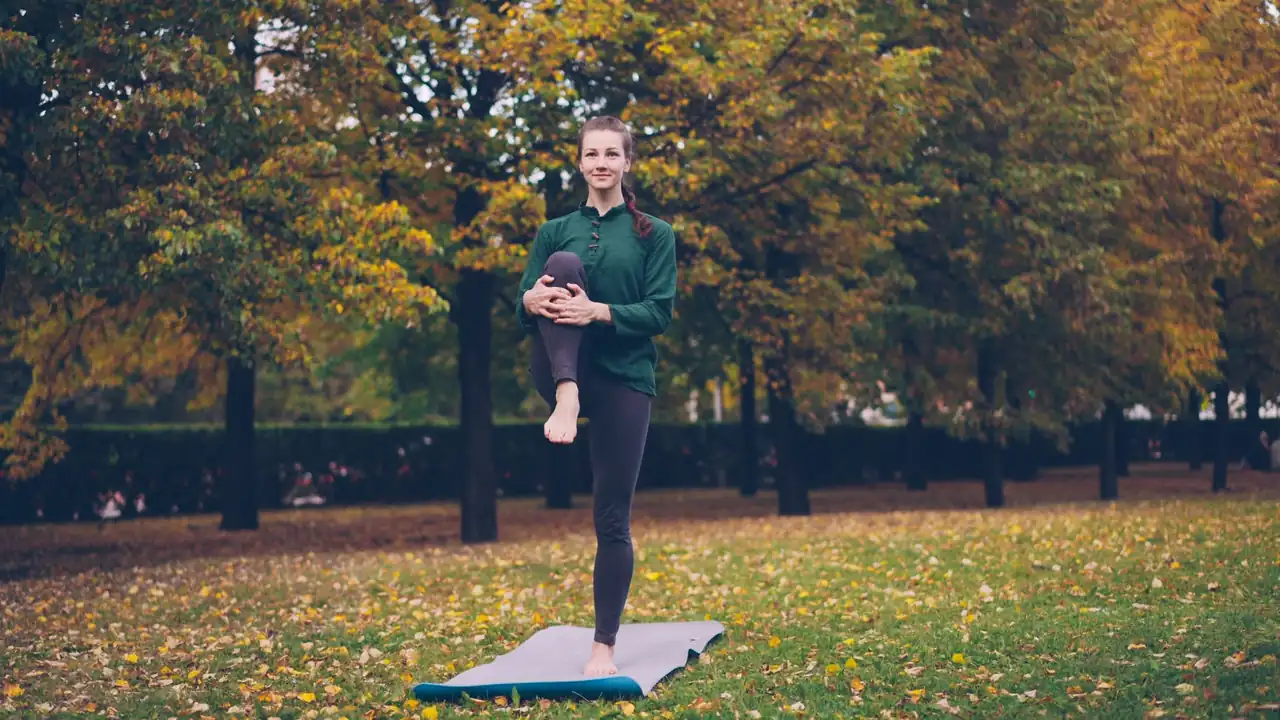
Standing on one leg says more about a runner than it seems. If the support wobbles too much, if the arch collapses, or if the hip drifts to one side, the body is showing a lack of control that will later multiply during running. Holding steady on one leg requires an active foot, an alert ankle, and a relatively quiet trunk, a combination that closely resembles what happens in each stride.
The natural progression goes from holding the position with a nearby support to closing the eyes, changing arm position, or moving the free leg slightly. At that point, the ankle is no longer working only through strength; it is working through anticipation. It is a small difference in appearance, but huge in practice, because it reduces the late reaction to small imbalances.
Balance also protects when fatigue sets in. At the end of a long run, technique breaks down and the foot becomes less precise. If the ankle has already trained stability, it can better maintain alignment when the runner loses freshness. That ability does not eliminate fatigue, but it does soften its effect on mechanics.
How to fit these exercises into a realistic week
Consistency is worth more than showmanship. There is no need to turn this work into an endless session. For most runners, short blocks repeated several times per week are enough to notice that the foot responds better and the ankle feels less fragile. The idea is not to exhaust, but to educate tissues and the nervous system.
A good order usually starts with mobility, continues with basic strength, and ends with balance. That sequencing makes sense: first the range is prepared, then it is loaded, and finally precision is required. On easy-run or rest days, the block can be brief. On heavier training days, it is better to reduce volume and prioritize quality. The area responds very well to moderate, regular stimuli.
Occasional barefoot work can provide useful information. Training without shoes on a safe surface for short periods forces the foot to participate more and reduces the tendency to hide inside the shoe. Still, this is not about living barefoot or forcing it. The important thing is for the foot to regain prominence, not to suffer because of a misunderstood trend.
Signs that the ankle needs more attention
Instability often speaks before pain does. Frequent trips, a feeling that the ankle gives way during quick turns, insecurity when stepping off curbs, or difficulty keeping balance on the first try are clear clues. In runners, so is the tendency to load the same side every time or to feel that support changes as the pace increases.
After a sprain, the problem does not end when the swelling goes down. Often there is still a loss of strength, poorer joint awareness, and a very specific, almost animal fear of twisting it again. If that underlying issue is not corrected, the ankle enters a cycle of relapses that affects training and daily life too, from walking briskly to going down stairs naturally.
Persistent pain should also not be normalized. If recurrent swelling, locking, painful clicking, or discomfort that worsens with impact appears, a clinical evaluation is needed. Exercises help a lot, but they do not replace professional judgment when there is a significant injury, previous fracture, tendinopathy, or established instability.
Common mistakes that reduce effectiveness
The first is doing everything in a hurry. In this kind of work, speed is deceptive. Raising and lowering the heels without control, wobbling on a single support, or completing repetitions at all costs turns the exercise into noise, not adaptation. The body learns more from one well-executed repetition than from ten disorganized ones.
It is also common to leave the foot arch out and focus only on the ankle as if they were separate compartments. In reality, they function as a unit. If the toes do not move, the arch does not participate; if the arch does not support, the ankle compensates. Real improvement comes when the sole of the foot starts working again as a small active platform.
Another common mistake is progressing too quickly. Moving from bilateral support to intense jumps without first consolidating stability is a recipe for going back to square one. Sensible progression goes from less to more: first control, then load, later speed, and only when all of that is established, more demanding impact.
What changes in runners when this work is maintained
The most valuable result is not always seen on a stopwatch. Sometimes it appears as the feeling of running on a firmer base, less fatigue at the end of intervals, or the absence of that small insecurity that forces you to hold back the movement. The runner notices that the foot lands better, that the ankle does not sink as easily, and that the stride leaves fewer doubts on turns or descents.
Over time, tolerance to uneven surfaces also improves. A dirt path, a slanted sidewalk, or a curving section stops feeling like a minefield. The body does not become invulnerable, but it does become more capable. And in running, joint competence is an elegant form of prevention.
There is another less visible and very valuable benefit. Working this area forces you to look at movement from the ground up. That shift in focus corrects the temptation to think everything depends on the hip, the core, or visible technique. The truth is more complete: stability begins in a small, silent, demanding base, where every toe, every footstrike, and every small imbalance truly matters.
The strong foot as a small piece that supports a lot
In running, the small supports the big. Feet and ankles do not grab headlines because they do not have the spectacular nature of a sprint or the visibility of a pace chart, but they shape every step. When they are strong, running feels cleaner; when they fail, the body pays for it with interest in the form of overloads, insecurity, and loss of efficiency.
That is why spending a few minutes on this area is not a minor add-on or a rehab detail. It is an investment in daily mechanics, in sprain prevention, and in the ability to keep running with fewer interruptions. In a sport where the movement is repeated so much, the base matters as much as the engine.
The good news is that improvement usually comes quickly if the work is regular. There is no need to look for a miracle solution, only to build a base that can hold up. And when the foot starts participating actively again, the ankle stops being a weak point and starts behaving as what it should really be: a small joint, yes, but a decisive one.



How to prevent thigh chafing: causes and real solutions

Women’s running windbreakers: seven jackets and how to choose

Do more workouts get rid of soreness? A guide for runners

Jaén Half Marathon 2026: Record 3,800 Runners Registered

Men’s short running tights: how to choose the right pair

World Triathlon confirms data breach involving medical data

Izan Edo targets podium at Miyazaki World Cup

María Pérez ranks ninth in World Athletics’ 2026 top ten

Dos Santos, Duplantis and Sawe: World Athlete of the Year finalists

San Silvestre Vallecana 2026: 42,000 places, prices and start times

 Races3 months ago
Valencia Half Marathon 2027: date and registration

 Races3 months ago
Valencia Marathon 2026: entry, ballot and course

 Reviews and Comparisons4 months ago
Asics Gel-Roadmiles 3 for men: review and current price

 Reviews and Comparisons4 months ago
Asics Gel Sonoma 8 Gore-Tex: complete analysis for trail and rain

 Sneakers3 months ago
Saucony Endorphin Pro 4: full review and verdict

 News5 months ago
Strava API 2026: what changes for clubs, challenges and runner apps?

 Reviews and Comparisons5 months ago
Nike Alphafly 3: opinions, sensations, and real key points

 Reviews and Comparisons4 months ago
Under Armour running shoes review 2025-2026: models and key features

 Sports Equipment4 months ago
Shoe sizes in cm: a clear guide to getting the right fit for your footwear

 Sneakers3 months ago
Skechers GO RUN Consistent 2.0 analysis: comfort and limits

 News5 months ago
Valencia Marathon 2026 route: key tips to train and run better

 Sneakers4 months ago
Adidas Adizero Boston 13 for men: review and verdict