Sneakers
Puma presents Deviate Pure NITRO for fast running without carbon
Puma Deviate Pure NITRO challenges carbon with a lightweight, responsive, and comfortable shoe for fast training without a rigid plate on everyday asphalt.

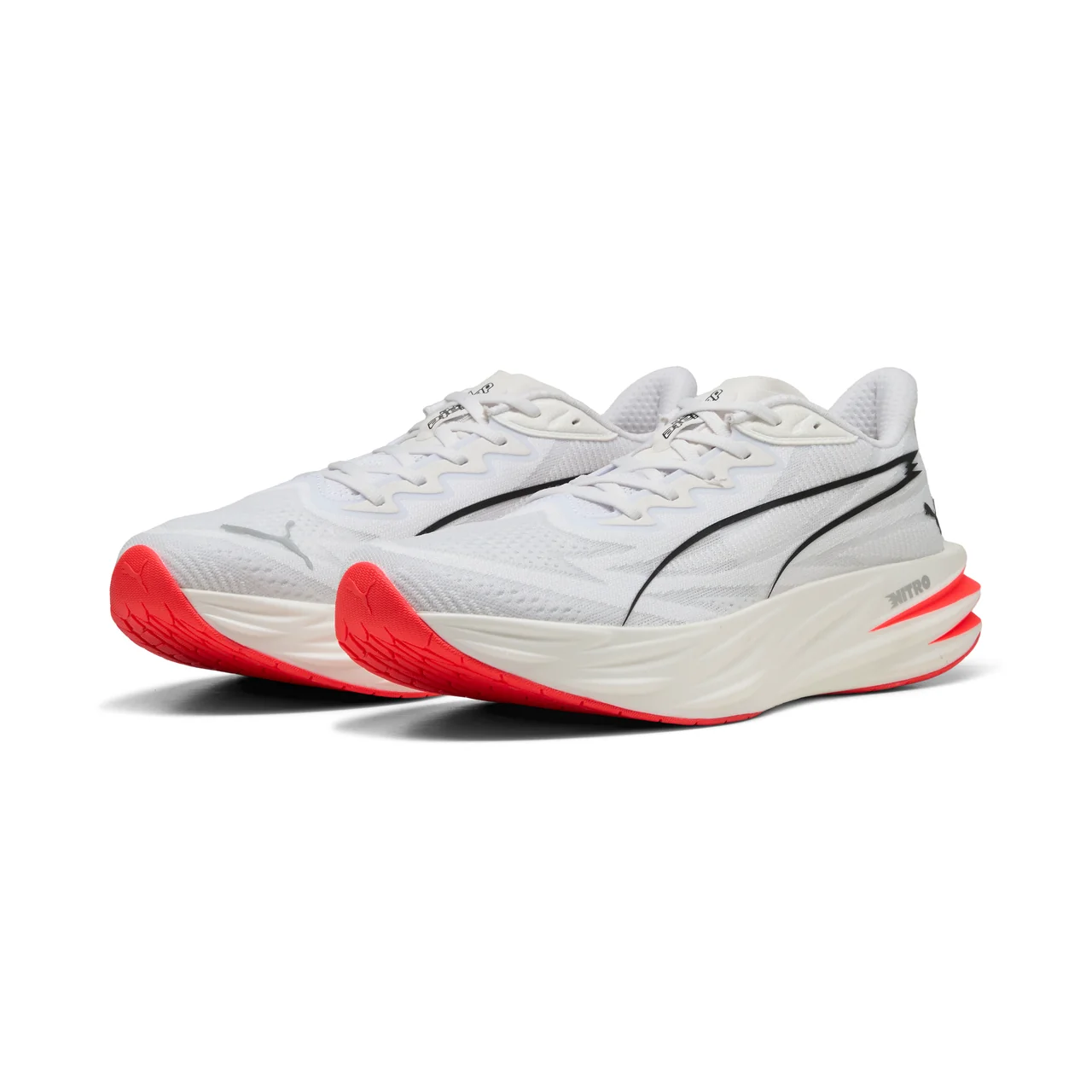
Image: PUMA
Puma has made an interesting move on the board of road running: the Puma Deviate Pure NITRO arrives as a fast, lightweight shoe without a rigid plate, designed for those who want to push the pace without getting every week into the almost notarized stiffness of a super shoe built for racing. It’s not a Deviate Nitro 4 cut down with scissors. It’s a different idea: less plate, more flexibility, a responsive foam and a geometry high enough not to feel like an old racer nostalgic for tartan.
The news has substance because it lands just as many runners have started looking at plated shoes with a mix of desire and fatigue. They’re fast, yes. They can also be demanding, expensive, a bit artificial and not always pleasant for everyday training. The Deviate Pure NITRO sits in that gap: running shoes without a plate for running lively, doing cheerful easy runs, pace changes, controlled long runs and quality sessions without feeling like your foot is riding on a carbon catapult. Puma presented it as a shoe without PWRPLATE within the Deviate family, with evolved NITROFOAM, 220 grams in men’s UK 8, 180 grams in women’s UK 4.5, 38 mm in the heel, 30 mm in the forefoot and an 8 mm drop. Its global launch was set for June 4, 2026.
The novelty: speed without the feeling of being tied to a plate
The appeal of the Puma Deviate Pure NITRO is not in promising a revolution, a word already worn out like a sole on hot pavement, but in doing something more concrete: bringing part of the language of modern fast shoes into a less rigid format. The brand keeps the Deviate surname, which in its catalog is associated with performance, but removes the PWRPLATE that does appear in other models in the line. The decision is not a minor one. In a market where almost everything that smells like speed boasts carbon, rods, plates or aerospace engineering with the name of a spacecraft, Puma says: you can run fast without putting a hard blade under your foot.
The model is built on a NITROFOAM midsole, a nitrogen-infused foam that the brand itself describes as lightweight, cushioned and responsive. In plain English: it aims to return energy without turning the stride into a block. The difference, for the runner, should be noticeable in the movement. A plated shoe tends to guide, push and stiffen the transition; a shoe without a plate leaves more freedom to the foot, more natural flex, more ability to adapt the landing when the pace changes or when the legs are no longer quite so sharp. Not everyone wants a speed prosthesis for 12 kilometers at moderate pace. Sometimes a lively, comfortable tool is enough, fast when asked.
Puma puts it quite clearly in its European product sheet: you don’t always need a plate to run fast; the model seeks smooth movement, responsive cushioning and a natural feel at different paces, with fluid transitions and constant energy return without the stiffness typical of racing shoes. In Spain it comes in at 150 euros, both in the men’s and women’s versions, a figure that places it below many carbon-plated shoes and in an appealing zone for anyone who wants performance without entering the aristocracy of impossible pricing.
Technical sheet with real-world reading: 220 grams, 38/30 mm and 8 mm drop
The cold numbers help, even if they don’t run for you. The Deviate Pure NITRO lists 220 grams in men’s UK 8 and 180 grams in women’s UK 4.5. For a shoe with 38 mm of heel height and 30 mm in the forefoot, the weight is striking. We’re not looking at a minimalist shoe with token foam, but at a fairly tall shoe, with generous cushioning and a clear fast-training vocation. The 8 mm drop puts it in familiar territory for many everyday runners: neither aggressively low nor excessively heel-biased. A friendly geometry, the kind that doesn’t ask you to sign a biomechanical mortgage before going out for a run.
The package is completed by a technical mesh upper, padded collar and padded tongue, three details that point more toward comfort than radicalism. The outsole uses PUMAGRIP, one of Puma’s most respected compounds in recent years for grip on dry and wet asphalt. This matters in cities like Valencia, where runners mix bike lanes, smooth sidewalks, seafront promenades, park sections and the occasional turn with paint on the ground that, when it rains, turns into a skating rink for the unwary. The shoe is designed for asphalt and for neutral runners, with maximum cushioning according to the brand’s own commercial sheet.
There’s another interesting detail: the brand highlights that the upper incorporates at least 30% recycled materials. It doesn’t turn the shoe into an environmental manifesto, let’s not get carried away, but it does place the product within that part of the industry that is beginning to normalize recycled materials without sacrificing visible performance. Runners buy feel, durability, fit and price. If the fabric also reduces part of the impact, even better. No sermon.
The inevitable comparison comes with the Deviate NITRO 4. Puma says the Pure weighs about 30 grams less than its carbon-plated sibling. That’s part of the technical headline: removing the plate doesn’t just change the feel, it also allows the package to be lighter. Less internal structure, less stiffness, less weight. The real question is not whether that makes it faster in an all-out 10K, but whether it makes it more usable on more days of the week. And that’s where its real interest begins.
Which runner this Puma makes sense for
The Deviate Pure NITRO seems designed for the runner who no longer divides the shoe rack into two absurdly separate worlds: a comfortable shoe for easy miles and an aggressive shoe for suffering fast. Between those two extremes lies an entire life. Progression runs, fartleks, tempo sessions, decent-leg days, Sunday long runs where the last third gets lively because someone in the group has decided to play neighborhood Kenyan. That’s what this kind of shoe is made for.
It is not, as far as is known, a pure racing shoe. Nor does it aim to be a calm, maximum-stability daily trainer for piling up miles without looking at the clock. Its natural zone seems to be moderate and lively paces, where a responsive foam helps but a rigid plate can be unnecessary. The everyday runner preparing for a 10K, a half marathon or even a marathon without elite obsession may find here a very logical piece: light, well cushioned, grippy, fast enough and without that feeling of being “pushed even when I don’t want to be.”
In practical terms, it looks especially suited to anyone who wants one shoe capable of doing almost everything except racing at the highest level. Not because it lacks character, but because of philosophy. Running fast is one thing; competing with every fiber of the product devoted to shaving seconds is another. The Deviate Pure NITRO leans more toward the first idea. Everyday speed, if you want to call it that. A less glamorous expression than “super shoe,” but probably more useful for 90% of those who head out to train before work, after picking up the kids or when the heat gives a small break.
The absence of a plate may also appeal to runners who have tried rigid models and ended up with calf, soleus or fascia discomfort, or simply with the feeling that the shoe was running for them. There’s no need to demonize carbon; that would be ridiculous. It has changed popular and professional athletics. But it also shouldn’t be turned into a religion. For training, the body appreciates variety. A flexible, lightweight, high-profile shoe can serve as a middle ground between the classic school and foamy modernity.
What it gains by not having a plate
By removing the plate, a shoe can gain natural feel, flex and tolerance across different paces. It doesn’t always gain stability; that depends on the foam, the base and the geometry. In the Deviate Pure NITRO, Puma tries to compensate for that absence with a responsive midsole and a generously covered outsole. Early specialized reviews have pointed precisely to that combination: soft, energetic foam, a good cushioning feel, a comfortable fit and an outsole capable of providing some response from ground contact.
This matters because a tall shoe without a plate can become too soft if the foam isn’t well controlled. The foot sinks in, the transition comes late, the ankle works harder and the promise of speed melts away. Like an ice cream in August. The key is that the foam is not just pleasant when you put it on, but efficient when the miles add up. According to the official sheet and the first available analyses, Puma has sought that mix between comfort and response, without going to an extremely hard feel or a lazy mattress.
The clearest benefit for the everyday runner is both psychological and physical: you can push without feeling like every workout turns into a race. Plated shoes usually need speed to make sense. At slower paces, some feel clumsy or too stiff. A shoe without a plate, if well made, lets you move better in that shifting territory where real training happens: one kilometer at 5:20, another at 4:45, three hard minutes, recovery, hill, turn, traffic light, pace again. Life. Not the lab.
What you shouldn’t expect
You shouldn’t expect the same lever effect as a carbon plate. Anyone looking for a shoe to race flat out in a marathon, with maximum propulsion, running economy and an aggressive racing feel, will probably still be looking at plated models like the Deviate NITRO Elite or the Fast-R within Puma’s own catalog. The Pure doesn’t seem designed to replace those shoes, but to live between them and the more classic daily trainers. That border, by the way, is increasingly crowded and increasingly interesting.
It will also be worth seeing how it responds for heavier runners or those with less stable technique. A 38 mm heel height is no small thing. Without a plate, stability depends a lot on the base, the outsole pattern, the width and the foam density. Early reviews speak well of its behavior, but one thing is the experience of trained testers and another is the daily use of runners with different foot strikes, different paces and legs worn down by work, lack of sleep or too much life accumulated. Popular running doesn’t happen in slow motion or under studio lights.
Where it sits against Nike, Adidas, Asics and Saucony
The launch makes sense within a category that is growing at full speed: fast shoes without a plate or with less invasive stiffness, halfway between daily trainer and supertrainer. The Deviate Pure NITRO has been placed by several reviews alongside names like Nike Zoom Fly 6, Adidas Boston 13, Asics Superblast 2, Adidas Adizero Evo SL, Saucony Endorphin Azura, Asics Megablast or Skechers Aero Razor. Not all of them compete in exactly the same box, of course. Some have plates, others don’t, some are pricier, others firmer, others more mileage-oriented. But the debate is the same: how to run fast without turning every landing into a negotiation with a rigid board.
The 150 euro price is one of its weapons. In 2026, talking about 150 euros as a reasonable running price may sound like economic satire, but the market has stretched the rubber so much that this figure sits below many racing shoes, some supertrainers and quite a few premium training models. That’s where Puma plays a smart card: offering modern foam, low weight, a good outsole and a high profile without asking what carbon racers cost. It’s not cheap in absolute terms. It is competitive within the orderly madness that is the high end of running today.
The comparison with the Adidas Evo SL is especially tempting because both point to that idea of running fast without fully entering the plate dogma. The initial reading from Spanish specialized media has gone in that direction too: a dynamic shoe, without a plate, with 220 grams, 38/30 mm, 8 mm drop, PUMAGRIP and a June 4, 2026 launch, placed in the showcase of versatile fast shoes.
In Puma’s catalog, the Deviate Pure NITRO helps organize the family better. The Fast-R and Deviate Elite remain competition tools. The Deviate NITRO 4 keeps its role as a fast trainer with a plate. The Velocity NITRO 4 stays closer to the versatile daily mileage shoe. The Pure appears in between: less radical, lighter, more flexible, but still ambitious about pace. A gap that once may have seemed small and that, given the market, is starting to look huge.
How it fits in Valencia: asphalt, humidity and changing paces
For a runner in Valencia, a shoe like this has a very specific reading. Valencia is fast, flat and friendly for running, but it also demands a certain versatility. It’s not the same to do intervals in the old Turia riverbed as it is to run along the Marina, cross avenues, train on humid days or extend the miles toward the beach with side wind and legs a bit cooked. The terrain isn’t technical, but it is varied in texture. There, outsole grip and upper comfort matter more than they might seem.
The PUMAGRIP can be a strong point in a city where the pavement changes every few meters. The runner doesn’t just step on perfect asphalt. They step on tile, concrete, paint, compact dirt, damp areas by the garden, ramps, crosswalks and that urban mosaic that brands rarely show in their immaculate photos. A fast training shoe needs to grip when the body is already on the edge; if it fails there, it doesn’t matter that the foam has the name of a reactor.
Lightness also matters in warm climates. A breathable upper and contained weight help when training happens in the heat, even if no shoe turns June into October. The Deviate Pure NITRO won’t solve humidity or make the sticky afternoon heat disappear, but a light build is always appreciated when the foot starts to swell and pace becomes a negotiation with the thermometer.
Where it may shine most is in half marathon and marathon workouts with blocks at goal pace. Not so much in very short intervals, where some runners will prefer a firmer, more aggressive shoe, but in continuous sessions: 3 x 3 kilometers, progression runs, 16 kilometers with a lively finish, 5-minute changes, sustained tempo. That kind of work where you need cushioning, response and comfort. A shoe that’s too soft numbs you; one that’s too stiff punishes you. The Pure tries to walk that narrow line.
The underlying question: is the runner getting tired of so much plate?
The arrival of this Puma says something about the market. For years, the plate has been the great totem. Carbon here, nylon there, rocker geometries, racing foams, promises of energy return and records falling like dominoes. The progress has been real. Denying it would be absurd. But the everyday runner doesn’t live in the final straight of a championship. They live in accumulation. In training three, four or five days a week without breaking down. In waking up wanting to run again the next day.
That’s why models that recover some natural feel without going back to the past are starting to make sense. They’re not minimalist shoes. They don’t give up modern foams or high profiles. They simply don’t place a plate as the moral center of the product. The Deviate Pure NITRO takes part in that current: more smart foam, less structural stiffness, more daily use, less competitive solemnity. A shoe for running fast without having to put on the imaginary bib every Tuesday.
This doesn’t mean plates are going to disappear. On the contrary. They will continue to dominate competition and many specific workouts. What’s interesting is that the market is becoming more mature, even if at times it still sounds like a car salesman on caffeine. Some runners want a plate. Others don’t. Others only want it for racing. Others want to alternate. The shoe rotation has become more sophisticated, even among everyday runners, and the Deviate Pure NITRO comes in precisely as that piece that can live alongside a comfortable daily trainer and a racing shoe.
There’s also a technical question. The plate can favor some runners and feel uncomfortable for others. The movement changes. The muscular load changes. The sense of stability changes. A shoe without a plate allows a more personal landing, less guided, though not necessarily better for everyone. Good gear doesn’t replace training, no matter how much the industry insists on selling little miracles wrapped in technical mesh. The runner who goes out too fast will still go out too fast. With carbon, without carbon and with epic soundtrack.
What the buyer should look at before jumping in
The Deviate Pure NITRO fits best for neutral runners looking for a lightweight, high-profile, responsive shoe that can be used at many paces. It doesn’t seem like the most logical option for someone who needs structured support, maximum stability or a purely calm shoe for slow mileage. Nor will it be the most rational purchase for someone who already has several fast shoes without a plate at home and is only looking for a radical difference. Here the nuance lies in the balance: low weight, high profile, a contained price within the fast category and an outsole with a reputation for reliability.
Fit will be important. Puma usually offers fairly secure midfoot shapes, though every model has its own story. The sheet talks about a regular width, lace closure and a technical mesh upper. Early international testers have highlighted a comfortable, breathable upper with a true-to-size fit, but the foot doesn’t read reviews: it goes in, moves, rubs or doesn’t rub. In a shoe designed for lively paces, midfoot and heel lockdown matter a lot. If the foot dances around, the foam stops being the star and the humble drama of the blister appears.
Durability is another point to watch. Puma states an average of 800 kilometers in the U.S. sheet, but that figure always depends on runner weight, technique, terrain, climate and use. A shoe used only for tempo on clean asphalt doesn’t age the same as one beaten daily by abrasive sidewalks and constant turns. The good rubber coverage should help, but the final test is dictated by the miles, not the press release.
For 150 euros, the proposition is clear: a modern shoe for those who want to train fast without necessarily paying for or suffering the full experience of a plate. It’s not a bargain-bin steal or an entry-level shoe. It’s a serious tool for runners who already know the difference between easy running, training and racing. And that, in a market saturated with bombastic names, is appreciated.
A shoe for running lively, not for showing off carbon
The Puma Deviate Pure NITRO arrives at the perfect moment to open a more sensible conversation about running gear. Running fast doesn’t always require a rigid plate. It requires legs, consistency, a coherent shoe and a bit of head, that accessory that doesn’t come in the box but is worth putting on from time to time. Puma has presented a lightweight option, with responsive foam, a high profile, 8 mm drop, a good outsole and a competitive price for the segment. It doesn’t aim to knock down the carbon super shoes. It asks them a more uncomfortable question: how many real workouts actually need that much stiffness?
For the runner looking for a fast everyday shoe, with a natural feel, good cushioning and the ability to move between cheerful easy runs and pace sessions, the Deviate Pure NITRO goes straight onto the shortlist. Not because of noise, but because of fit. It’s less spectacular than a plate shining underfoot, sure. It may also be more usable, kinder and more logical for the real week. And in running, where almost everything is decided in the gray repetition of normal days, that logic is worth a lot more than a promise with carbon fiber.
You may also like: Puma Deviate Nitro Elite 2: analysis, price and key usage tips.
Este artículo contiene enlaces de afiliado: si compras a través de ellos, se genera una pequeña comisión sin coste adicional para ti. Más información.



How to prevent thigh chafing: causes and real solutions

Women’s running windbreakers: seven jackets and how to choose

Do more workouts get rid of soreness? A guide for runners

Jaén Half Marathon 2026: Record 3,800 Runners Registered

Men’s short running tights: how to choose the right pair

World Triathlon confirms data breach involving medical data

Izan Edo targets podium at Miyazaki World Cup

María Pérez ranks ninth in World Athletics’ 2026 top ten

Dos Santos, Duplantis and Sawe: World Athlete of the Year finalists

San Silvestre Vallecana 2026: 42,000 places, prices and start times

 Races3 months ago
Valencia Half Marathon 2027: date and registration

 Races3 months ago
Valencia Marathon 2026: entry, ballot and course

 Reviews and Comparisons4 months ago
Asics Gel-Roadmiles 3 for men: review and current price

 Reviews and Comparisons4 months ago
Asics Gel Sonoma 8 Gore-Tex: complete analysis for trail and rain

 Sneakers3 months ago
Saucony Endorphin Pro 4: full review and verdict

 News5 months ago
Strava API 2026: what changes for clubs, challenges and runner apps?

 Reviews and Comparisons5 months ago
Nike Alphafly 3: opinions, sensations, and real key points

 Reviews and Comparisons4 months ago
Under Armour running shoes review 2025-2026: models and key features

 Sports Equipment4 months ago
Shoe sizes in cm: a clear guide to getting the right fit for your footwear

 Sneakers3 months ago
Skechers GO RUN Consistent 2.0 analysis: comfort and limits

 News5 months ago
Valencia Marathon 2026 route: key tips to train and run better

 Sneakers4 months ago
Adidas Adizero Boston 13 for men: review and verdict