News
Summer running socks: fabric, thickness, and chafing under the sun
Technical fabrics, a precise fit, and ventilation make all the difference when the heat is on and the asphalt is burning.

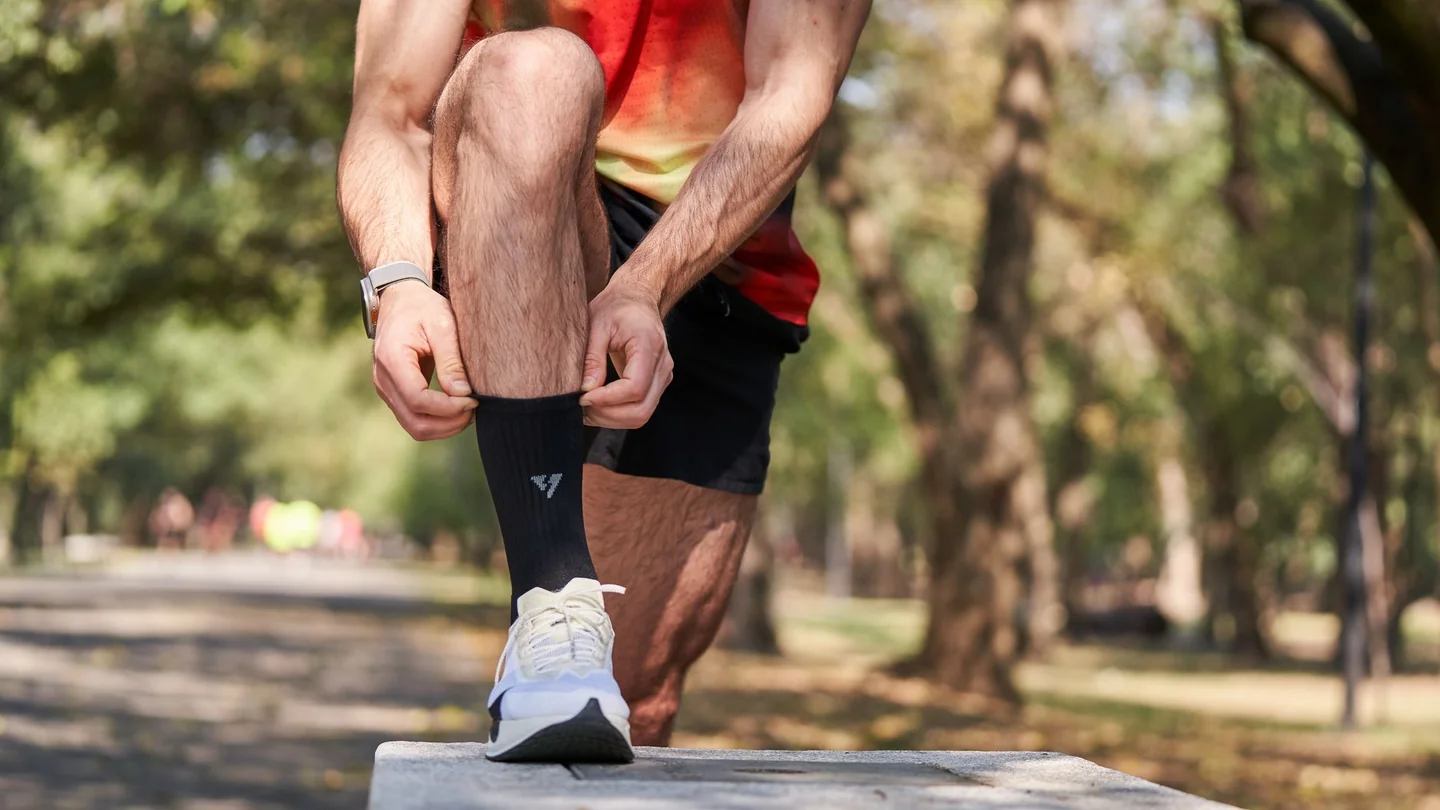
Imagen: Willians Huerta / Pexels
The heat does not spare the feet: on a July run, a bad sock can turn a normal workout into a string of rubs, sweat, and small blisters that ruin the day. In summer, the difference between finishing fresh or with softened skin usually comes down to an element that goes unnoticed until it fails: the sock. Thin, breathable, well-fitting models have earned a clear place in a runner’s gear because they reduce friction, wick away moisture better, and stabilize the foot inside the shoe.
The right choice is not about fashion, but mechanics. When the temperature rises, the foot sweats more, the skin softens, and the rubbing against the shoe multiplies. That is why socks designed for the warm months usually rely on quick-drying synthetic fibers, ventilation zones, and very discreet seams or none at all. In short races, intervals, or runs under the sun, that combination matters more than any aesthetic detail.
What changes in summer inside a running shoe
The foot works in a closed microclimate. Inside the shoe, the temperature rises fast, and with it, the humidity. That environment works like a small steam chamber: the skin gets damp, loses firmness, and becomes more exposed to friction. If, on top of that, the sock absorbs too much sweat or takes too long to dry, the result is predictable. The surface of the foot becomes more vulnerable and any repeated movement leaves a mark.
That is the reason so many runners notice that a sock that felt comfortable in April starts to bother them in August. It is not a random feeling. Heat changes the interaction between skin, fabric, and shoe, and forces you to choose materials that breathe, adapt, and do not add unnecessary weight when there is already enough with the asphalt’s heat.
In the catalogs of specialized brands, very similar formulas appear, but the logic is clear: the better a sock manages sweat, the less chance there is of blisters or small irritations appearing. That management starts in the yarn, continues in the construction pattern, and is completed with the fit. If one of those pieces fails, the whole thing shows it right away.
The fabrics that respond best to heat
The fiber is what matters. Cotton is still a bad idea for running in summer because it holds moisture, takes a long time to dry, and gives that heavy feeling of soaked fabric that sticks more than it protects. By contrast, most technical socks use polyester, polyamide, elastane, or blends designed to move sweat outward and speed up drying. In the most advanced models, commercial names like Coolmax or technical polyester variants with antibacterial treatment appear.
That kind of construction has a very specific goal: to keep the skin as dry as possible during effort. It does not eliminate sweat, because that would be impossible, but it does prevent it from pooling. The difference is huge on a muggy day, when every kilometer seems to double the heat load. A thin, well-ventilated sock does not cool by itself, but it helps keep the foot from turning into a soft, slippery surface.
Merino wool deserves a separate mention. Although many people associate it with winter, there are lightweight versions that work quite well in summer thanks to their natural ability to regulate temperature and manage moisture. It is not the most obvious choice for a very hot day in the city, but it can fit early outings, mountain runs, or long workouts where a softer feel is welcome without giving up breathability altogether.
Thin does not mean fragile
A summer sock should be light, not weak. The temptation is to think that the less fabric, the better, but reality is more nuanced. A model that is too lacking in structure can move inside the shoe, form folds, or lose stability halfway through the session. And a fold in the toe or heel, no matter how small, becomes a silent piece of sandpaper.
The best designs balance two ideas that seem opposite: thinness and support. They do it with elastic zones in the arch, bands that wrap the midfoot, and a gentle level of compression that keeps the sock in place without squeezing too much. In practice, the runner should barely notice it. That is the sign that the fit works.
Anatomy also matters. Models differentiated for the right and left foot usually follow the natural curve of the support better. That decision, which at first glance seems like a minor detail, reduces wrinkles and improves the feeling of continuity between the foot and the shoe. In summer, when every rub is amplified, that continuity is worth gold.
Seams, toe, and heel: the points where everything is decided
Blisters rarely start in the middle of the foot. They usually appear at the edges, in the toe, or in the heel, right where movement repeats a small punishment over thousands of steps. That is why seamless construction or flat finishes is one of the great arguments of socks designed for running in the heat. The less relief there is, the less chance the skin has of getting irritated.
The point-by-point closed toe, very common in technical models, avoids that classic bump that used to be noticeable even when trying the sock on at home. The heel, for its part, needs to stay put. If it shifts, the fabric rubs the back of the foot and can leave a mark that starts as discomfort and ends as a wound. Heel stability is one of the most reliable tests of quality.
For runners with sensitive feet or a history of chafing over middle distances, these finishes are almost as important as the shoe itself. Summer does not invent problems; it simply makes them more visible. The wrong material can go unnoticed in spring and become a small executioner when the thermometer settles above 30 degrees.
Sock height: ventilation versus protection
Low-cut socks dominate in summer, especially on asphalt. They leave the ankle freer, improve the thermal feel, and reduce the visual and real weight of the whole setup. For many runners, they are the most balanced option for easy runs, tempo changes, and 5K or 10K races. They breathe well and, if the shoe does not irritate the ankle area, they usually do the job without surprises.
Invisible models have a clear appeal: they almost disappear inside the shoe. They are cool and discreet, but they also demand more care. If the shoe’s heel counter is stiff or the last does not suit them, they can slip or leave the skin exposed exactly where the shoe moves the most. They are not a universal solution, even if they work well with softer models and for those looking for the least coverage possible.
Mid-calf socks remain useful when there is more risk of rubbing against the shoe collar, on trails, or on routes with grass, dust, and low branches. In summer they also provide a small barrier against dirt and little stones. They are not the coolest option, but sometimes it is worth sacrificing a bit of ventilation in exchange for more protection.
What happens with odor and hygiene
Sweat does not smell, but it feeds the problem. Odor appears when bacteria break down the accumulated moisture, and that is where antibacterial treatments play a useful role. Many technical socks include treated fibers to delay that proliferation and keep a cleaner feeling for longer. They do not work magic, but they help, especially in frequent workouts or humid climates.
This has a very clear practical reading in summer: a sock that dries quickly and manages moisture better is not only more comfortable, it also reduces the chance of the foot ending up irritated and smelling bad at the end of the session. Textile hygiene is part of performance, even if it is often treated as a minor matter. In reality, a dry foot handles effort better and tolerates repeated impact better.
There is another detail that is not very glamorous but is relevant: washing. Some models keep their shape and color well after many cycles, while others deform, loosen, or lose elasticity right away. In an accessory that works right against the skin, durability matters as much as initial comfort.
Road, track, and trail do not ask for the same thing
There is no single perfect sock for everything. On road and track, the lightest models usually win, with a low profile, high breathability, and little volume. They are the ones that fit best with fast workouts and short races, where a feeling of freedom is sought and wear is moderate. Lightness rules there.
On trail, the story changes. Protection gains ground because the foot faces stones, mud, roots, and debris entering through the cuff. A slightly more structured sock can better protect the instep, ankle, and toe. In the mountains, summer does not reduce the risks, it only shifts them: less cold, yes, but more abrasion, more dust, and more hours of sun exposure.
Long runs deserve special consideration. As the kilometers go by, the foot swells slightly, moisture builds up, and rubbing multiplies. That is why many runners reserve their thinnest models for shorter sessions and turn to versions with a bit more cushioning when the distance gets longer. It is not a rigid rule, but it is a very reasonable guideline.
How to recognize a good summer model
The first test is tactile. When you pick up the sock, it should feel soft, elastic, and not too thick. When you put it on, it should not form wrinkles or require too much force to adapt. If it squeezes at the cuff or leaves strong marks before you even start running, it is probably not the right size or the pattern does not fit that foot well.
The second test comes while running. The foot should not slide, the toe should not touch with every stride, and the heel should stay where it was placed. If all that is true, the model is doing its job well. Real comfort is noticed after several kilometers, not in the first minute in the store or in the product photo.
It is also worth looking at the density of the fabric. Mesh panels on the instep or in side areas usually improve airflow, something especially useful on midday outings or workouts with a lot of built-up heat. That localized ventilation does not replace a good fiber, but it complements it very effectively.
The sizes and fit that avoid the most problems
An incorrect size ruins even the best fabric. A small sock compresses too much, strains the seam, and can leave the toe worked like a glove that is too short. A large one, on the other hand, wrinkles, shifts, and creates that annoying accordion effect that ends up punishing the skin in the same place as always.
That is why it is worth looking at the size range with the same care given to shoes. A size 39 foot does not always fit the same in a model that goes from 39 to 43 as in one designed for narrower ranges. Fit is not just length; it is also volume, support, and fabric memory. When all that fits together, the sock seems to disappear.
For runners with a pronounced arch, flat feet, or slight asymmetry between both feet, that difference is even more noticeable. An anatomical, well-graded design avoids extra compensations inside the shoe. It is a small nuance on paper, but a big one in practice. Friction does not always come from heat; often it starts with a seam or a poorly resolved size.
What role cushioning plays in summer
Not all thin socks are the same. Some include slightly denser zones in the heel, forefoot, or toe to absorb impact and protect sensitive areas. That localized cushioning does not turn the sock into an insole, but it does soften contact with the shoe and can make a difference in long sessions or for runners who strike hard.
Summer, paradoxically, does not eliminate the need for cushioning. What it does is force you to find a middle ground between protection and ventilation. Too much padding can feel hot; too little can punish the skin. The smartest solution is usually strategic protection, concentrated only where it is really needed.
In practice, that explains why so many technical seasonal models combine a more open mesh on the instep with discreet reinforcements in the heel and toe. The fabric breathes on top, protects below, and keeps the whole thing light. It is an elegant, almost surgical balance, but easy to appreciate when the workout stretches out under a harsh sun.
The Spanish market and the consolidation of the technical sock
The industry has stopped treating the sock as a secondary accessory. In Spain, several specialized brands have built part of their identity around this garment and have brought to market very specific proposals for running in the heat, racing, or training every day. The technical level has clearly risen in recent years, both in materials and in pattern making.
That change is also visible in the brands’ language: they no longer talk only about comfort, but about moisture control, anatomical fit, antibacterial treatments, and zones of gentle compression. The sock has become more professional. It is no longer a filler item in the runner’s bag, but an element that can improve the training experience if chosen well.
The current variety makes possible something that once seemed unthinkable: choosing according to the feeling you want. There are ultralight options for those who want an almost barefoot stride, models with a bit more structure for long runs, and versions with eye-catching designs for those who also value aesthetics. Summer, in that sense, has pushed the offer to the point of turning a small garment into a fairly serious decision.
The small detail that decides many runs
In summer races, the right sock is worth more than it seems. It does not give free minutes or replace good training, but it does remove noise. And in running, removing noise means running with fewer discomforts, fewer distractions, and fewer chances of ending up looking at your foot before the watch.
The equation is usually simple: technical fabric, quick drying, firm fit, and soft seams. From there come the nuances of each runner, the distance, the type of shoe, and personal tolerance to heat. But the core does not change. The foot needs air, stability, and a gentle contact with the shoe. When those three things are met, summer stops feeling like a textile punishment and becomes just another training season.
That is why the best socks for running in summer are not judged by color or slogan, but by how they respond when the asphalt starts to shine and the stride becomes more demanding. There, in that silent stretch between the start and the first kilometer, almost everything is decided.



How to prevent thigh chafing: causes and real solutions

Women’s running windbreakers: seven jackets and how to choose

Do more workouts get rid of soreness? A guide for runners

Jaén Half Marathon 2026: Record 3,800 Runners Registered

Men’s short running tights: how to choose the right pair

World Triathlon confirms data breach involving medical data

Izan Edo targets podium at Miyazaki World Cup

María Pérez ranks ninth in World Athletics’ 2026 top ten

Dos Santos, Duplantis and Sawe: World Athlete of the Year finalists

San Silvestre Vallecana 2026: 42,000 places, prices and start times

 Races3 months ago
Valencia Half Marathon 2027: date and registration

 Races3 months ago
Valencia Marathon 2026: entry, ballot and course

 Reviews and Comparisons4 months ago
Asics Gel-Roadmiles 3 for men: review and current price

 Reviews and Comparisons4 months ago
Asics Gel Sonoma 8 Gore-Tex: complete analysis for trail and rain

 Sneakers3 months ago
Saucony Endorphin Pro 4: full review and verdict

 News5 months ago
Strava API 2026: what changes for clubs, challenges and runner apps?

 Reviews and Comparisons5 months ago
Nike Alphafly 3: opinions, sensations, and real key points

 Reviews and Comparisons4 months ago
Under Armour running shoes review 2025-2026: models and key features

 Sports Equipment4 months ago
Shoe sizes in cm: a clear guide to getting the right fit for your footwear

 Sneakers3 months ago
Skechers GO RUN Consistent 2.0 analysis: comfort and limits

 News5 months ago
Valencia Marathon 2026 route: key tips to train and run better

 Sneakers4 months ago
Adidas Adizero Boston 13 for men: review and verdict