News
COROS and Wahoo launch the integration that improves indoor treadmill running
COROS and Wahoo connect watch and treadmill to better measure pace, distance, and incline in indoor workouts that are becoming increasingly common in Spain

COROS Wahoo integración cinta indoor
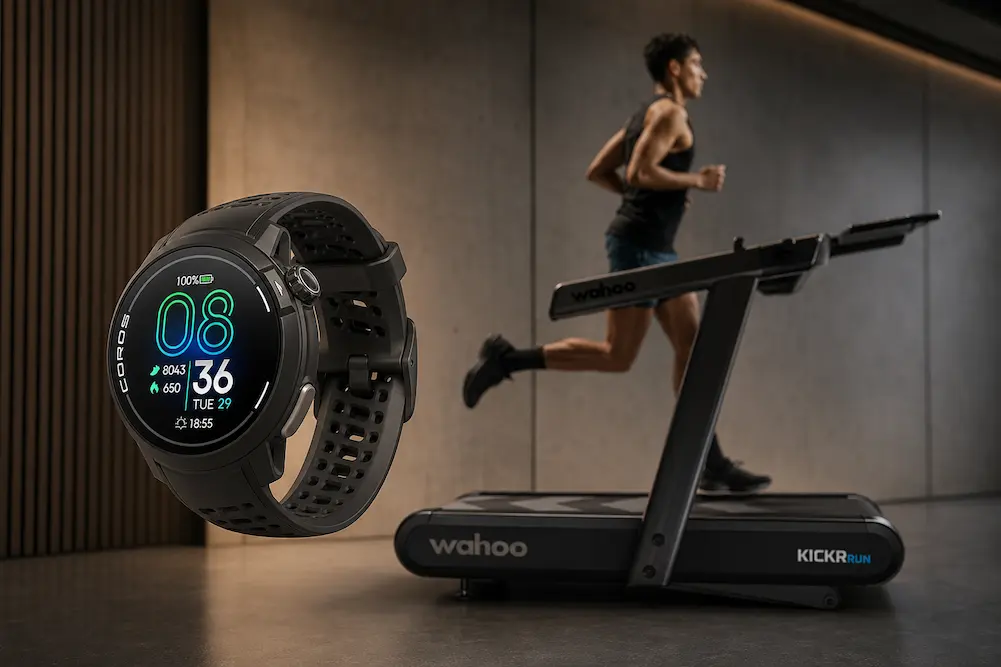
The alliance between COROS and Wahoo is no longer a courtesy between brands or just another sticker in the connected runner ecosystem. It is an integration designed to solve a very specific annoyance: running on a treadmill, looking at the watch and seeing that pace, distance or training load seem to come from another planet. The new feature makes it possible to sync activities between both platforms and, above all, connect several COROS watches directly to the Wahoo KICKR RUN treadmill to receive pace, distance and incline data via Bluetooth, without relying on an additional pod or on the watch’s accelerometer estimate.
For the runner who trains indoors, the change has more substance than it might seem. The treadmill has always been a kind of awkward pact: good for controlling the environment, doubtful when it comes to measuring accurately if each device tells the story in its own way. With this integration, the data comes from the machine itself and goes into the watch, so the workout is recorded in COROS with much greater consistency. It doesn’t turn a treadmill into the Turia at seven in the morning, of course. It doesn’t smell like wet earth either, nor does it give you a headwind in your face. But it does help an indoor session stop being a statistical blur.
The integration between COROS and Wahoo arrives at a time when running on a treadmill has stopped being just a punishment tool for rainy days. In Spain, with heatwaves arriving earlier and earlier, gyms full of runners preparing marathons and homes turned into small training labs, the treadmill is starting to have a different reputation. Less penance, more tool. And that’s where the data matters. It matters because modern training feeds on load, fatigue, recovery, critical pace, zones, progression and those words that used to sound like a coach with a stopwatch and now live inside an app.
What exactly changes with the COROS Wahoo integration
The news has two main parts. The first is the bidirectional sync between COROS and Wahoo accounts. An activity recorded on a COROS device can appear in Wahoo, and a session recorded within the Wahoo ecosystem can land in COROS history. The goal is for the runner not to have their sporting life split into different folders, like someone who keeps the good workouts in one drawer and the treadmill ones in another, with a certain amount of shame. The sync works for new activities after authorizing the connection; it does not automatically bring over old workouts.
The second part, the most interesting for treadmill runners, is the direct connection of the COROS watch with the Wahoo KICKR RUN. Here the watch is not guessing pace from wrist movement. It receives the information directly from the treadmill. Compatible models can be paired to obtain accurate pace, distance and incline data, and cadence and elevation are also mentioned as part of the real-time data flow. In other words: less rough calculation, more measurement from the source.
The nuance matters because the GPS watch, outdoors, behaves like a fairly reliable notary. On an open avenue, with a good signal, it knows where you are, how far you’ve gone and how fast you’re moving. Indoors, the GPS disappears. The watch is left with internal sensors, movement patterns and previous calibrations. Sometimes it gets it right. Sometimes it invents a short novel. And sometimes it turns an easy run into a suspiciously heroic session, which always flatters the ego but not the training plan.
With KICKR RUN paired, COROS can record the indoor session with cleaner data. The treadmill measures what happens on its surface and sends it to the watch. The watch stores it. The app interprets it. Training load is adjusted better. There is no magic; there is interoperability, that ugly word that in sport means something quite beautiful: your devices stop behaving like medieval kingdoms.
The compatible watches and what is left out
The direct connection with KICKR RUN does not reach every COROS watch. The brand lists the PACE 3, PACE 4, PACE Pro, COROS NOMAD, APEX 2, APEX 2 Pro, APEX 4, VERTIX 2 and VERTIX 2S as compatible. Activity sync with Wahoo is broader, but the specific part of pairing the watch with the treadmill requires those models and updated firmware. It’s worth not confusing the two, because that’s where a lot of tech disappointments begin: “my app syncs” does not always mean “my watch connects directly to the machine.”
The process involves updating the app and firmware, opening the watch’s Bluetooth accessories menu, locating the KICKR RUN and pairing it. Then, when starting an Indoor Run activity, the watch should show the connected sensor before you begin. From there, the pace and distance shown on the watch match the treadmill output. Simple on paper. In practice, like all sports technology, it will depend on the firmware not being asleep, on Bluetooth not deciding to become poetic, and on the user not having fifteen devices fighting over the same signal.
The most obvious limitation is that this does not turn any gym treadmill into a KICKR RUN. The direct integration relies on a specific Wahoo machine, a high-end treadmill designed for serious training. The brand highlights features such as RunFree, maximum speed equivalent to 2:30 min/km, incline up to 15%, decline down to -3% and a wide running surface. It is a machine for someone who trains a lot, has space and is not satisfied with a treadmill that squeaks like an old shutter by the third kilometer.
That’s where the first brake appears for the average Spanish runner. Not everyone will have a Wahoo KICKR RUN at home. Not every gym will install one tomorrow. And not every household budget is ready to turn the living room into a high-performance center. But the news goes beyond one specific treadmill. It shows where the sector is heading: fewer islands, more bridges; fewer screens that don’t talk to each other, more data that travels with purpose.
Why running on a treadmill measures worse than running on the street
Running on a treadmill seems easy to measure. One thinks: if the machine says 10 kilometers, then it’s 10 kilometers. If the watch says 9.47, the watch is wrong. If it says 10.62, the watch is getting ahead of itself. Reality is less tidy. A treadmill can be miscalibrated, the watch can misread stride, the runner can vary stride length with fatigue and the arm can move differently when you’re watching Netflix, suffering through a set of 400 meters or grabbing the side rail for a second to survive with dignity.
GPS does not work indoors the way it does outdoors, so watches estimate indoor distance with accelerometers and stride models. That can be enough for an easy run, especially if the watch already knows the runner well, but it becomes more delicate with pace changes, simulated hills, short intervals or incline sessions. On a treadmill, the body does not move through space; it moves on a moving surface. It’s a strange choreography. The watch hears the movement, but it doesn’t always understand the music.
That’s why integrating an external source makes sense. A foot pod has done something similar for years: bringing measurement closer to the foot rather than the wrist. The difference here is that the treadmill itself becomes the sensor. If the KICKR RUN knows its speed, incline and session dynamics, sending that data to the watch avoids a layer of interpretation. And every layer removed, when we’re talking about training, usually means less mud.
The clearest benefit appears in training load. COROS uses activities to build metrics such as base fitness, load, fatigue or performance progression. If a treadmill session is recorded with inflated paces or poor distances, those metrics get contaminated. Not dramatically from a single day, but yes when indoor training takes up many weeks: preseason, hot summer, injury recovery, specific marathon prep, work trips. One drop doesn’t soak the file. A hundred drops make it damp.
The treadmill stops being second-class training
For years, the recreational runner has treated the treadmill with a certain condescension. It’s useful when it rains. Useful when there’s no time. Useful when the park is dark. But the street, ah, the street rules. There’s some truth in that. Running outside means reading the terrain, wind, temperature, curves, roundabouts, curbs, distracted cyclists and pedestrians with extendable dogs, that invention of urban evil. The treadmill removes many variables and that’s why some see it as a domesticated version of effort.
However, the treadmill also offers an environmental precision that doesn’t exist outside. It lets you nail paces, repeat conditions, work on inclines without hunting for a specific hill, do intervals without traffic lights, control hydration and stop the session if something goes wrong. For runners preparing a marathon, half marathon or fast races, it can be a surgical tool. Cold, yes. But useful. Like a scalpel: nobody invites it to dinner, but it’s good to have it sharp.
The COROS Wahoo integration pushes in that direction. If indoor training starts to have more reliable data, it stops being an “approximate” session in the history. It fits better into planning. A treadmill run in the heat no longer sits there as a side note. A simulated hill workout doesn’t get lost in a doubtful file. A threshold session indoors can speak to outdoor workouts. And that dialogue, when used well, is worth more than many colorful charts.
The KICKR RUN adds a particular ingredient: the RunFree mode, which adjusts the treadmill speed to the runner’s pace without pressing buttons. Wahoo presents it as a way to run more naturally, changing stride and speed while the machine tries to keep the user centered on the platform. For anyone who has done intervals on a conventional treadmill, with those endless seconds waiting for the speed to go up or down, the idea makes a lot of sense.
It’s not exactly running outside. Nor does it need to be sold that way. Asphalt cannot be replicated with firmware. But it does correct one of the big flaws of the traditional treadmill: the feeling that you are obeying a machine, not running. If the watch also captures the data without asking for another sensor, the whole setup feels cleaner. Less gear, less friction, less excuse.
What the Spanish runner gains and what they should not expect
For a runner in Spain, the immediate usefulness will depend on their environment. Anyone who has a KICKR RUN or trains in a center that includes one gains a much more integrated indoor record with COROS. Anyone who uses Wahoo for a trainer, cycling or structured workouts also gains data continuity. And anyone who combines outdoor running, treadmill work and cross-training sessions will see fewer gaps between platforms. The pretty word would be ecosystem. The more human one: order.
There’s also an interesting angle for clubs, coaches and training centers. If several athletes use COROS and a Wahoo treadmill, indoor sessions can generate more consistent data. That makes it easier to compare loads, adjust paces and review progressions. It doesn’t replace the coach’s eye, but it removes noise. And in sport, removing noise is almost always saving time.
Still, it’s worth turning the volume down a bit on the excitement. The integration does not solve all indoor running measurement problems. It doesn’t work with every treadmill. It does not automatically sync historical activities. Only activities performed after authorizing the connection are shared, and activities from third-party environments do not always move from one platform to another as if everything were a toll-free highway. Connected sport still has its customs checkpoints, even if they are increasingly well signposted.
It also doesn’t turn a bad workout into a good one. That seems obvious, but in sports technology it never hurts to say it. Accurate data does not make up for sleeping badly, doing intervals too fast or turning every easy run into a small civil war against yourself. The integration improves the record; the judgment still belongs to the runner. Or the coach. Or both, when they talk before the ego gets on the treadmill.
The feature can be especially useful on very hot days, something far from exotic for runners in Valencia and much of Spain. When going out to run in the middle of the afternoon feels like a mineral endurance test, the treadmill lets you keep training without playing the hero. If that session is well measured, with coherent pace and distance, the plan doesn’t get distorted. Not everyone can train at dawn. Not everyone wants to run at night. Real life, that merciless calendar, also trains.
An alliance that says a lot about the future of connected running
COROS and Wahoo are not identical brands. COROS has earned its place among runners with lightweight watches, long battery life and a fairly direct proposition: less useless luxury, more performance. Wahoo, historically very strong in indoor cycling, has been trying for some time to bring that connected training logic to running. The KICKR RUN is an ambitious piece of that movement. The fact that both companies understand each other is no coincidence; it responds to a very clear trend: athletes no longer want to choose between devices, they want everything to work together.
COROS’s May update included, along with the Wahoo integration, other software improvements, but the treadmill part stands out because it addresses an old and concrete problem. It’s not a new watch face to stare at like an astronaut. It’s not a decorative metric that nobody can later explain. It’s a practical improvement: indoor training can fit better into the runner’s real history. And that, in an era obsessed with measuring everything, is worth quite a lot.
The running sector has spent years promising a perfect experience between watch, app, sensors, platforms, treadmills, trainers, headphones and training plans. Reality has been more prosaic: failed connections, duplicates, activities appearing twice, data that doesn’t migrate, syncs that arrive late and apps that look at each other with the cordiality of two neighbors at a building meeting. That’s why useful integrations stand out. Not because they sound futuristic, but because they make an annoyance disappear.
In this case, the annoyance was clear. The runner did a treadmill session and then had to decide who to believe: the machine, the watch, the app, the pod or the internal feeling. A small summary trial after every run. With the direct connection between COROS and KICKR RUN, at least on compatible hardware, the chain gets shorter. And when the chain gets shorter, the margin for error goes down.
There’s another less flashy detail: the integration also helps the runner not get trapped inside a single brand. For years, many companies have tried to keep the user inside their walled garden. Buy my watch, use my app, connect my sensors and, if you want to leave, we’ll see. Here there’s a different signal: two ecosystems share data because the athlete mixes tools. That’s not altruism; it’s market. But the user benefits. And in the end, blessed market when it stops treating the runner like a hostage.
Indoor data is starting to get serious
The integration between COROS and Wahoo is not going to change the way everyone runs tomorrow morning. That would be exaggerated, and also pretty tedious. What it does do is solve a specific part of the indoor experience: making the treadmill and the watch speak the same language when the workout is recorded. For those who use COROS and have access to a KICKR RUN, the improvement is direct. For everyone else, the news works as a sign of the trend: indoor running no longer wants to be the weird sibling of outdoor running.
The recreational runner will still go outside whenever they can. They’ll keep looking for shade, a flat route, a fountain, fresh air and that small pleasure of coming home with warm legs and a clearer head. But they’ll also keep going into gyms, using treadmills, training in hotels, dodging heat, rain, schedules and pollution. The boundary between inside and outside is becoming more porous. Less epic, more practical.
COROS and Wahoo have put a sensible piece on that board. Not the cheapest. Not the most universal. But one of the most coherent for anyone training seriously indoors. The treadmill measures, the watch collects, the app organizes. And the runner, for once, can stop arguing with three screens after sweating for forty minutes while staring at a wall. That is progress too. Modest, technical, almost domestic. But progress.
Este artículo contiene enlaces de afiliado: si compras a través de ellos, se genera una pequeña comisión sin coste adicional para ti. Más información.



How to prevent thigh chafing: causes and real solutions

Women’s running windbreakers: seven jackets and how to choose

Do more workouts get rid of soreness? A guide for runners

Jaén Half Marathon 2026: Record 3,800 Runners Registered

Men’s short running tights: how to choose the right pair

World Triathlon confirms data breach involving medical data

Izan Edo targets podium at Miyazaki World Cup

María Pérez ranks ninth in World Athletics’ 2026 top ten

Dos Santos, Duplantis and Sawe: World Athlete of the Year finalists

San Silvestre Vallecana 2026: 42,000 places, prices and start times

 Races3 months ago
Valencia Half Marathon 2027: date and registration

 Races3 months ago
Valencia Marathon 2026: entry, ballot and course

 Reviews and Comparisons4 months ago
Asics Gel-Roadmiles 3 for men: review and current price

 Reviews and Comparisons4 months ago
Asics Gel Sonoma 8 Gore-Tex: complete analysis for trail and rain

 Sneakers3 months ago
Saucony Endorphin Pro 4: full review and verdict

 News5 months ago
Strava API 2026: what changes for clubs, challenges and runner apps?

 Reviews and Comparisons5 months ago
Nike Alphafly 3: opinions, sensations, and real key points

 Reviews and Comparisons4 months ago
Under Armour running shoes review 2025-2026: models and key features

 Sports Equipment4 months ago
Shoe sizes in cm: a clear guide to getting the right fit for your footwear

 Sneakers3 months ago
Skechers GO RUN Consistent 2.0 analysis: comfort and limits

 News5 months ago
Valencia Marathon 2026 route: key tips to train and run better

 Sneakers4 months ago
Adidas Adizero Boston 13 for men: review and verdict